


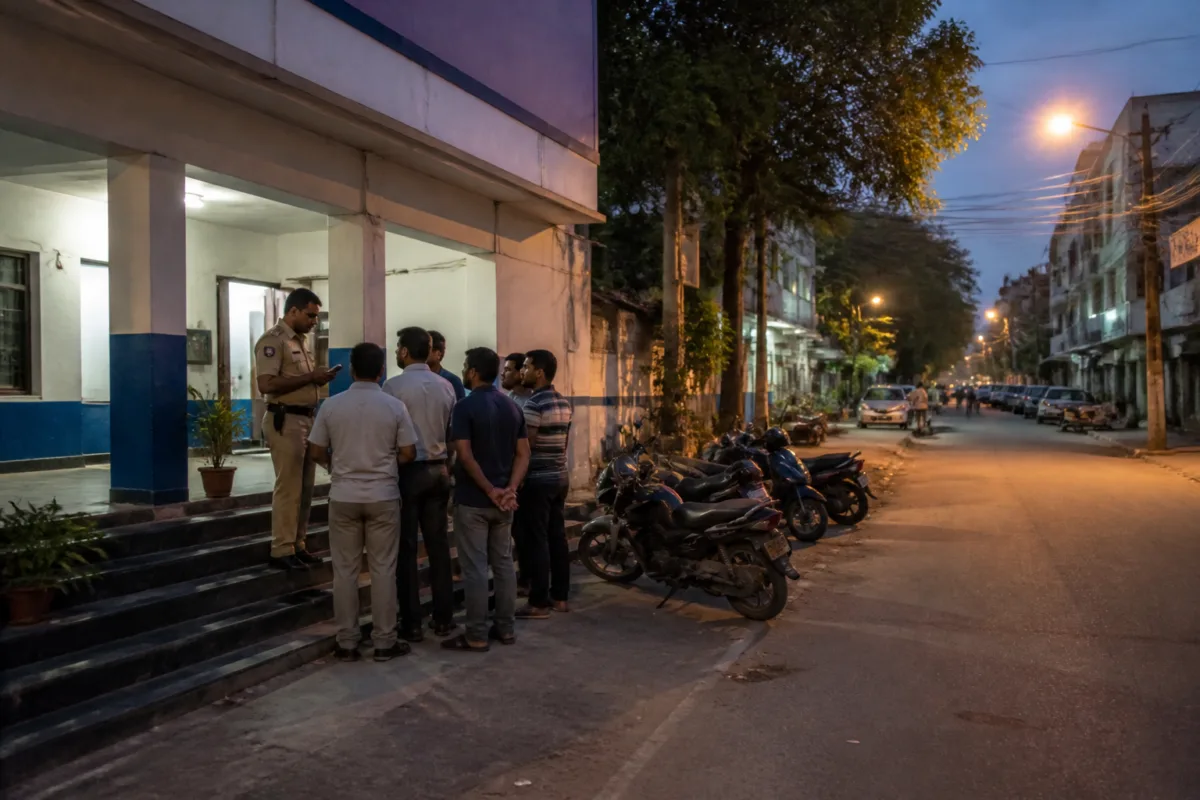
The Meerpet double murder has brought Hyderabad’s preventive-policing system under scrutiny after Telangana Today reported that one of the victims had submitted a written complaint about a threat to her life a day before the attack. The report says the complaint was allegedly not treated with sufficient urgency, raising a central question for urban governance: how do police stations assess and act on warnings before a dispute becomes a violent crime?
According to the report, one of the victims in the Meerpet case approached the police and expressed apprehension about a threat to her life. The next day, a relative identified in the report as Siddiquie allegedly attacked the family. Niranjan B and Reshma were killed, while Yusuf was reported to be battling for his life in hospital. The account does not include a police statement confirming receipt of the complaint, the action taken on it, or the circumstances leading up to the attack.
That limitation is important because the question of preventive failure depends on what the police knew, when they knew it and how the complaint was assessed. A written petition indicating a threat does not by itself establish that an attack was predictable or legally preventable. At the same time, if a complaint clearly identified a credible and immediate danger, the response to it becomes a matter of public accountability. The supplied report does not provide the complaint, a station diary entry, a first information report relating to the earlier warning, or an official explanation from the police.
The wider concern raised by the report is that threat complaints can fall into an administrative gap between a routine petition and an emergency requiring immediate protection. Telangana Today quoted Majlis Bachao Tehreek spokesperson Amjedullah Khan as saying that police officers previously verified whether a threat was genuine and initiated safety measures when required. These measures, according to Khan, could include asking the complainant to remain at the police station until the other party arrived and the matter was addressed.
Khan alleged that complainants are now sometimes sent away with instructions to return later or the following day. This claim is not independently established in the supplied material, but it identifies a practical problem in station-level policing: the time between receiving a complaint and deciding whether it requires intervention. For a person reporting intimidation, that interval may determine whether the state acts before violence or only after it.
City-based social worker and advocate SM Abdul Samad told the publication that complaints involving threats with knives or daggers were also not being treated seriously enough. He argued that police should verify the complaint, seize a weapon if one is found and register a case under the Arms Act where applicable. His remarks describe what he believes should happen after a threat is reported; the supplied material does not establish how frequently such complaints are received, how many lead to preventive action or whether the relevant provisions were considered in the Meerpet case.
The issue therefore extends beyond the conduct of one police station. It concerns how urban policing converts information into risk assessment. A threat complaint may contain details about the alleged aggressor, the relationship between the parties, previous incidents, weapons, locations and the immediacy of the danger. The report does not say whether these details were present in the Meerpet complaint. Without that information, it is not possible to determine whether the complaint met a threshold for immediate protection or whether police procedures were followed and found inadequate.
Human rights activist Mohd Ishaq told Telangana Today that policing often receives greater public attention after a violent incident, when suspects are arrested and authorities hold press conferences, than during the earlier stage when warnings are available. He said early intervention was particularly important in disputes involving family members and relatives, where repeated threats and aggressive conduct could precede serious violence. His argument places the Meerpet case within a broader preventive framework, while stopping short of proving that intervention would certainly have prevented the deaths.
This distinction matters for both accountability and policing reform. A violent outcome does not automatically prove that authorities could have stopped it. However, a complaint made before an attack creates a record that can be examined. Investigators and oversight authorities would need to establish when the complaint was submitted, who received it, whether it was entered into official records, whether the complainant’s threat assessment was conducted, whether the alleged aggressor was contacted and whether any protective or legal steps were considered.
The report also points to the role of relationships in threat assessment. The alleged attacker was described as a relative, and the incident reportedly involved a family dispute. Such cases can be treated as private disagreements even when threats, weapons or repeated intimidation indicate a risk of escalation. The supplied material does not provide a verified history of the dispute, so it cannot establish whether there were earlier complaints or incidents. It does, however, show why the boundary between domestic or family conflict and public safety is difficult to manage at the police-station level.
For residents, the institutional question is straightforward: what happens after a person reports that another individual may cause serious harm? The answer should not depend entirely on whether the complainant can produce evidence after the threat has materialised. At the same time, the report does not establish that police can or should act on every allegation in the same way. A functioning system requires a documented process that distinguishes routine disputes from credible, immediate threats while ensuring that serious warnings are not dismissed without assessment.
The available account contains no data on the number of threat complaints made in Hyderabad, the proportion receiving preventive action, the time taken to respond or the number of cases in which earlier warnings were followed by violence. It also contains no statement from the Hyderabad police explaining their response to the Meerpet complaint or outlining existing procedures for threat assessment. These gaps prevent a broader statistical conclusion about whether preventive policing is deteriorating across the city.
What the Meerpet case does establish, based on the supplied report, is that a reported prior threat has become central to public discussion after two deaths and a serious injury. Activists and advocates are using the incident to demand more serious treatment of warnings, while the police response remains insufficiently documented in the material available here. The central fact therefore requires confirmation through the original complaint, police records and an official account of the action taken.
The next stage should be a clear reconstruction of the complaint and the police response: when it was filed, what it contained, which officer or station received it, what verification was attempted and whether any preventive or legal measure followed. Until those questions are answered, the Meerpet double murder can identify a serious preventive-policing concern, but it cannot by itself establish that police inaction caused the deaths or that timely intervention would definitely have changed the outcome.

