


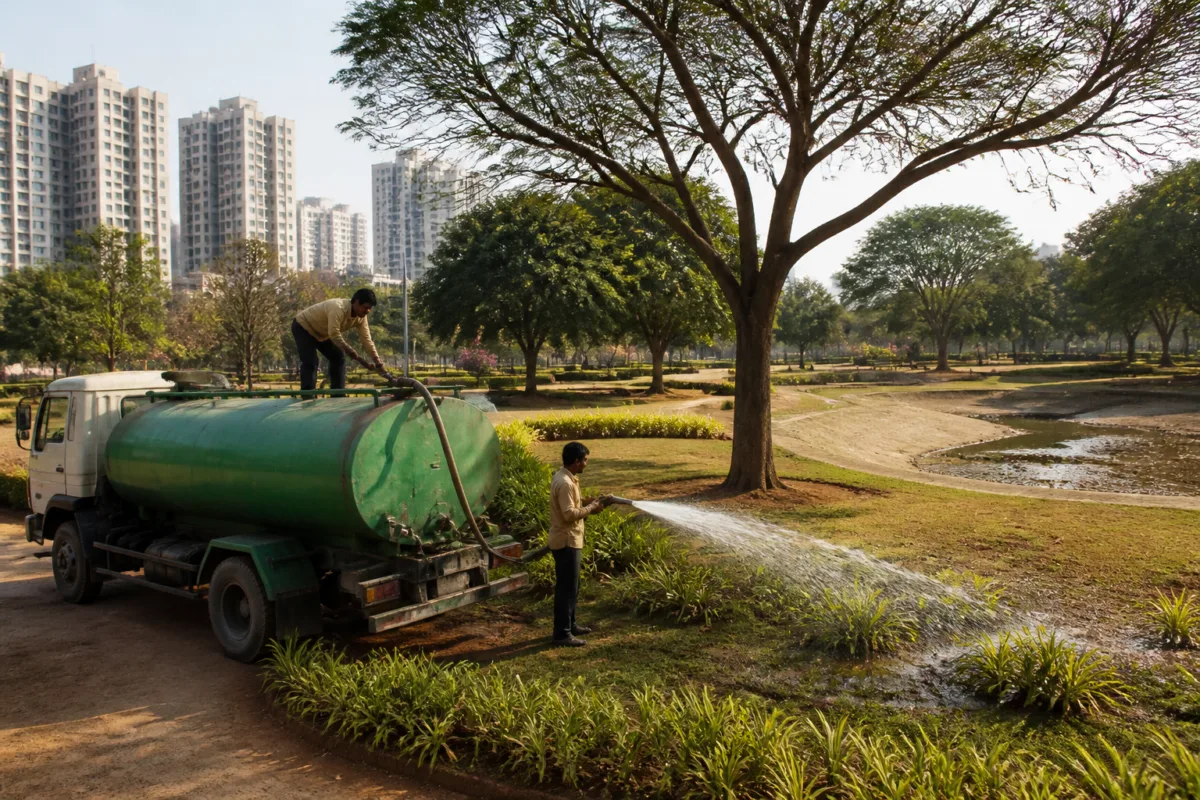
The Greater Hyderabad Municipal Corporation (GHMC) has stopped using fresh drinking water to maintain public parks, colony lung spaces and road medians, shifting the city’s urban greenery to treated water supplied from sewage treatment plants (STPs) with immediate effect.
The change covers major, median and small public parks, central medians on major avenues, urban forestry initiatives and greenery under flyovers across the twin cities. It is being implemented by the GHMC Urban Biodiversity wing in coordination with the Hyderabad Metropolitan Water Supply and Sewerage Board (HMWSSB).
A senior GHMC-Urban Biodiversity official told Telangana Today that the municipal body had reprogrammed its dedicated fleet of 50 to 60 water tankers as “Green Tankers”. The vehicles will draw treated water exclusively from decentralised STPs for watering public greenery.
The move comes as deficit rainfall has dried up most GHMC borewells and reduced water levels in park ponds, according to the report. The municipal corporation said the switch was intended to reduce pressure on groundwater and reservoirs ahead of a possible summer water crisis.
The tankers being used by GHMC have capacities of 5,000 litres and 12,000 litres. They are being deployed to sustain lawns and planted areas in parks that continue to receive daily visitors, including Krishna Kanth Park and Jalagam Vengal Rao Park.
KBR Park is currently using four to five tankers of treated water to maintain its greenery, park manager L. Srinivas told Telangana Today. He said the number of tankers would be increased if demand rises.
The operational change separates water used for public landscaping from potable supplies at a time when the municipal system is facing pressure from depleted local sources. Instead of relying on borewells and park ponds, GHMC’s Urban Biodiversity wing will use treated wastewater transported from STPs through its tanker network.
The decision also places decentralised sewage treatment plants in a more visible role within Hyderabad’s water system. Their treated output is now being used for a routine municipal function that spans parks, medians and other planted public spaces. The report does not specify the total daily volume of treated water being supplied, the number of STPs involved or the treatment standards applied before the water is loaded into tankers.
GHMC has said the tanker deployment will be adjusted according to demand. For now, the immediate priority is to maintain existing urban greenery without drawing fresh drinking water, while the city manages reduced groundwater availability and falling water levels in park ponds.

