


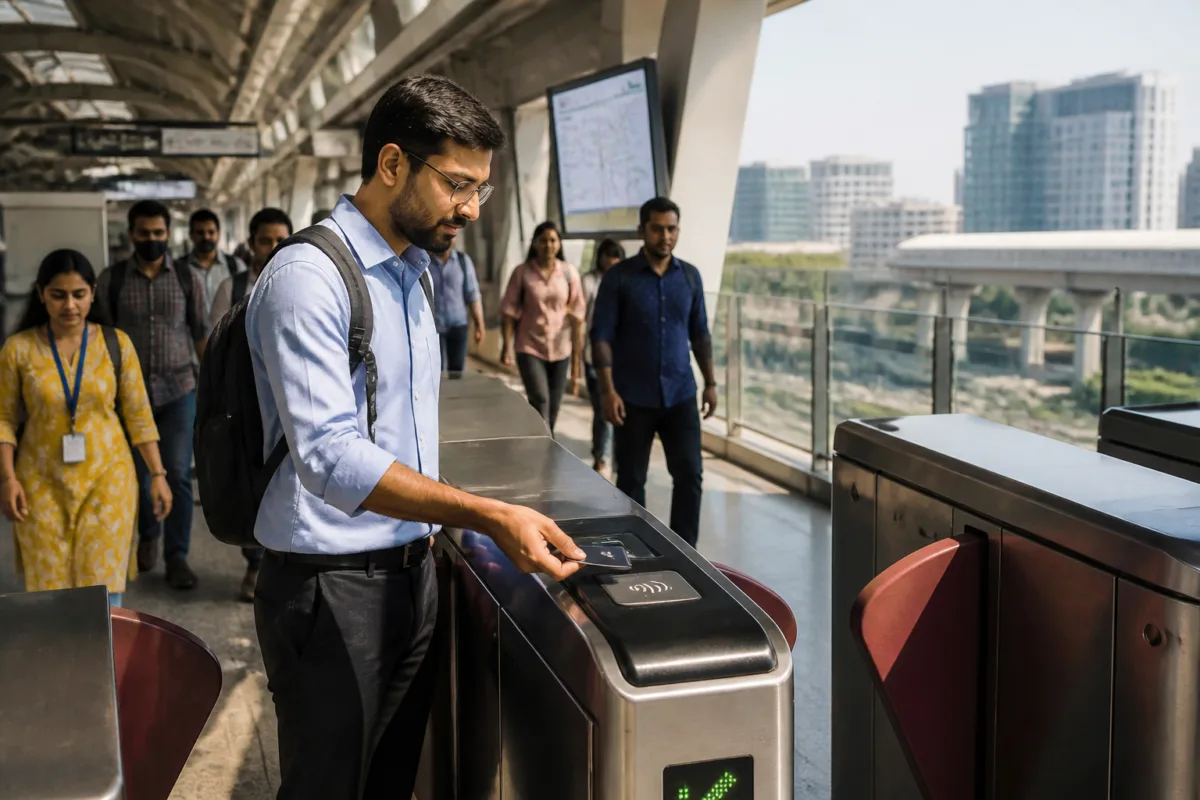
The One Pune Metro Card is positioned as more than a travel pass for passengers using Pune Metro Line 3 between Hinjewadi and Shivajinagar. The National Common Mobility Card (NCMC) RuPay card combines metro access, contactless payments and selected retail and online transactions, while offering a reported 10% discount on eligible recharges. Its launch comes as passenger services on the 23.203-kilometre Line 3 create a new public transport link between Pune’s information technology hub and central Pune.
The significance of the card lies in the way it changes the transaction around a metro journey. Instead of purchasing a ticket for every trip, passengers can tap the card at the entry and exit gates. The fare is then calculated according to the stations used and deducted from the available balance. This means that passengers do not need to decide their final destination before beginning the journey, provided the card has sufficient balance and is used correctly at both gates.
That feature is particularly relevant on a corridor expected to serve IT employees, students and daily commuters travelling between Hinjewadi and Shivajinagar District Court. The source report describes Line 3 as an elevated metro route developed by the Pune Metropolitan Region Development Authority. Its stated transport purpose is to provide an alternative to road travel and reduce the need for commuters to depend entirely on congested road corridors.
The card’s value, however, depends on the difference between convenience and cost. The reported card issuance charge is Rs 100, while annual maintenance is Rs 75. Card replacement is also listed at Rs 100. The maximum balance is Rs 2,000, and the minimum recharge amount is Rs 50. A recharge fee of 1.8% applies, subject to a maximum charge of Rs 12, while balance enquiries are free. Eligible recharges carry a 10% discount, making the card financially more attractive for regular users than for occasional passengers, although the effective benefit will depend on the recharge terms and the fee applied.
The card also has limits that passengers need to understand. Each contactless transaction is capped at Rs 2,000, and the reported daily limit is 20 contactless transactions. These limits are part of the card’s operating framework and may matter to users who intend to use it beyond metro travel. The card can also be used for metro passes and pass renewals at stations, according to the source report.
The One Pune card is based on NCMC and RuPay infrastructure. In addition to metro travel, the card can be enabled for contactless retail payments and e-commerce transactions through the customer portal. This makes it a broader payments instrument than a closed-loop metro card, but it also means that users must manage payment settings and transaction controls rather than treating it only as a station-access device.
The customer portal provides several controls for cardholders. After registering with the card number and date of birth, users receive an OTP on their registered mobile number and can create login credentials. The portal reportedly allows users to check their balance, view transaction statements, temporarily block the card, set a PIN, define transaction limits, and enable or disable contactless and e-commerce transactions.
These controls are important because the card is designed to operate across multiple settings. A passenger using it only for metro entry and exit may have different security preferences from one using it for retail or online payments. The ability to disable e-commerce or contactless transactions, if required, gives users a way to narrow the card’s exposure. The source report also says that transaction information is sent by SMS to the registered mobile number. In the case of offline ticket transactions, a consolidated message is reportedly sent at the end of the day.
The card’s operating model also places responsibility on passengers at both ends of a journey. A user must tap the card on the reader at the entry gate and tap it again at the exit gate. The fare is determined from those records. A missed tap, an incorrect transaction or an insufficient balance can therefore affect the travel experience, although the supplied information does not specify the resolution process for every possible gate or payment failure.
Pune Metro is not relying on a single ticketing channel. Alongside the One Pune Card, passengers can reportedly book tickets through WhatsApp, the official mobile application, QR codes, automatic ticket vending machines and station ticket counters. The WhatsApp process requires users to save the official number +91 94201 01990, send “Hi”, select “Book Now” and then choose Line 3. Passengers select their origin and destination, enter the number of travellers and complete payment through UPI or a debit or credit card. The QR-code ticket is sent after successful payment, while the payment process must be completed within five minutes.
The app-based process follows a similar structure. Users select “Book Ticket”, choose Line 3, enter the starting and destination stations, and complete online payment. The QR ticket is then made available in the application. These options create a layered ticketing system: the One Pune Card is designed for repeat users, while WhatsApp, the app, vending machines and counters provide alternatives for occasional travellers or passengers who do not want to maintain a prepaid card.
This distinction matters because a transport system becomes easier to use when passengers have options, but options can also create confusion if their charges, limits and refund or support processes are not clearly communicated. The One Pune Card has an issuance charge, maintenance fee and recharge fee, while digital tickets involve a separate payment process. The supplied material does not provide a comparative fare table for all channels, so passengers cannot determine from the available information whether the card is cheaper in every use case. What can be established is that the card’s principal financial incentive is the reported 10% discount on eligible recharge transactions.
The card also reflects a wider shift in urban mobility from isolated ticketing systems towards interoperable payment instruments. NCMC cards are intended to allow one payment card to work across different mobility and transaction environments, although the actual usefulness depends on where acceptance is available. In Pune’s case, the supplied details establish metro access and the possibility of retail and online use after activation, but they do not establish the full list of external merchants or transport systems that accept the card.
For Line 3, the immediate administrative challenge is likely to be ensuring that new users understand the relationship between the corridor, the card and the alternative ticketing systems. The route connects Hinjewadi with Shivajinagar District Court and is expected to serve commuters with different travel patterns. A daily office commuter may benefit from the card’s automatic fare deduction and recharge discount, while a passenger making a one-off trip may prefer a QR ticket through WhatsApp or the app.
The source report lists a helpline number, 022-45000800, for balance-related issues, card blocking, transaction information, statements and complaints. Card replacement is available at metro station counters. These support mechanisms are significant because a digital ticketing system is only as reliable as its recovery process when a card is lost, blocked or charged incorrectly.
The One Pune Metro Card therefore represents both a convenience product and a test of how Pune Metro manages the everyday mechanics of network expansion. The reported benefits are clear: contactless entry and exit, automatic fare deduction, multiple payment uses, auto top-up, transaction controls and a recharge discount. The constraints are equally concrete: issuance and maintenance charges, a Rs 2,000 balance ceiling, recharge fees, transaction limits and the need to complete gate taps correctly.
What the available information confirms is that Pune passengers now have a broader set of ways to pay for Line 3 journeys. The One Pune Card is most relevant to regular users who value faster station access and intend to use the recharge facility repeatedly. The next practical measure of its success will be how easily passengers can obtain, recharge, manage and troubleshoot the card as Line 3 services settle into routine operation.

