


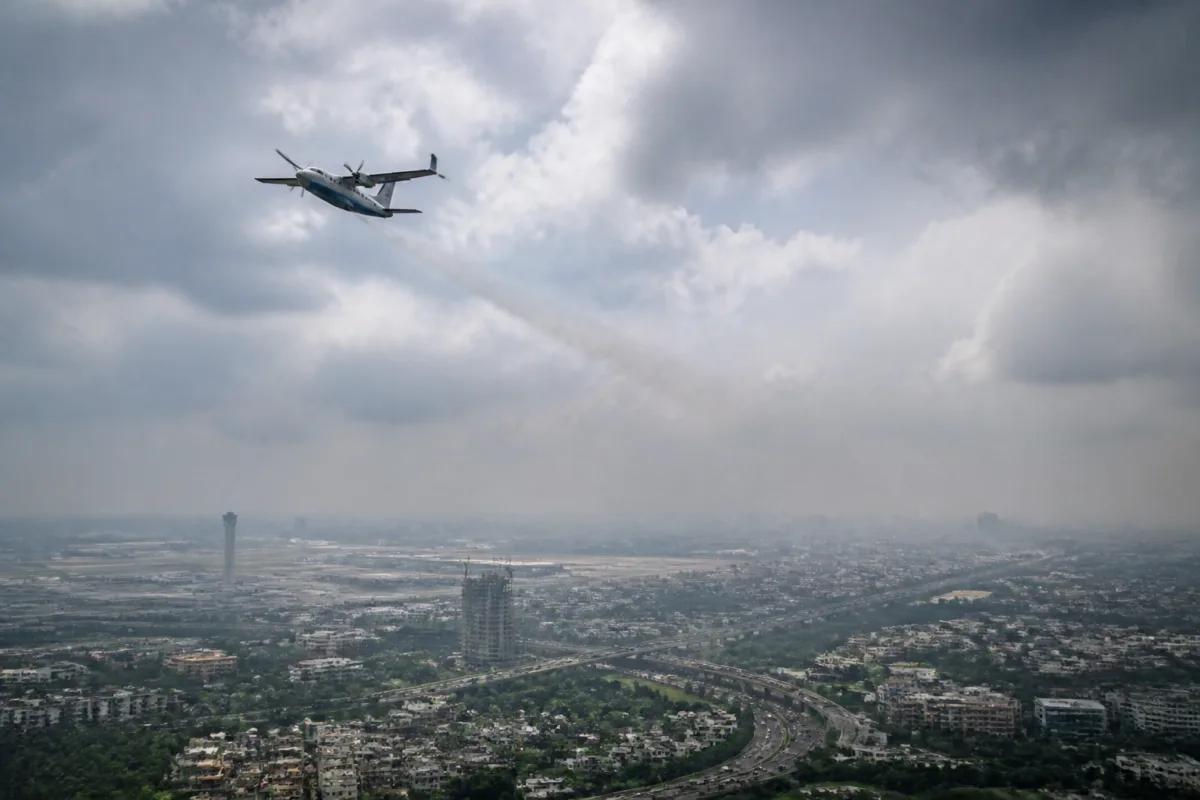
The Delhi government has resumed cloud seeding trials near Indira Gandhi International Airport as part of an effort to reduce air pollution, with two experiments conducted over the past 15 days and more likely after Diwali and Chhath, according to a report by Jagran – New Delhi.
The recent trials were carried out at an altitude of around 30,000 feet, government sources told the publication. This is substantially higher than the approximately 10,000-foot altitude used during experiments conducted in Delhi last year. Further trials will depend on the availability of suitable weather conditions and clouds.
Chief Minister Rekha Gupta told Dainik Jagran that the government would conduct cloud seeding but would not publicly announce the experiments to the media. The government has adopted a cautious approach after last year’s trials failed to produce rainfall and faced questions over their results.
Cloud seeding involves releasing substances such as silver iodide or sodium chloride into suitable clouds. These materials are intended to accelerate the formation of water droplets or ice crystals and increase the possibility of rainfall. The technique requires sufficient atmospheric moisture and favourable cloud conditions, meaning it cannot be deployed independently of the weather.
Delhi began its earlier cloud seeding programme in collaboration with IIT Kanpur to explore whether artificial rainfall could help address winter air pollution. The Environment Department and IIT Kanpur signed a memorandum of understanding for the project on September 25, 2025. Two rounds of trials were conducted in October that year.
During each of those experiments, four chemical flares containing silver iodide and sodium chloride were released. No rainfall was recorded as a result of the trials. The Delhi government later issued a report claiming that pollutant particle levels fell in the targeted areas despite the absence of rain. The supplied report does not provide the extent of that reduction or establish whether it was caused by cloud seeding.
The renewed trials therefore represent an attempt to test the technique under different atmospheric conditions rather than a confirmed pollution-control intervention. The government has not announced a fixed schedule for the next experiments, which will be considered after Diwali and Chhath if the weather is favourable.
Cloud seeding is being examined as a weather-dependent measure, not as a permanent replacement for controlling emissions from vehicles, construction, road dust, industrial activity or other urban sources. The next stage of Delhi’s programme will depend on whether suitable clouds form and whether the government releases further information on the results of the trials.

