


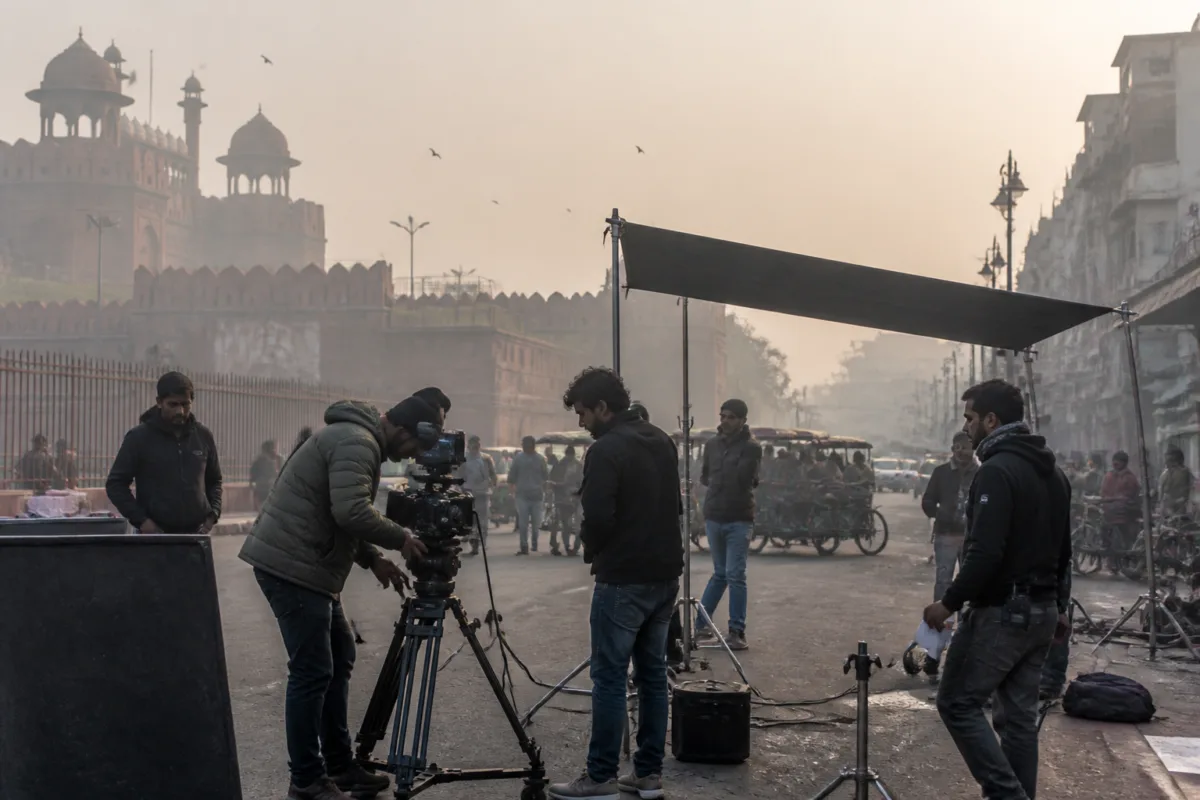
Delhi film shoots are increasingly concentrated outside the city’s most pollution-sensitive months, according to RTI data obtained from the Delhi Tourism and Transportation Development Corporation (DTTDC). Of 209 applications received for film shooting over the past two financial years, 118 came between January and March, while the October-December period recorded significantly fewer applications. The pattern raises a wider urban question: whether poor winter air is weakening Delhi’s ability to function as a location for the cultural and creative economy that its film policy was designed to attract.
The figures do not by themselves prove that pollution caused every producer to avoid Delhi. They do, however, show a clear seasonal concentration. Around 56.5 per cent of all applications during the two-year period were submitted between January and March, despite that quarter covering only three months of the year. October to December, when Delhi’s air quality is typically a major public concern, saw fewer applications. The data therefore points to a relationship between the city’s environmental conditions and the timing of outdoor production activity.
That relationship matters because film shooting depends on more than the availability of locations. It requires crews to spend long periods outdoors, move equipment through congested areas and work to fixed schedules involving performers, technicians, permissions and transport. When visibility, outdoor comfort and working conditions become less predictable, the administrative value of a location may be reduced even if its architecture and streets remain attractive. The RTI figures provide an early indication of that pressure without establishing the full range of reasons behind individual production decisions.
### What the application data shows
DTTDC received 108 film-shooting applications in 2024-25 and 101 in 2025-26. The monthly figures cited in the RTI response show a pronounced difference between the first quarter and the months associated with winter pollution. In 2025, applications stood at 24 in January, 29 in February and nine in March. In 2026, the figures were seven in January, 21 in February and 28 in March.
Taken together, the two years produced 118 applications between January and March. The source does not provide a complete month-by-month table for the other nine months or identify the precise pollution readings attached to each application. It also does not record whether producers explicitly cited air quality as the reason for selecting or avoiding a date. Those limitations are important. The strongest conclusion supported by the evidence is that applications were concentrated in the January-March window and were lower during October-December, the period identified in the report as environmentally sensitive.
Approval numbers add another layer to the picture. Under Delhi’s film policy, 41 applications were approved in 2024-25 and 56 in 2025-26. Other applications were withdrawn or related to changes in shooting dates and locations. At the time of the RTI response, no application was pending for approval. This suggests that the available data does not point to a backlog of permissions as the main explanation for the lower winter activity. However, it cannot distinguish between applications that were never submitted because of anticipated conditions and applications that were submitted but later withdrawn.
That distinction is central to understanding the institutional problem. A film policy can simplify permissions and promote locations, but it cannot by itself guarantee workable outdoor conditions. If producers are adjusting their schedules before approaching the authorities, the impact will appear as lower demand rather than as a visible administrative failure. Conversely, if applications are being withdrawn after permissions are granted, the issue may involve coordination, scheduling or location-specific constraints. The RTI material does not provide enough information to separate these possibilities.
### Delhi’s film policy faces an environmental test
Delhi introduced its film policy in 2022 with the stated objective of developing the capital as a major film-production centre. By 2025, around 39 films and web series had been shot in the city, according to the report. The government has also sought to expand the range of locations available to producers, including the Red Fort, Sunder Nursery and Delhi University’s North Campus.
The policy’s institutional design appears to focus on permissions, incentives and location promotion. Yet the application pattern shows that the city’s attractiveness is also shaped by a basic environmental condition: whether a production can reliably work outdoors during the period when Delhi’s pollution problem is most severe. This is not only a question for the film department. It connects air-quality management with tourism, public-space administration, traffic control, heritage-site access and the use of prominent urban locations.
The concentration of filming in a small number of well-known districts makes that connection more significant. Officials cited in the report said that around 95 per cent of films made in the capital are shot in areas such as Chandni Chowk and Connaught Place. These locations offer recognisable urban settings, but they are also high-activity public areas where a production must negotiate with pedestrians, businesses, traffic and local administration. A policy that promotes additional heritage and institutional locations will need to manage those operational relationships alongside the environmental conditions affecting the crew.
The economic-support component of the policy has so far had limited uptake. Only the film “12th Fail” has received financial assistance, with its producers receiving a subsidy of Rs 30,08,464. No other film applied for financial assistance during the two years covered by the RTI response. This does not establish that the subsidy is ineffective, since the report does not give the scheme’s eligibility conditions, application barriers or the number of productions that considered applying. It does show that the financial-assistance mechanism has not yet become a widely used part of the policy.
### The urban economy behind a cultural activity
Film shooting is often treated as a temporary use of the city, but the activity depends on a large urban support system. Crews need access to roads and locations, permissions from public authorities, transport for equipment, predictable schedules and the ability to work in public spaces without excessive disruption. The shoot itself may be temporary, but the administrative work required to make it possible is distributed across several urban functions.
The RTI data makes the environmental part of that system visible. Air pollution is usually discussed through the language of health, school closures, construction restrictions or transport impacts. The film-shooting pattern indicates that poor air can also affect whether the city is selected as a workplace and production environment. The available information does not quantify the economic value of the applications, the number of workers involved or the cost of moving productions elsewhere. It nevertheless identifies a form of urban impact that is rarely included in discussions about air quality.
The numbers also complicate a simple claim that a film policy automatically creates a film hub. The city has a formal policy, a permissions process, a subsidy mechanism, established locations and substantial promotional spending. The government has spent Rs 30 crore on organising an international film festival and is encouraging producers to use additional heritage and institutional sites. Yet the number and timing of applications remain sensitive to conditions outside the policy’s immediate control.
This is why the distinction between promoting a city and making it production-ready matters. Promotion can highlight landmarks and simplify access. Production readiness requires the wider urban system to function consistently: air conditions must be manageable, streets and public spaces must be usable, and agencies must coordinate without making filming unpredictable. The source material confirms the policy instruments and the seasonal application pattern, but it does not establish how effectively these elements work together.
### What the evidence confirms—and what remains unclear
The evidence supports four firm conclusions. First, Delhi received 209 film-shooting applications across the two financial years cited. Second, 118 of those applications arrived between January and March, representing about 56.5 per cent of the total. Third, applications were lower during October-December, the period associated in the report with poor air and smog. Fourth, the policy’s financial assistance has so far been used only by the producers of “12th Fail”.
The evidence does not establish the exact share of producers who rejected Delhi because of pollution, nor does it show whether applications declined in direct proportion to air-quality readings. It also does not explain whether producers shifted to other cities, moved shoots to different months or changed locations within Delhi. Those are the next questions that would need to be answered before the effect on the city’s film economy could be measured more precisely.
For now, the data points to a structural tension in Delhi’s film policy. The city is trying to attract more productions and broaden the location base, while the environmental conditions of a critical season appear to be narrowing the window in which outdoor shooting is attractive. Future assessments of the policy will need to examine not only how many permissions are granted, but also when applications arrive, how often they are withdrawn, which locations are used and whether producers identify air quality as a factor in their decisions. The central issue is no longer simply whether Delhi has the locations to host films, but whether its urban conditions allow those locations to be used reliably throughout the year.

