


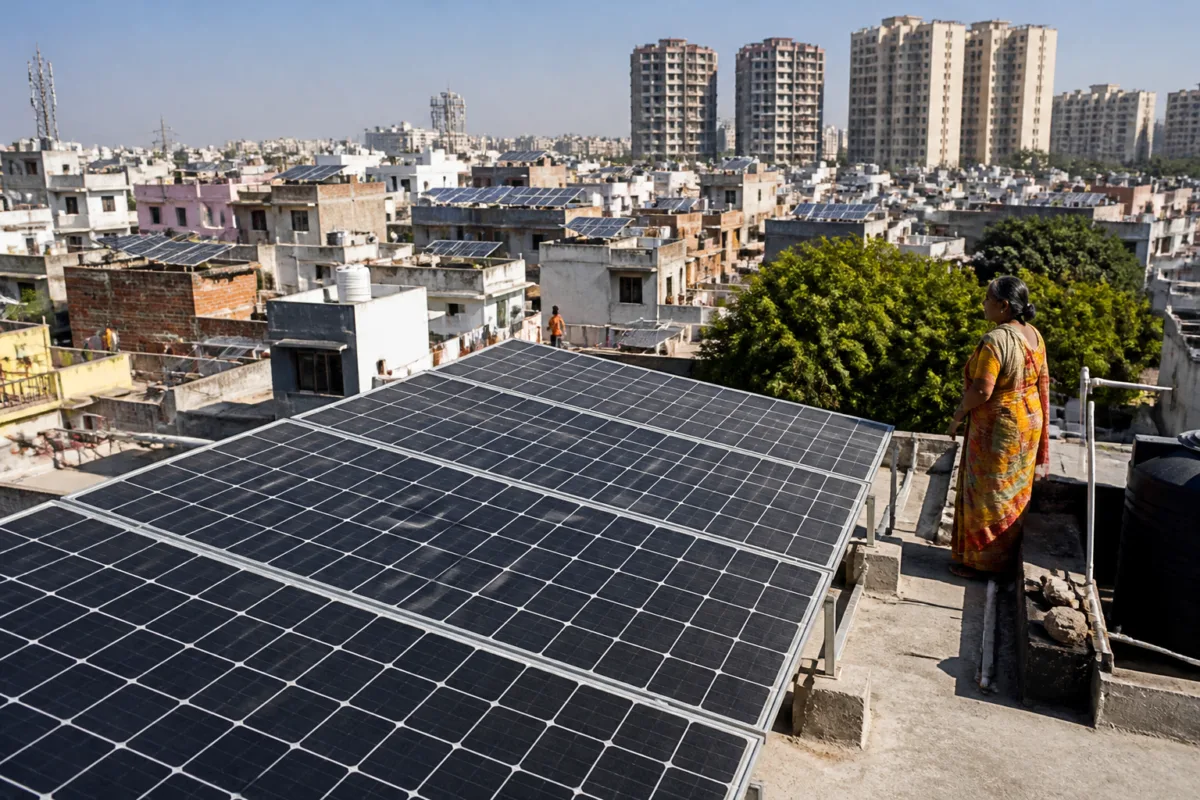
The PM Surya Ghar Muft Bijli Yojana is moving from a subsidy-led household programme into a larger test of how India generates, distributes and manages electricity. More than 55.3 lakh rooftop solar systems had been installed under the scheme by 2 November, according to figures cited from the National Portal for Rooftop Solar, while Union New and Renewable Energy Minister Pralhad Joshi said the installation rate could soon rise from one lakh systems every six days to the same number in four or five days.
That pace matters because the scheme is not only about reducing electricity bills for individual households. It is also intended to create a much more distributed power system in which homes and farmers become electricity producers alongside conventional power plants. The shift moves part of the energy system from a small number of central generation points towards thousands or millions of smaller installations connected to the grid.
The programme was launched in February 2024 with an announced outlay of Rs 75,000 crore. Its stated objective is to install rooftop solar systems for one crore households by 31 March 2027 and provide up to 300 units of electricity a month to eligible households through the programme. The government offers subsidy support of up to Rs 78,000 for rooftop installations, making the capital cost of a system a central part of the scheme’s appeal.
The numbers show both significant progress and the size of the task ahead. The report says the programme had received more than 88.3 lakh applications by 2 November. More than 55.3 lakh rooftop solar systems had been installed, and the portal data cited in the report indicated that over 65.4 lakh homes were being illuminated through the scheme. These figures are not identical measures: applications, installed systems and homes benefiting from the programme represent different stages or outcomes of the rollout.
That distinction is important for understanding implementation. A large application base indicates demand or interest, but it does not by itself establish that systems have been installed, connected to the grid or delivering the intended household benefit. The reported installation figure is closer to physical execution, while the number of homes described as being illuminated indicates the programme’s reported reach. The supplied report does not provide a district-wise breakdown, the capacity installed per household, the proportion of applications awaiting approval or the time taken between application and commissioning.
The minister’s remarks place the scheme within a broader change in the power sector. Joshi said traditional power plants are no longer the only generation points and that households and farmers are increasingly producing electricity. He also said some farmers are selling power to distribution companies. The report does not specify the number of such farmers, the states where this is occurring, or the payment and grid-connection arrangements involved, but the statement identifies the institutional change the rooftop programme is intended to accelerate.
For distribution companies, this changes the relationship between the utility and the consumer. A household with rooftop solar can remain a consumer while also generating electricity. Depending on the system and applicable connection arrangements, power may be used within the home or flow into the distribution network. That makes the local grid more central to the programme’s success. The report explicitly notes that the expanding rooftop-solar ecosystem is creating new opportunities and challenges for utilities and grid operators, although it does not detail the technical or financial scale of those challenges.
The scheme therefore combines three policy mechanisms: household-level financial support, a national installation target and a change in the structure of electricity generation. The subsidy is designed to lower the barrier to adoption. The one-crore-household target gives the programme a measurable implementation goal. The rooftop model, meanwhile, places generation closer to consumption than a conventional centralised power plant does.
The promise of up to 300 units of monthly electricity is also central to the programme’s public appeal. The report presents the scheme as a way for households to reduce or eliminate electricity bills, particularly when using appliances such as geysers and room heaters. However, the supplied material does not establish that every participating household receives a zero bill, nor does it explain how household consumption, system size, seasonal generation, net metering, maintenance and distribution-company billing affect the final amount payable. The evidence supports the existence of the benefit framework, but not a universal guarantee of zero bills.
The rollout rate cited by the minister is another important signal, but it should be read as a pace claim rather than a completed milestone. At one lakh installations every six days, the reported average is already substantial. A move to one lakh every four or five days would represent a faster execution cycle. The report says Joshi expects this acceleration in the coming weeks. It does not provide a separate official installation series to show whether the rate has been stable, rising or concentrated in particular periods.
The distance to the 2027 target remains visible in the figures supplied. More than 55.3 lakh systems had been installed against a stated goal covering one crore households. The reported count represents a little over half of that target, although the report does not clarify whether all installed systems correspond one-to-one with beneficiary households or whether the government’s target is being measured through a different administrative definition. The application figure is closer to the target than the installation figure, but applications cannot be treated as completed connections.
This makes execution capacity as important as the subsidy itself. The programme’s next phase will depend on how quickly applications become installations, how efficiently systems are connected and how reliably the resulting power is integrated into local distribution networks. The source material confirms the scale of the rollout and the government’s confidence in meeting its milestones, but it does not provide performance data on approval delays, installer availability, equipment quality, maintenance or grievance resolution.
The urban and built-environment dimension is equally significant. Rooftop solar changes the function of residential buildings by turning roof space into part of the electricity system. At programme scale, this links housing, construction, energy infrastructure and municipal electricity management. Yet the material supplied does not establish how apartment buildings, rented homes or buildings with shared roofs are being handled. It also does not state whether participation is concentrated among independent houses, which would affect how broadly the programme reaches urban households.
The most consequential question is therefore not simply how many panels are being installed. It is whether the programme can convert a high-volume subsidy and installation effort into a dependable distributed-energy system. That requires the figures for applications, installations and beneficiary homes to remain aligned, while utilities manage a growing number of generation points. The minister’s comments indicate that this structural transition is already underway, but the available report does not yet provide enough evidence to assess its performance across regions or household types.
The confirmed picture is one of rapid expansion: more than 88.3 lakh applications, over 55.3 lakh reported installations and more than 65.4 lakh homes linked to the programme by 2 November, supported by a Rs 75,000-crore national scheme and subsidies of up to Rs 78,000. The next developments to watch are the promised acceleration in installation rates, the conversion of applications into commissioned systems and the way distribution companies manage the growing role of households and farmers as power producers.

