


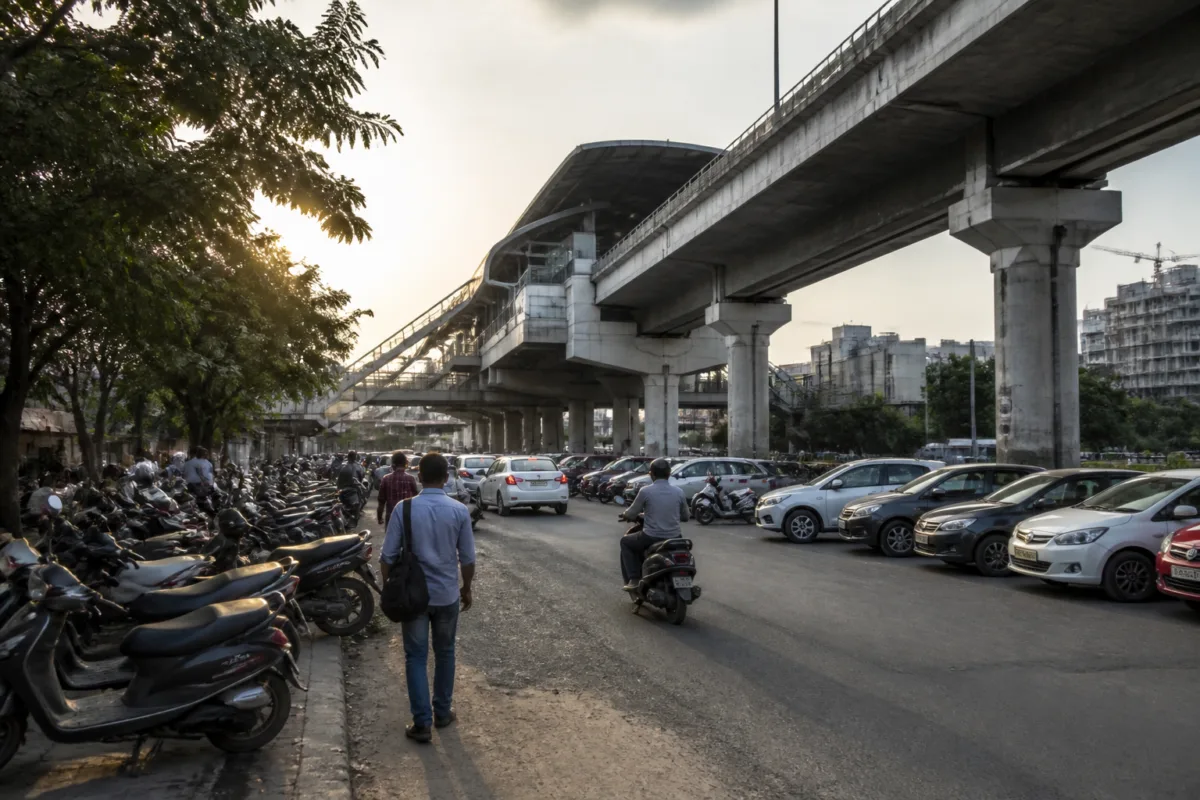
Pune’s Metro network is expanding, but the basic infrastructure needed to reach its stations remains incomplete. The Pune Metropolitan Region Development Authority’s request for eight parking sites along Metro corridors exposes a gap that is easy to overlook in project announcements: a rail line can be operational, yet remain difficult to use if commuters cannot reach stations without driving, stopping on roadsides or searching for informal parking under elevated structures.
The immediate trigger is the launch of the 23-kilometre elevated corridor from Civil Court in Shivajinagar to Maan through Hinjewadi. The corridor has 23 stations and connects the established city area with one of Pune’s major employment districts. PMRDA officials said demand for vehicular parking had increased after new Metro stretches opened and was likely to rise further. The authority has therefore sought eight parking sites along Metro routes, including locations around Baner and Balewadi.
This is not simply a request for ancillary land. It is a test of whether station access has been planned as part of the Metro system or treated as a separate civic obligation to be addressed later. The report shows that authorities are still negotiating the land question after trains have begun serving additional corridors. PMC has shared terms and compensation options with PMRDA, while negotiations are also under way with private landowners. Publicly owned land is expected to be prioritised, but the next steps depend on the response to the civic body’s terms.
The access problem is already visible at street level. According to PMRDA officials cited in the report, commuters are parking on roadsides or beneath elevated Metro corridors because dedicated lots are unavailable. That behaviour creates traffic jams around stations and weakens the practical advantage of a mass-transit service. A Metro journey does not begin when a passenger enters the station. It begins with the trip to the station, and that first leg can determine whether the system is convenient enough to use regularly.
Pune’s existing numbers show how far the city is from resolving that first-mile problem. PMC data cited in the report says the corporation has developed only 31 of 137 designated public parking reservations. The remaining 106 are still on paper. Separately, PMC has identified 20 locations near Metro stations for parking development, of which five have been constructed while the rest are being processed. These figures refer to different sets of sites, but together they point to the same administrative pattern: land has been identified more readily than parking capacity has been delivered.
That distinction matters. A reservation on a plan does not provide a commuter with a usable parking space. Construction, land transfer, compensation, design approvals, access arrangements and operations are all required before a site can support Metro ridership. The gap between designation and completion also makes it difficult to judge the transport system only by its route length, number of stations or opening schedule. Station-area facilities are part of the network’s effective capacity, even when they are not counted as Metro infrastructure.
Pune’s operational network currently spans 33.2 kilometres across the north–south Purple Line and east–west Aqua Line, with 30 stations, according to the report. Most of these stations currently lack parking spaces. The newly launched Maan–Civil Court corridor adds another 23 kilometres and 23 stations to the city’s expanding rail geography. As the network reaches areas with different land markets and travel patterns, the parking challenge is unlikely to be uniform. Baner and Balewadi, where several proposed sites are located, are also among the areas where demand for road space is already intense because of employment, commercial and residential activity.
The institutional arrangement further complicates delivery. PMRDA is seeking sites along the Metro corridors, while PMC controls or negotiates access to some of the land and is responsible for its own designated parking reservations. Private landowners may also be involved. This creates a chain in which the authority managing the metropolitan transport expansion may depend on a municipal corporation, public agencies and private owners to assemble station-area facilities. The delay is therefore not only a construction issue; it is also a coordination issue involving jurisdiction, compensation and land ownership.
The report does not establish that every proposed parking site will be built, nor does it provide a completion date for the eight locations sought by PMRDA. PMC officials said the civic body had shared its conditions and compensation options, and that the future course would depend on PMRDA’s response. Another civic official said negotiations with private landowners were in progress and that land held by PMC and other public bodies would receive priority. These statements indicate that the land and financing framework remains under discussion.
The public transport case for station parking is also more complicated than simply adding spaces for cars and two-wheelers. Jugal Rathi of PMP Pravasi Manch said facilities near public transport should be available to improve access and reduce traffic congestion and pollution. Regular Metro commuter Gauri Kulkarni described the lack of a reliable connection from stations to final destinations as a barrier to using the system instead of private vehicles. Their observations underline two linked problems: commuters need a dependable way to reach stations, but providing parking alone does not solve the wider last-mile connection.
The parking gap can therefore push the Metro into an awkward cycle. If stations are difficult to reach, residents may continue using private vehicles for the full journey. Those vehicles then occupy road space near stations, increasing congestion and making the approach to the station less convenient for buses, pedestrians, two-wheelers and other motorists. The resulting disorder can reinforce the perception that public transport is inconvenient, even when the rail journey itself is faster or more predictable.
PMC has said that public awareness campaigns will begin once the completed parking hubs become operational. That sequencing suggests that the authority views information and facility delivery as connected tasks. However, the supplied report does not specify the capacity, pricing, operating agency or access rules for the five completed locations. Without those details, the number of constructed sites alone cannot show how effectively they will serve Metro users.
The larger urban question is whether Pune is measuring Metro expansion as a line-building exercise or as an access system. The evidence in the report points to a mismatch between the rapid visibility of new corridors and the slower delivery of supporting land uses. A 33.2-kilometre operational network, a newly launched 23-kilometre corridor and a proposed set of eight parking sites represent different stages of the same system. For commuters, however, these stages meet at the station entrance and on the roads around it.
What is established is that parking demand has risen with the launch of new Metro stretches, that roadside and under-corridor parking is contributing to congestion, and that most designated or proposed facilities have not yet been completed. What remains unresolved is when the eight sites sought by PMRDA will be secured, how many vehicles they will accommodate and how the responsibilities of PMRDA, PMC and private landowners will be divided. Those implementation details will determine whether Pune’s Metro expansion produces a complete public transport network or leaves a critical part of the journey outside the system.

