


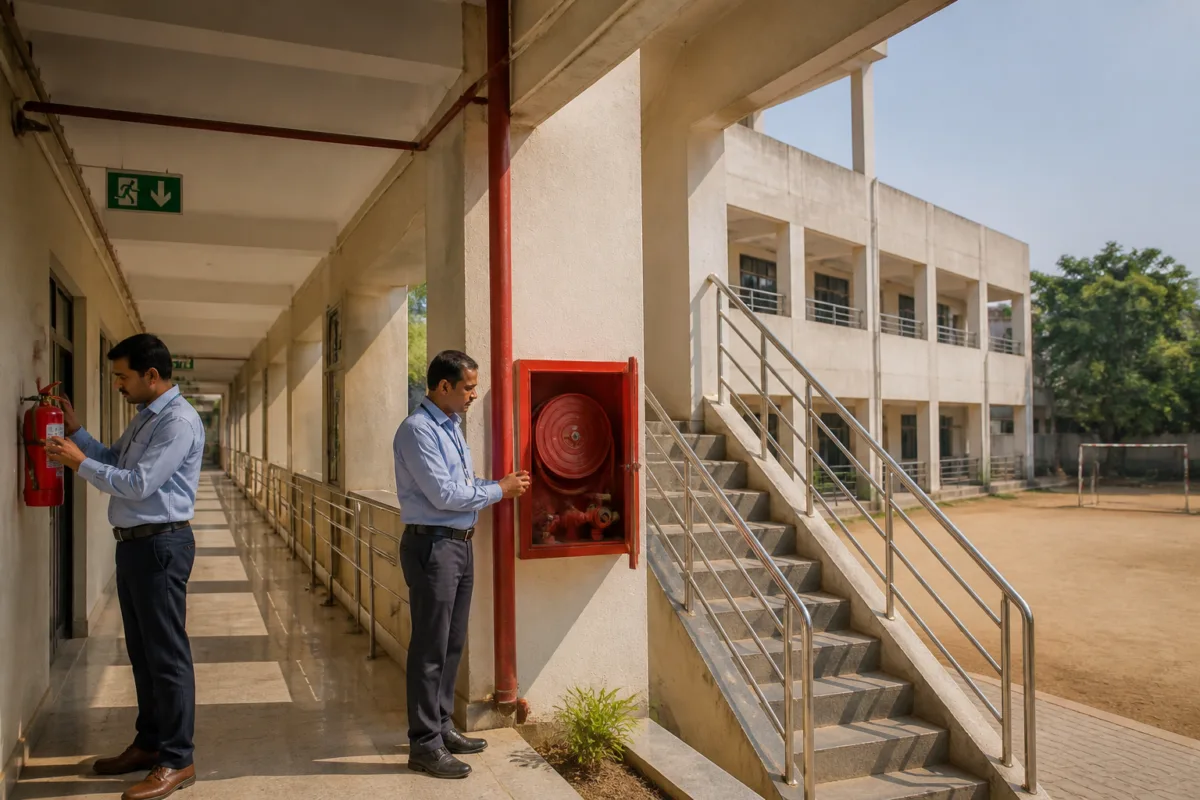
Telangana has relaxed certain fire safety requirements for existing schools and junior colleges while retaining mandatory provisions for fire prevention, evacuation and emergency response, according to revised guidelines issued by the state Fire, Disaster Response, Emergency and Civil Defence Department.
The guidelines apply to fire no-objection certificate (NOC) applications received on or after November 10. They allow educational institutions to retain existing open spaces within their premises instead of providing additional setbacks. Where setbacks are inadequate, institutions must install water curtains on the deficient sides that do not adjoin a road and provide a four-way fire brigade inlet.
The revised rules also modify requirements for additional staircases. Buildings below nine metres in height, including the stilt floor, must have a second staircase if the floor area exceeds 500 square metres and only one staircase currently exists. Buildings above nine metres must provide a second staircase irrespective of floor area when only one staircase is available.
Additional staircases may be built using concrete or metal and must have safety railings. The prescribed width of 1.5 metres has been relaxed, with the department accepting the maximum feasible width based on available space. The two staircases must be positioned as far apart as possible to support evacuation from different parts of a building.
Fire safety equipment requirements continue to vary according to building height and configuration. Educational institutions housed in buildings up to 15 metres must provide at least four fire extinguishers on each floor, with the equipment accessible within 15 metres. Buildings of ground plus two floors or more, up to 15 metres, must also have first-aid hose reels, manually operated electronic fire alarms, a 10,000-litre terrace water tank and a pump capable of delivering 450 litres per minute.
For buildings between 15 and 30 metres, the requirements include hose reels, downcomers, a 25,000-litre terrace water tank and a pump with a capacity of 900 litres per minute. Schools and colleges must keep exits, corridors and open spaces clear, display evacuation plans and emergency contact numbers, and install emergency lighting and illuminated exit signs.
The guidelines also specify that preschool, kindergarten and Class 1 students must be accommodated on the ground floor or on the first floor where a stilt floor exists. Fire services director general Vikram Singh Mann said the changes were intended to address practical difficulties faced by educational institutions in meeting building requirements while ensuring essential fire prevention and life safety measures.
Occupancy NOCs issued under the revised guidelines will remain valid for three years. Institutions must apply for renewal two months before the expiry of their NOCs, according to the department’s revised provisions.

