


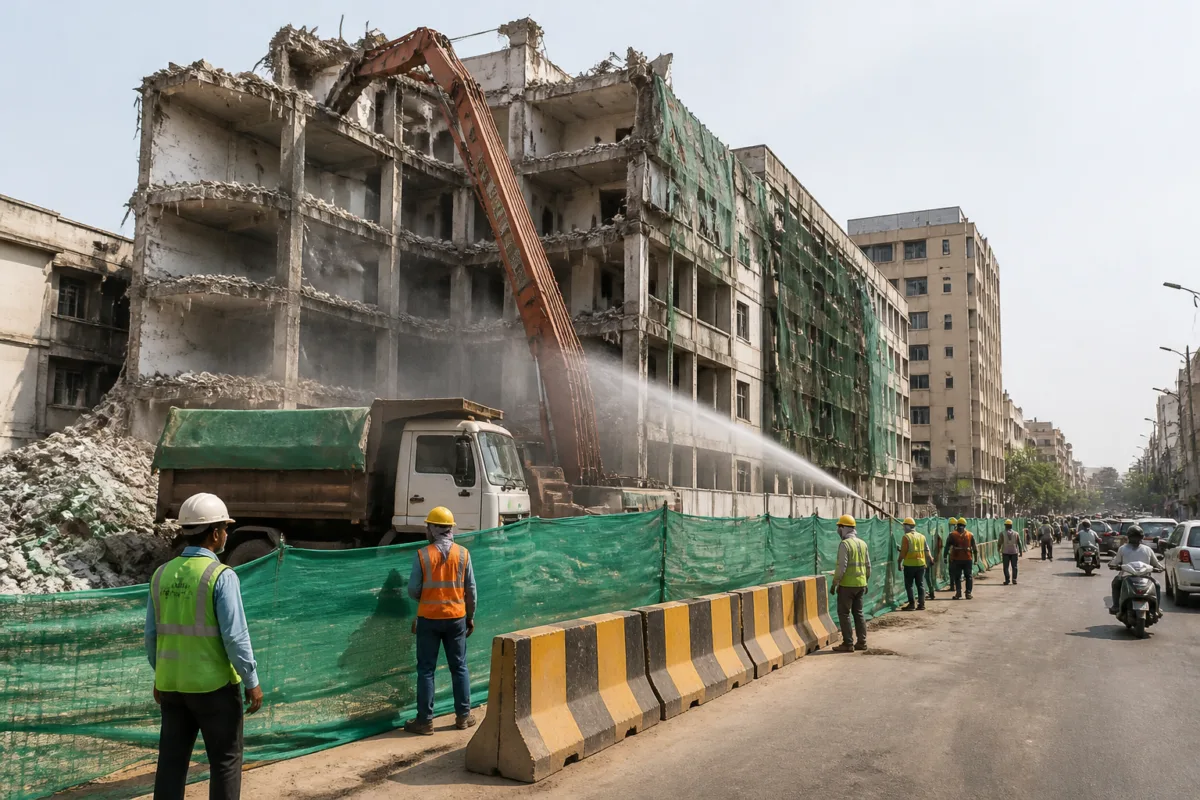
Ahmedabad Municipal Corporation has proposed stricter demolition rules for old buildings and redevelopment projects, including seven days’ advance notice, mandatory safety nets and protective equipment for workers, dust-control measures and formal disposal of construction and demolition waste. The Ahmedabad Sustainable Demolition Policy-2026 was approved by the civic body’s Town Planning Committee on 4 November and will take effect only after approval by the Standing Committee and General Board.
Under the proposed policy, owners or other responsible parties must submit written notice to the Estate and Town Development departments of the relevant zonal office at least seven days before demolition begins. The submission will have to include photographs of the structure, its floor area, its use and other relevant details. Depending on the site category, applicants may also need to provide a structural assessment report, a demolition-waste management plan and an environmental and safety management plan.
The policy proposes dividing demolition sites into five categories based on built-up area and building height. The category system is intended to match documentation, technical supervision, safety arrangements and environmental controls to the scale and risk of the work. Responsibilities have been assigned to property owners, developers, applicants, contractors, demolition agencies, registered engineers, structural engineers, clerks of works, waste transporters and authorised processing facilities.
Sites would need adequate barricading, green nets or windshields around their boundaries. Safety nets would be compulsory when upper floors of multi-storey buildings are demolished. Workers would have to be provided with helmets, safety shoes, gloves and other required personal protective equipment. Warning boards stating that demolition is in progress and identifying danger areas would have to be visible from public roads, while traffic and pedestrian movement would need to remain unobstructed.
The proposed rules also require demolition work to be carried out during the day. Where work continues at night, adequate lighting would be required at the site. Special precautions would apply to basements and foundations, including appropriate shoring and shuttering. Contractors would also have to prevent damage or leakage to drainage and other service lines and limit the effect of machinery vibration on neighbouring properties.
Dust-control provisions include water spraying before and after demolition, cleaning surrounding roads and covering structures with green nets or other dust-blocking material. Cutting, grinding and drilling would have to be conducted in suitably enclosed and ventilated areas. Larger sites in specified categories would require continuous water fogging or mist systems, dust-control equipment and on-site dust monitoring.
The policy proposes that demolition debris be covered and removed within 48 hours. It would have to be transported in covered vehicles directly to an authorised processing facility, with transport logs and receipts retained as records. Materials including concrete, bricks, blocks, mortar, iron, metal scrap, wood, doors, windows, tiles, ceramics and soil would need to be segregated. Glass, plastic, PVC pipes and electrical fittings would also be separated at larger sites, while asbestos, chemical containers, paint and oil would require separate handling as hazardous waste.
For specified higher categories of construction and redevelopment, at least 15% of construction-and-demolition waste or products made from it would have to be reused, provided that doing so does not compromise construction quality or safety. Demolition work would be carried out under the supervision of a registered engineer or clerk of works and a structural engineer, with higher-category sites requiring more senior technical supervision.
The proposed policy allows penalties, stoppage of work and action under Section 248(2) of the Gujarat Provincial Municipal Corporations Act, 1949, for violations. Police intimation is also permitted where legal action is required. Owners and other responsible parties would remain liable for injury, property damage, structural damage or accidents caused by demolition. Demolition undertaken by the corporation as part of statutory enforcement or encroachment removal would be excluded from the policy. The proposal now moves to the Standing Committee and General Board for consideration.

