


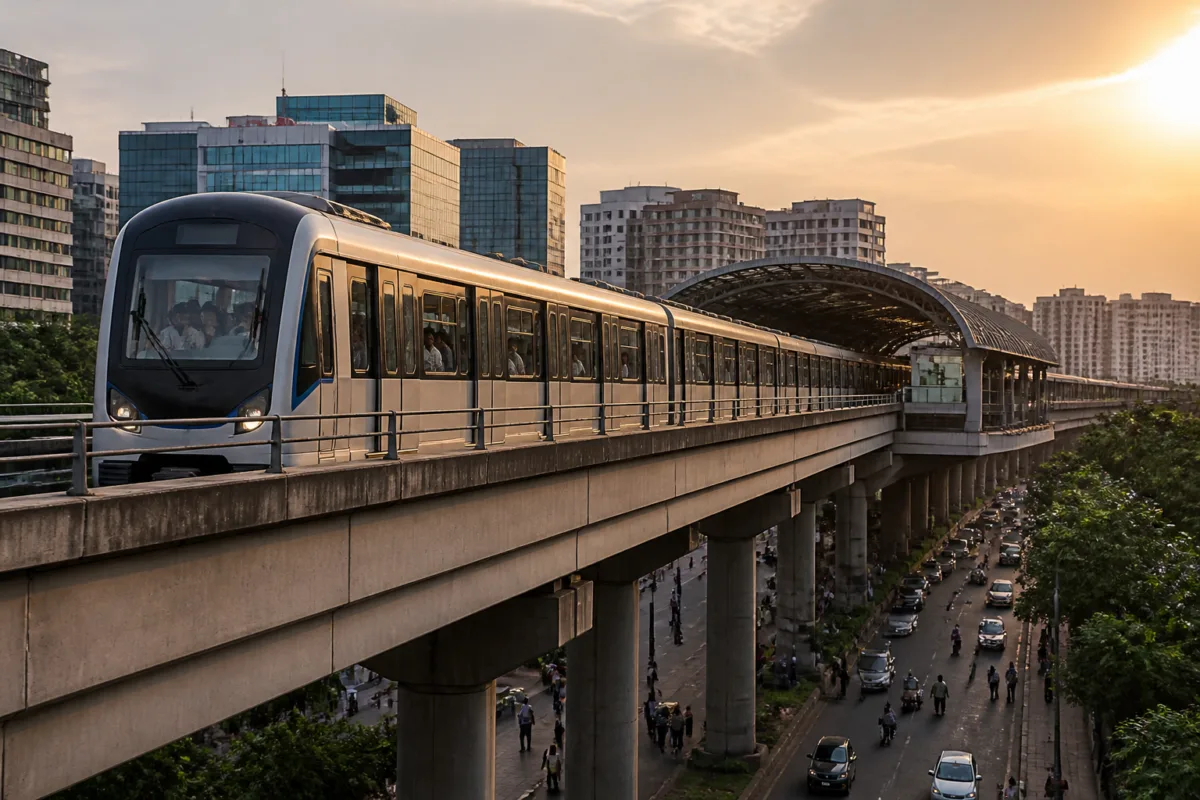
Pune Metro Line 3, connecting Maan-Hinjewadi with Shivajinagar, has begun passenger operations on 17 of its planned 23 stations, opening a new public-transport link for the city’s information technology workforce, students and other commuters. Prime Minister Narendra Modi inaugurated the corridor online on Tuesday, while the remaining six stations are expected to be completed by January 2027.
The corridor has been discussed for years amid revised deadlines, protests and changes in the leadership of the Pune Metropolitan Region Development Authority (PMRDA). It has been developed under a public-private partnership model and is intended to connect the Hinjewadi employment district with the wider Pune urban region and central Shivajinagar.
Following the inauguration, Maharashtra Chief Minister Devendra Fadnavis, Deputy Chief Minister Eknath Shinde and Deputy Chief Minister Sunetra Pawar travelled on the line from the Balewadi sports complex metro station to the Hinjewadi Phase 2 station. The journey covered approximately six kilometres. The service was operated by women train drivers, with Pragati Biradar serving as the chief train driver and Aishwarya Suryapujari also playing a key role during the inaugural journey.
PMRDA Commissioner Abhijit Choudhary said the journey from Maan to Civil Court would take approximately 40 to 45 minutes by metro. The available fare structure starts at ₹12 for journeys between zero and two kilometres. Fares rise to ₹25 for two to four kilometres, ₹37 for four to eight kilometres, ₹43 for eight to 12 kilometres, ₹49 for 12 to 18 kilometres and ₹62 for journeys longer than 18 kilometres.
The first phase of passenger operations is expected to serve employees working in Hinjewadi’s IT sector, students and residents travelling between the western suburbs and central Pune. During the inaugural journey, Fadnavis spoke with school students and IT employees about their experience, the facilities available and the possible effect of the new corridor on their daily travel.
Modi said Pune’s importance in information technology, automobiles, pharmaceuticals, startups, innovation and manufacturing made the expansion of metro services significant for the city’s economic development. He said Maharashtra’s operational metro network had expanded from approximately 10 to 11 kilometres in 2014 to around 200 kilometres, with more than 680 kilometres of metro projects under construction, according to figures cited during the inauguration.
The Prime Minister also said that India’s operational metro network had grown from 248 kilometres in 2014 to approximately 1,200 kilometres, with metro services operating in 26 cities and more than one crore passengers travelling by metro each day. These figures were presented as part of the wider expansion of urban mass transit in the country.
Fadnavis said around 120 kilometres of metro routes had been developed in Pune, with work continuing on some corridors. He also said the Centre had provided ₹5,000 crore for the development of the Pune metropolitan region and that the funding would be used to strengthen modern transport infrastructure. He described the Shivajinagar-Hinjewadi project as the country’s first metro project developed through a public-private partnership.
The opening gives Pune a new operational transit connection to one of its largest employment clusters, but the corridor is not yet fully complete. The immediate service will cover 17 stations, while work on the remaining six stations is expected to continue until January 2027.

