


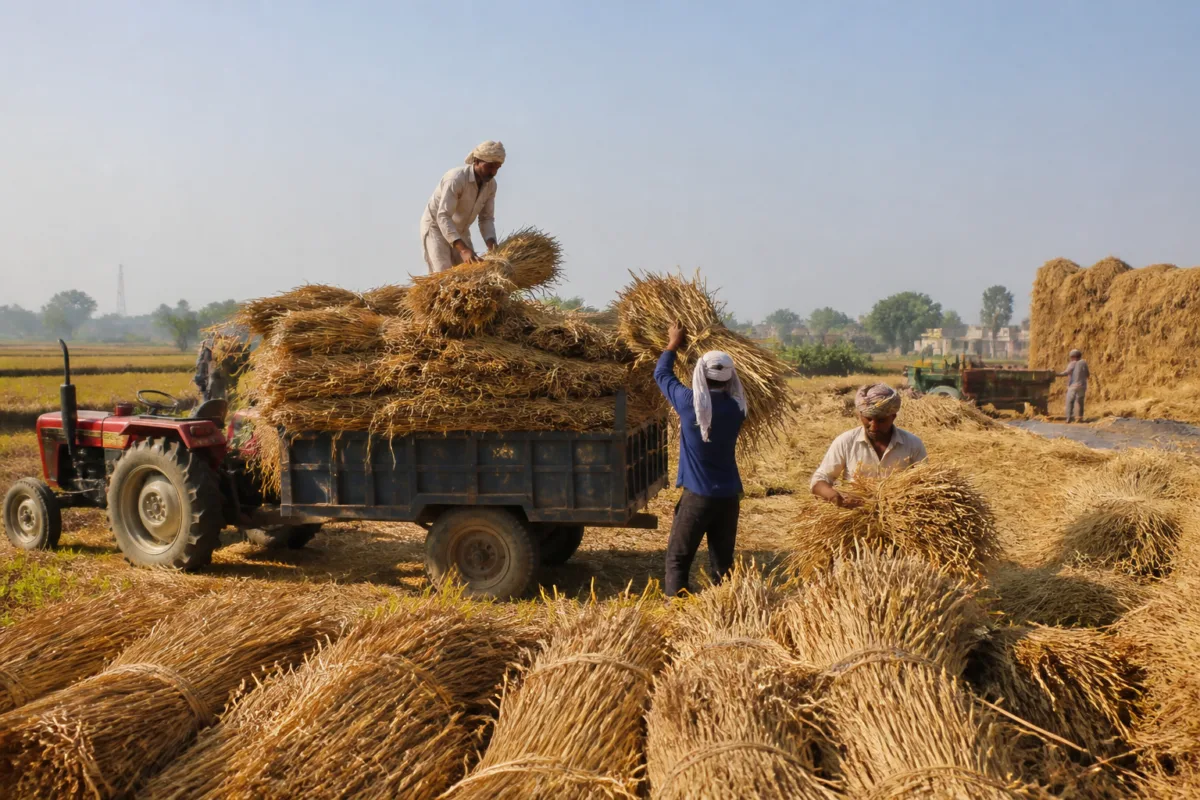
Haryana’s stubble-burning incidents have fallen from 118 by November 2, 2025, to 42 by the same point this year, according to agriculture department data cited by The Times of India. The decline is unfolding alongside a sharp rise in the value of paddy straw, with farmers reportedly earning Rs 7,000–9,000 per acre by selling crop residue to buyers supplying livestock-feed markets in Rajasthan.
The change is significant because it shifts the stubble question away from enforcement alone. In the villages described in the report, paddy residue is becoming a tradable commodity, supported by demand for cattle and other livestock feed, storage facilities, transport operators and biomass users. At the same time, the economics are not uniform: the price farmers receive depends on how the paddy is harvested, how quickly fields must be cleared and whether buyers can collect the residue left behind.
That distinction matters to any policy response. A farmer does not decide about residue in isolation. The decision is tied to the cost of harvesting, the time available before the next crop, the availability of machinery, the location of buyers and the certainty of payment. The experience reported from Jind and nearby villages suggests that burning declines when these pressures are matched by a reliable commercial alternative.
The figures cited by the report show the scale of the immediate change. Haryana recorded 118 stubble-burning incidents by November 2, 2025, compared with 42 this year. The report attributes the reduction to several factors working together: higher straw prices, administrative monitoring, strict action against violations, greater awareness among farmers and the establishment of biogas plants that use paddy straw as raw material.
No single factor is presented as sufficient. Narender Pal, a quality control inspector with the agriculture department in Jind, said the decline reflected continuous field presence by officials, action against violations, awareness among farmers and the emergence of biogas plants. This combination is important because it shows that the residue economy is operating within an administrative framework rather than replacing enforcement altogether.
The most visible market link runs from Haryana’s paddy fields to Rajasthan’s livestock economy. Raju, a private stubble purchaser who has established a large storage facility in Ramrai village, told The Times of India that he buys straw directly from farmers at a minimum price of Rs 7,000 per acre. He attributed the high rates to increased demand in Rajasthan, where the straw is used to feed camels, goats and other livestock.
This demand has created a chain of activity beyond the farm gate. According to Raju, labourers, farmers who own tractors and operators of loading machinery are benefiting from the trade. Storage is another essential link. Without a place to accumulate straw, private buyers cannot manage seasonal supply, and farmers have limited capacity to hold residue while waiting for transport or a purchaser.
The reported benefits therefore extend beyond the price paid to a farmer. A market for straw can generate work in loading, transport and storage while giving agricultural residue a use outside the field. In urban terms, it also connects rural production decisions with wider environmental concerns, because reducing open-field burning can reduce smoke affecting settlements and cities across the region. The supplied report does not provide air-quality measurements, so the effect on pollution levels cannot be quantified here. It does, however, document a fall in the number of reported farm-fire incidents.
For farmers, the value of straw is especially important when it covers the cost of preparing the next crop. Birender Bisla, a farmer from Rajthal, said the price of paddy straw had become an additional source of income and helped with field preparation. He estimated that cultivating wheat on one acre costs about Rs 5,000: Rs 1,500 for fertilisers, Rs 1,500 for seeds and Rs 2,000 for tractor-related expenses. At the reported straw price, the residue can cover or exceed those expenses.
That calculation explains why a market incentive can alter behaviour more effectively than an abstract environmental message. If farmers receive money at the point when they are preparing land for the next crop, the transaction directly addresses a cash-flow problem. It also changes the status of residue: straw is no longer only a disposal burden but a possible source of funds.
However, the market has a major limitation. Anil Godara, a farmer from Rajthal village in Hansi district, said the attractive Rs 7,000–8,000 per-acre price was generally available when paddy was harvested manually. Manual harvesting, he said, costs around Rs 10,000 per acre in labour. By contrast, combine harvesters charge around Rs 2,500 per acre, but private buyers generally do not purchase the residue left behind after combine harvesting.
This is the central operational problem in the emerging straw economy. The harvesting method that reduces the farmer’s immediate cost can also produce residue that is more difficult for buyers to collect. The method that makes straw more commercially recoverable can impose a labour cost large enough to erode the value of the sale. Unless collection systems, machinery and pricing are aligned, the market will remain accessible mainly to farmers whose fields and harvesting arrangements fit buyer requirements.
Time pressure further complicates the choice. Farmers must prepare fields quickly for the next crop, and the report says this pressure can push some towards burning when residue remains after combine harvesting. The decision is therefore not simply about awareness or willingness. It is a time-bound logistics problem involving equipment, labour, collection and the next sowing cycle.
This is why the presence of private buyers and storage facilities matters. They can potentially shorten the distance between field and market, but the report does not establish how widely such facilities are available, how much straw they can store or whether they serve all villages. It also does not provide a complete account of the number of biogas plants, their capacity or their procurement arrangements. Those gaps prevent a broader assessment of whether the current price surge represents a stable market or a seasonal opportunity.
The reported experience nevertheless illustrates how institutional responsibilities overlap. Agriculture officials monitor violations and promote awareness. Private purchasers organise procurement and storage. Tractor owners, labourers and loading-machine operators provide services. Biogas plants create another source of demand. Rajasthan’s livestock economy supplies the market pull. Farmers make the final decision under the constraints of cost and time.
The arrangement also shows why farm-fire reduction cannot be treated only as a policing issue. Enforcement may raise the cost of burning, but it does not by itself create a practical alternative for residue that cannot be sold or removed quickly. Similarly, a high straw price may reduce burning in villages connected to buyers, but it cannot solve the problem where combine-harvested residue is excluded from procurement. The evidence in the report points to a layered system in which enforcement, awareness and market access reinforce one another.
The village-level accounts provide an important ground view of that system. Raju described a business supporting hundreds of workers and equipment operators. Bisla said the income helped cover wheat cultivation costs. Godara reported that no stubble-burning incident had been recorded in his village so far, while also identifying the harvesting-cost problem that continues to push some farmers towards burning. These accounts show both the promise and the unevenness of the model.
The larger urban question is how environmental outcomes are shaped by economic networks outside city boundaries. Air pollution episodes are often experienced in urban areas, but the decisions that contribute to seasonal smoke are made across farm fields, machinery markets, transport routes, storage sites and livestock-feed networks. A durable response must therefore account for the entire chain rather than focusing only on the visible act of burning.
The evidence currently confirms a sharp fall in reported Haryana farm fires by November 2 and a parallel increase in the reported value of paddy straw. It also confirms that the reduction is associated with several factors, including private procurement, Rajasthan’s fodder demand, administrative action, awareness and biogas plants. What remains unclear is the durability of the market, its coverage across harvesting methods and villages, and the amount of residue it can absorb. Those are the next questions for officials and market participants as the crop cycle continues.

