


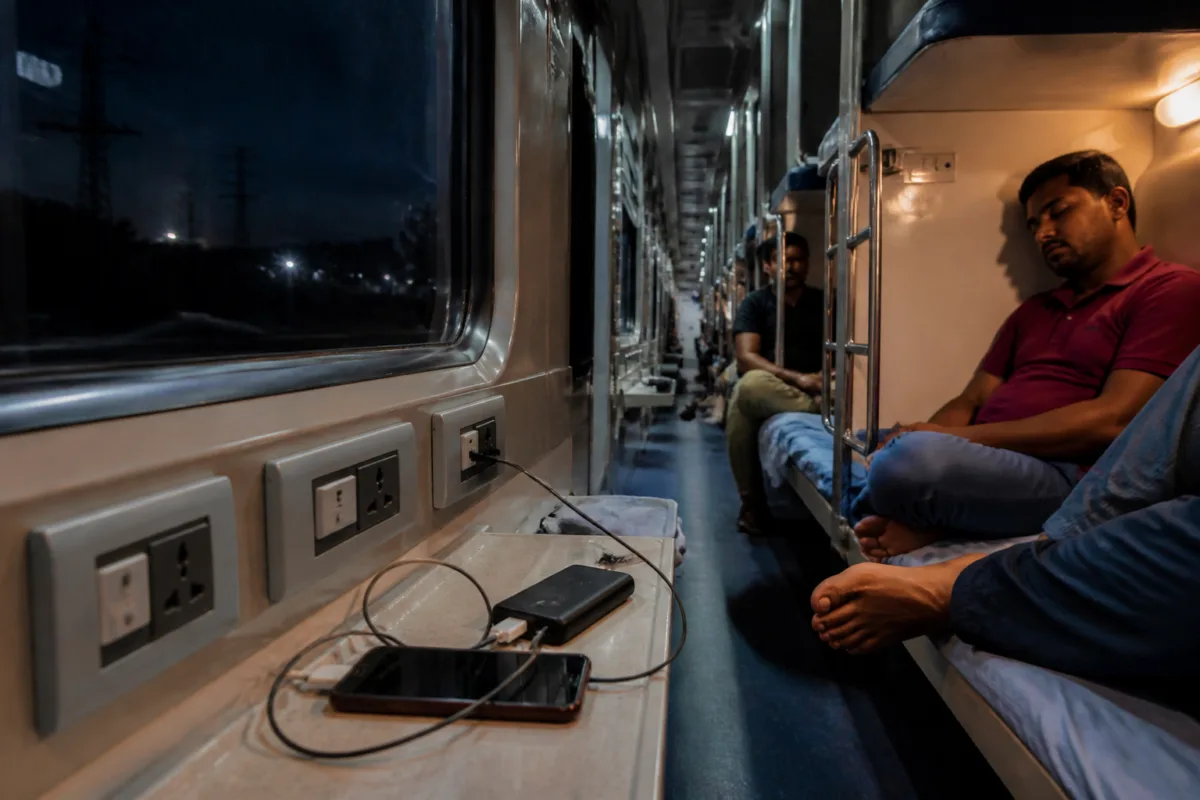
The Railway Ministry’s order to switch off mobile charging points in train coaches between 11pm and 5am has exposed a growing gap between railway safety controls and the digital needs of passengers. The directive is intended to prevent fires and other hazards, but passengers in Jharkhand say a blanket six-hour shutdown may leave them without access to phones needed for tickets, payments, travel information and emergency communication.
The ministry issued the instruction to the principal chief electrical engineers of all railway zones in a letter dated October 26. It directed railway authorities to ensure that charging points in all coaches remain switched off during the overnight period. The measure applies to train coaches, including those used by passengers travelling long distances and overnight.
The order is a safety intervention, but its effect is not limited to electrical equipment. It also changes how passengers manage essential services during a journey. A mobile phone is now used to display e-tickets, access railway information, contact family members, book cabs after arrival, make digital payments and report problems through online systems. As a result, the availability of a charging point has become part of the practical infrastructure of train travel, even though the charging socket itself is not a transport service in the conventional sense.
That shift explains why the directive has prompted opposition from passengers and commuter representatives. Prem Kataruka, secretary of the Jharkhand Passengers’ Association, described the decision as arbitrary and inconvenient. He said passengers increasingly depend on mobile phones during train journeys and argued that the Railways should consider alternative safeguards instead of disabling charging facilities for six hours.
Kataruka’s criticism also points to the central administrative question raised by the order: whether a system-wide restriction is the most proportionate response to a safety concern. The ministry’s instruction identifies fires and other hazards as the reason for the shutdown. However, the material available in the report does not specify whether the directive followed a particular incident, an inspection finding, a technical assessment, or a broader review of charging equipment across coaches.
That information matters because charging points are not isolated consumer devices. They are connected to the electrical systems installed in coaches, and the safety of the arrangement depends on equipment condition, wiring, load management, maintenance and passenger use. The report does not establish which of these factors led to the ministry’s decision, nor does it identify whether the risk is concentrated in particular coach types, train services or equipment categories.
In the absence of those details, the overnight shutdown operates as a uniform precaution. It is simple to communicate and enforce: charging points are unavailable during a fixed six-hour window. But a uniform rule also affects passengers who may have different levels of access to alternatives. Some travellers carry power banks, while others rely entirely on the charging facilities available in the coach. The operational convenience of a blanket shutdown therefore produces an uneven passenger experience.
The experience of passengers cited in the report illustrates that difference. Sanjay Chatterjee, a Dhanbad resident who travelled to Jaipur on October 28, said attendants informed passengers in his third AC coach that charging facilities would remain unavailable from 11pm to 5am. Chatterjee had a power bank, but he said several other passengers had to wait until morning to charge their phones.
The account shows that the directive is not merely a technical instruction issued at the administrative level. It is being experienced at coach level, where passengers must plan around the loss of access. The six-hour window covers the period when many long-distance travellers are sleeping, but it can also include the hours immediately before arrival for trains reaching destinations early in the morning. The report does not provide a network-wide assessment of how many services or passengers are affected, so the scale of the impact cannot be quantified from the available evidence.
Dinesh Singh, who travelled from Ranchi to Delhi, described the phone as necessary even after a passenger leaves the train. He referred to cab bookings, online payments, communication with family members, railway applications and helplines used to report issues such as dirty coaches and faulty facilities. His concern broadens the issue from personal convenience to access to transport-related services.
This is significant for railway administration because digital tools increasingly sit between the passenger and the public service. A ticket may be stored on a phone. A passenger may need a digital payment method at the destination. A person arriving in an unfamiliar city may need a phone to arrange onward travel. A complaint about the journey may also be submitted through an online channel rather than at a station counter. The report does not claim that passengers are formally denied these services during the shutdown, but it records why passengers consider a charged phone necessary to use them reliably.
The directive therefore creates a tension between two forms of public infrastructure. The first is the electrical system inside the coach, where the ministry has identified a potential fire and safety risk. The second is the digital access layer used by passengers to navigate the journey and its immediate aftermath. The Railways is addressing the first through temporary unavailability of charging points, while passengers are concerned that the measure weakens the second.
A more detailed policy explanation would need to clarify what safeguards exist before a charging point is switched off. The passengers quoted in the report have called for safer charging systems, regular inspections and stricter action against faulty equipment. These demands are not presented as an official alternative plan, but they identify the implementation choices that remain unclear: whether equipment is inspected at fixed intervals, how defective sockets are isolated, whether coach-level electrical faults are recorded, and how passengers are informed about the reason for the restriction.
The ministry’s instruction to principal chief electrical engineers places the operational responsibility within the railway electrical engineering structure. The report does not state how the order is being monitored across zones, whether compliance is automated or manual, or whether attendants are required to inform passengers before the shutdown begins. Chatterjee’s account indicates that attendants were communicating the unavailability in at least one coach, but it does not establish whether that practice is consistent across trains.
That distinction matters because enforcement and communication shape the effect of a safety rule. A passenger who knows before boarding that charging will be unavailable overnight can plan accordingly. A passenger who learns only after settling into a long-distance journey has fewer options. The source material does not state whether the Railways has issued a passenger advisory, changed booking information or provided alternative charging arrangements.
The order also raises a question about how safety risks are communicated. The ministry has cited fires and other hazards, but the report contains no technical explanation of the identified risk and no official statement detailing the evidence behind the six-hour period. Passengers, meanwhile, have questioned whether mobile-phone charging has been linked to a train fire. Kataruka said he had never heard of a train catching fire because of mobile phone charging, but that comment represents the association’s position, not an official finding about railway safety.
The available evidence therefore supports two clear conclusions and leaves several others open. It confirms that the Railway Ministry directed zones to switch off coach charging points between 11pm and 5am. It also confirms that passengers and a commuter association consider the measure disruptive because phones are used for essential travel and communication services. It does not establish the number of incidents that prompted the order, the technical failure rate of charging points, the number of affected passengers, or whether a review date has been set.
Those missing details are central to judging whether the measure is a temporary precaution or part of a longer-term change in train operations. They would also show whether the restriction is being used alongside equipment upgrades and inspections or instead of them. The report records calls for safer systems and stricter action against faulty equipment, but it does not include a response from the ministry on whether such measures are planned.
The dispute is consequently not only about whether passengers should be able to charge phones at night. It is about how a large public transport system balances a preventive safety rule with the dependence that its own digital services have created. The Railways has acted on the safety side through a clearly timed restriction. Passengers are asking for the access side of the system to be protected through better equipment, maintenance and alternatives.
For now, the confirmed position is that charging points in train coaches are to remain switched off from 11pm to 5am under the ministry’s October 26 directive. The next significant information will have to come from the Railways: the technical basis for the order, the inspection and maintenance measures supporting it, how passengers will be informed, and whether any alternative charging or safety arrangements will be introduced.

