


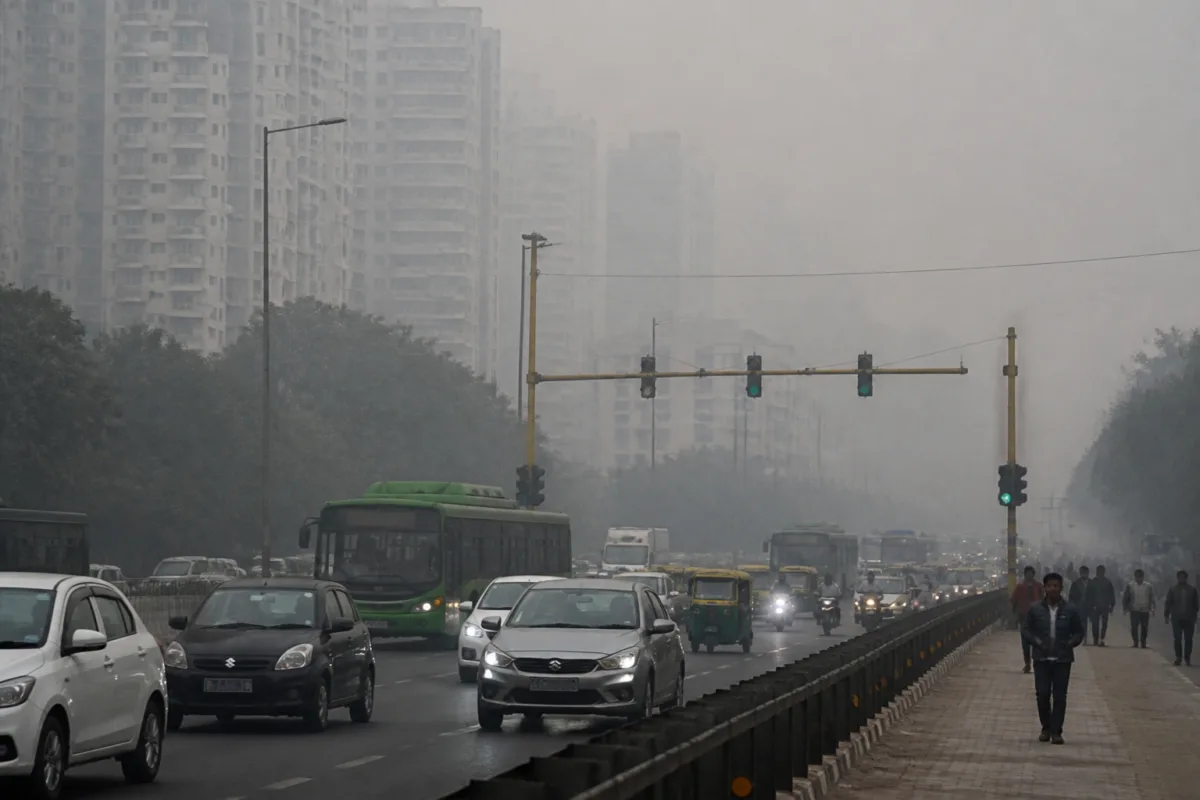
Delhi air pollution worsened sharply on Tuesday, with the city’s average air quality index reaching 350 by 4 pm and 10 monitoring stations recording AQI levels above 400, according to Central Pollution Control Board data. Jahangirpuri recorded the worst reading at 452, placing it in the ‘severe’ category.
The deterioration followed three consecutive days of worsening air quality in the National Capital Region. Delhi’s average AQI was 261 on November 1 and rose to 324 on November 2 before reaching 350 on Tuesday. The reading was also higher than the 2026 peak of 378 recorded on January 20.
The India Meteorological Department has warned of morning fog or haze across Delhi and the NCR through November 9. Wind speeds are expected to remain low during the morning and evening, conditions that can limit the dispersal of pollutants. Winds are also expected to remain north-westerly until November 6, according to the report.
Data from the decision support system showed that stubble burning accounted for 15.301 per cent of Delhi’s PM2.5 pollution on Tuesday, up from 8.583 per cent on November 2. The contribution is forecast to rise to 20.057 per cent on November 4 and 22.207 per cent on November 5.
The figures come as farm-fire activity continues across northern India. Between September 15 and November 2, a total of 3,535 field-fire incidents were recorded, including 1,612 in Punjab, 738 in Rajasthan, 614 in Madhya Pradesh, 349 in Uttar Pradesh, 176 in Uttarakhand, 44 in Haryana and two in Delhi.
At the same time, the number of recorded farm fires during the period remains lower than in several previous years. The corresponding figure was 51,822 in 2020, 24,583 in 2021, 26,490 in 2022 and 4,993 in 2025. The reporting period for the current season falls within the period when stubble-burning incidents are generally recorded, extending from September 15 to November 30.
The report also noted that fireworks during Diwali could add to the pollution burden. With low wind speeds, rising PM2.5 contributions from farm fires and continued morning haze forecast through November 9, weather conditions will remain a key factor in how quickly pollutants disperse from the city. The latest forecast period extends through November 9, while north-westerly winds are expected until November 6.

