


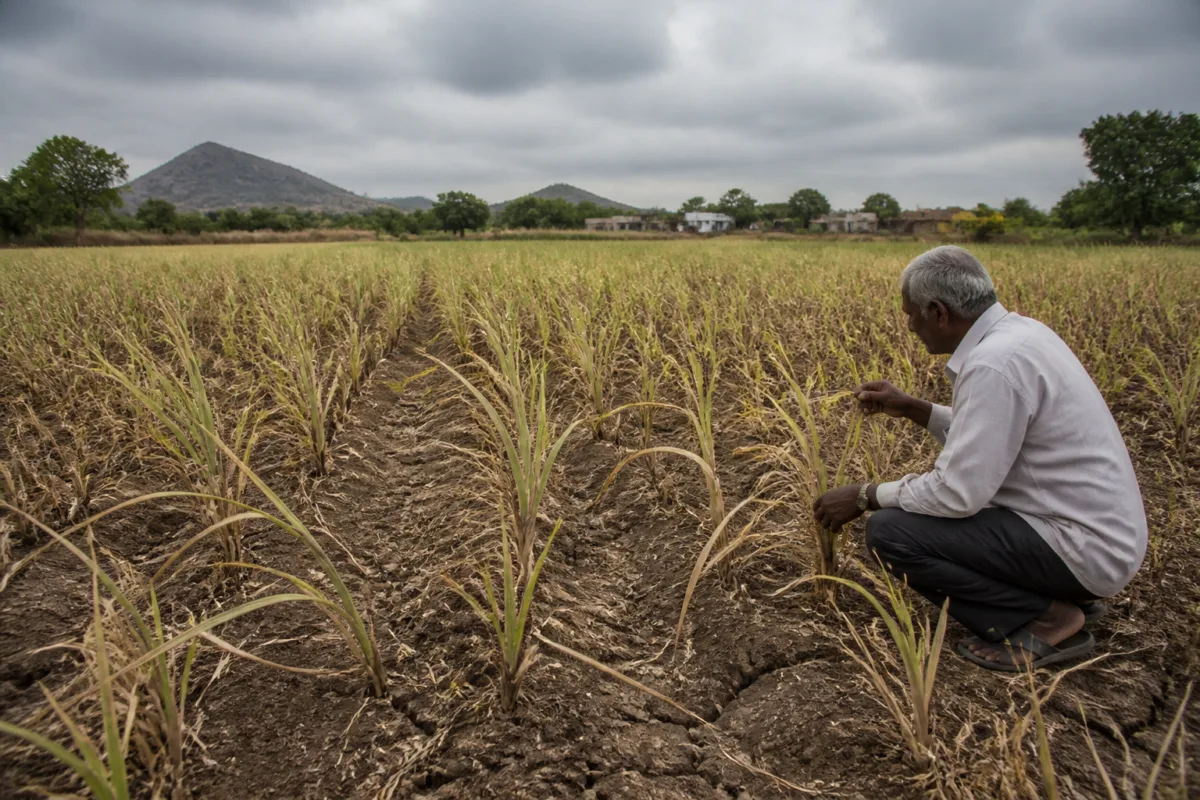
Pune’s crop damage assessment has moved the deficient monsoon from a seasonal weather problem to a wider livelihood and local economic crisis. The district agriculture office estimates that nearly 65% of the district’s kharif acreage has been damaged, while the affected agricultural area across kharif crops, sugarcane, onions, vegetables and fruit orchards has reached an estimated 3.18 lakh hectares.
The immediate loss is measured in damaged fields. The deeper problem is the financial chain attached to those fields: expenditure incurred before harvest, income expected across several months, and the ability of farming households to finance the next cropping cycle. The assessment indicates that the consequences of rainfall failure are not confined to one harvest. They can extend into rabi cultivation, perennial plantations and the local economy of the tehsils most affected.
According to the district agriculture office assessment released this week, around 1.3 lakh hectares of kharif acreage has been damaged out of a total 2 lakh hectares in the district. When damage to other crops is included, the estimated affected area rises to 3.18 lakh hectares. District agriculture officer Vaibhav Tambe described the scale as unprecedented and identified sugarcane losses as a major blow to farmers, particularly in Baramati, Indapur, Daund and Shirur.
The figures distinguish between the kharif acreage assessment and the larger estimate covering other crops. That distinction matters because the crops do not carry the same production cycle or financial exposure. Seasonal crops may be replanted or replaced in a subsequent cycle, although the source material does not establish the extent of recoverability. Sugarcane and fruit orchards, by contrast, require substantial investment and continuing maintenance over longer periods.
For sugarcane growers, the rainfall deficit has affected crops at a crucial stage of growth. Sachin Lawte, a grower from Indapur, said farmers had already spent on field preparation, planting material, fertilisers and labour before insufficient rainfall left sections of his field stunted. He said that even an improvement in rainfall would not restore the crop’s lost potential, raising the prospect that final yields will be too low to recover the investment.
This is the first structural feature of the damage: the loss is not limited to the value of produce that will not be harvested. It also includes sunk costs incurred before the weather failure became visible in the final output. Where cultivation requires upfront spending, a poor season can leave households with lower income but largely unchanged obligations. The source does not quantify the monetary value of those losses, but farmer accounts indicate that the exposure is substantial.
The second feature is the longer time horizon of orchard damage. Pomegranate grower Baban Pandhare of Indapur said orchards require expenditure throughout the year, regardless of whether they generate income. Insufficient rainfall has made it difficult to water the trees and has affected growth and fruit development. Pandhare’s concern extends beyond the current season: stress to established trees could affect productivity in the coming years, while restoring an orchard is more difficult than replanting a seasonal crop.
That distinction changes the meaning of the 3.18 lakh hectare estimate. The number represents the area reported as affected, but it does not by itself measure the duration of the economic impact. A damaged seasonal crop, a stunted sugarcane field and a stressed fruit orchard may all appear within the same area count while carrying different recovery periods and different requirements for finance, irrigation and labour. The supplied assessment does not provide a crop-wise monetary valuation or a forecast of recovery.
Onions and vegetables account for the remaining damaged area identified in the report. The impact has again been severe in Baramati, Indapur, Daund and Shirur, where rainfall stopped as crops entered the growth stage. Farm activist Shripad Lonari from Khed said onions and vegetables provide income through the year and that some farmers combine them with sugarcane to maintain a more regular flow of earnings.
This mixed-cropping pattern makes the rainfall deficit a cash-flow problem as well as a production problem. A household cultivating more than one crop may normally use different harvest periods to spread income across the year. When sugarcane, vegetables, onions and orchards are affected by the same weak monsoon, that diversification can fail to provide the expected protection. The report does not establish how many households use this combination, but it records the concern among local stakeholders that losses will continue to affect the local economy for months.
The district’s exposure is therefore linked to the relationship between agricultural production and household liquidity. Farmers need money not only to cultivate the current crop but also to purchase seeds, fertilisers and other inputs for the next season. An agriculture officer quoted in the report said farmers who received poor returns from kharif crops may find it difficult to finance the rabi season. Sugarcane growers and orchard owners, meanwhile, may have to continue spending on cultivation even as productivity declines.
This creates a timing problem for public administration. Damage assessment begins after the weather event and is generally expressed through affected acreage, but the financial consequences unfold over several stages: crop failure, reduced sale proceeds, continuing cultivation expenses and difficulty funding the next cycle. The source confirms the first and third elements through the district assessment and farmer accounts, and records officials’ concern about the next rabi season. It does not provide details of compensation, insurance settlements, credit support or government relief measures.
The institutional picture presented in the report is centred on the district agriculture office. Its assessment supplies the principal measurement of damage, while the district agriculture officer has described the scale and crop-specific impact. Farmers and a farm activist provide ground-level accounts from Indapur and Khed. Together, these sources show how an administrative acreage estimate translates into field-level problems: stunted sugarcane, stressed pomegranate trees, damaged onions and vegetables, and uncertainty over the ability to buy inputs.
What remains absent from the supplied material is equally important. There is no district-wide estimate of the number of affected households, no crop-wise breakdown of the 3.18 lakh hectares, no monetary estimate of production loss and no information on whether irrigation, insurance or relief mechanisms are reducing the impact. There is also no rainfall total or comparison with a defined long-term average in the assessment provided. Those gaps do not invalidate the reported acreage, but they limit how precisely the scale of the crisis can be evaluated.
The geography of the reported damage points to a concentrated problem in parts of Pune district. Baramati, Indapur, Daund and Shirur are repeatedly identified in connection with sugarcane and other crop losses, while Khed is the location of the farm activist quoted on the income effects. The report does not claim that every farm or every crop in these tehsils has been damaged equally. The available evidence supports a pattern of severe impact in these areas, not a uniform district-wide outcome.
The urban significance lies in the way a rural production shock travels through a wider district system. Pune district is not only a collection of agricultural fields; it is also a network of settlements, markets, households and public institutions connected by income and supply flows. The supplied report does not quantify effects on food prices, wholesale markets, employment or migration, so those outcomes cannot be assumed. It does establish that officials and local stakeholders expect the losses to trouble the local economy for months and to constrain future farm spending.
The episode also exposes the limits of treating monsoon performance as a single seasonal indicator. Different crops require water at different stages, and the same rainfall deficit can produce different kinds of damage depending on whether a farmer is cultivating a seasonal vegetable, newly planted sugarcane or an established orchard. The assessment’s headline acreage is therefore a starting point for planning rather than a complete account of resilience.
For policymakers, the immediate administrative task is to translate the acreage assessment into a clearer crop-wise and household-wise picture. The supplied report does not say whether that work has been completed or what assistance has been authorised. What it does show is that the next pressure point may arrive before the current losses are resolved: farmers must decide whether and how to finance rabi cultivation while absorbing reduced returns from kharif crops and continuing expenses on sugarcane and orchards.
The evidence confirms a severe, geographically concentrated agricultural shock driven by deficient rainfall, with around 65% of kharif acreage damaged and an estimated 3.18 lakh hectares affected across the crops assessed. It also confirms that the consequences differ by crop and may extend beyond one harvest. The next developments to monitor are the district’s crop-wise damage valuation, the number of affected farming households, the support available for rabi inputs and the condition of perennial crops in the following season.

