


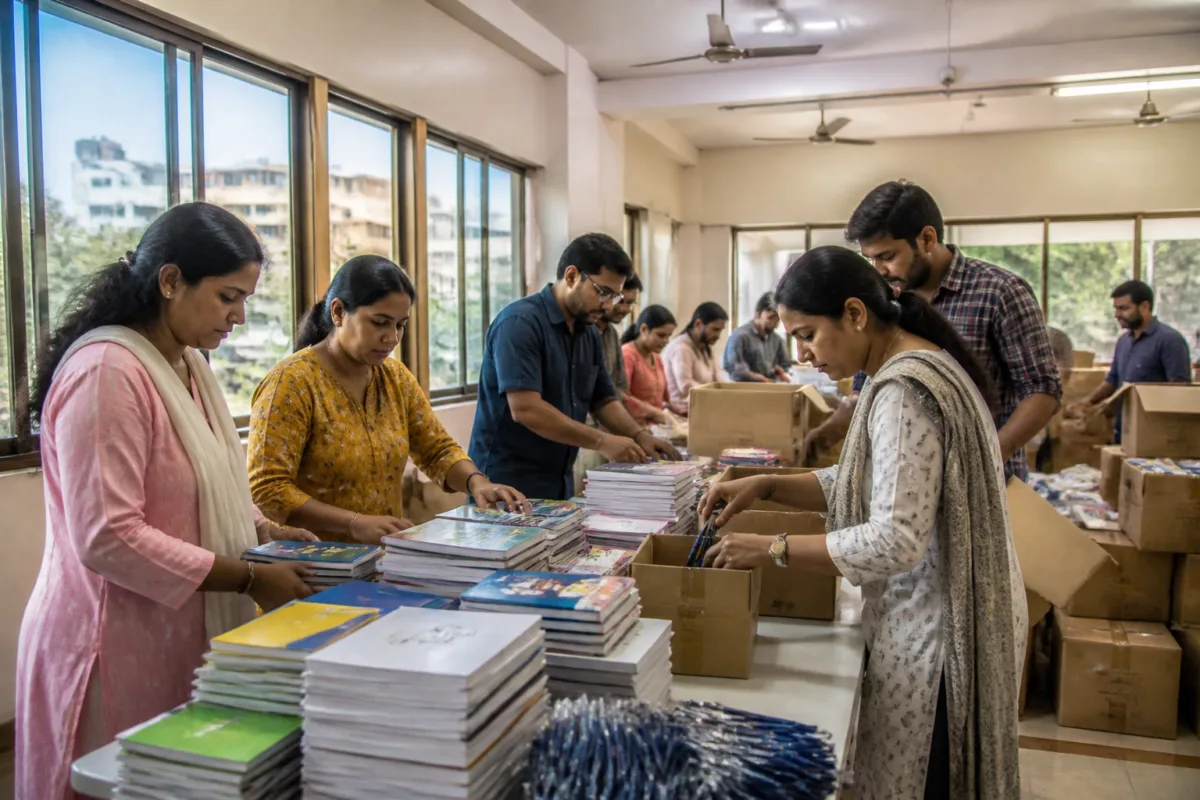
A Pune Ganeshotsav campaign that collected 36,000 notebooks and more than 20,000 pens for schools in drought-prone and underserved parts of Maharashtra is more than a story about charitable giving. It reveals how a household crisis involving food, water and income can reach the classroom, while also showing how informal civic networks step in when families cannot easily meet the everyday costs of education.
The ‘Bappa Charni Ek Vahi Ek Pen Arpan’ initiative, run by Navgrah Mitra Mandal in Kasba Peth, began in 2017 with 24 notebooks. By 2025, the collection had reached 5,500 notebooks. This year’s much larger response came after wider media and social media outreach, with donations arriving from across India and 11 countries. The supplies are now being distributed through teachers, grassroots organisations and schools in districts including Beed, Dhule, Chandrapur and Wardha, with further distribution planned in Marathwada, Vidarbha and parts of western Maharashtra.
The immediate problem is simple but consequential. According to organiser Aniket Mundada, families facing drought are forced to prioritise essential household needs, leaving notebooks and pens to be purchased later or not at all. For a student, that shortage is not merely a question of having the right stationery. It can shape whether the child enters the academic year equipped to participate in classroom work.
The source report does not establish how many children in drought-affected areas lack school supplies, nor does it quantify the effect of the campaign on attendance or learning. What it does document is the chain linking household stress to school readiness. The initiative’s design responds to that narrow but tangible gap: donors are encouraged to replace traditional offerings at a Ganesh pandal with items that can be used by children in schools.
That distinction matters because the campaign is not presented as a substitute for public education provision. Its organisers are identifying schools through teachers and grassroots organisations, verifying requests by telephone and, where possible, visiting the institutions before deciding where supplies should go. The distribution therefore depends on local knowledge that can connect a city-based collection to schools in districts facing different forms of deprivation.
By October 28, material had reached 12 schools in Vidarbha and two each in Dhule and Beed. Supplies were also sent to schools associated with Anandwan, Somnath Prakalp, Maharogi Seva Samiti and Lok Biradari Prakalp in Chandrapur and Wardha. Zilla Parishad schools in Shindkheda taluka in Dhule and Shirur-Kasar taluka in Beed had also received educational material.
The next phase is expected to cover Zilla Parishad schools in Latur, Beed and Parbhani in Marathwada; Chandrapur, Wardha and Nagpur in Vidarbha; Dhule; and parts of western Maharashtra. The organisers said around 40 more schools were expected to receive supplies in the coming days. These locations show the campaign’s shift from a neighbourhood donation drive to a distributed support network spanning several regions of the state.
The geography is important. The collection happens in Pune, but the need identified by the organisers lies largely outside the city. Pune’s pandal, media networks, content creators, donors and quick-commerce deliveries have become the mobilisation infrastructure, while teachers and local organisations in recipient districts provide the information required for distribution. The model is therefore built on a division of roles between an urban donor base and rural or regional institutions that understand local school needs.
The campaign’s expansion also demonstrates the power and limits of visibility. Organisers said a Times of India report encouraging devotees to bring notebooks and pens instead of flowers generated around 2,000 calls and messages. More than 150 content creators were approached before Ganeshotsav, and 30 agreed to produce reels without charging a fee. Contributions came from countries including Japan, Qatar, the United Arab Emirates, Ireland, the United States and the United Kingdom.
A contribution coordinated by the South Sydney Indian Association raised 700 Australian dollars and helped procure stationery from Navneet Education. The company reportedly supplied the material at reduced rates and donated 72 notebooks after one of its representatives visited the mandal. These details show how a local campaign can acquire a wider operational footprint when publicity, diaspora participation and commercial support align.
They also expose a problem that is often hidden by impressive collection figures: collecting material is easier than storing, verifying and distributing it. The organisers said requests from schools and donations from individuals continued to arrive, while storage space was running short. Some contributions had to be placed on hold because there was not enough room to store the quantities already received. Donor details were recorded so that contributors could be contacted when the new academic year begins.
This logistical pressure is not a minor administrative inconvenience. It is the point at which goodwill must become a functioning delivery system. A notebook has value only when it reaches the right school, at the right time and in usable quantities. The campaign’s decision to verify requests and maintain donor records indicates an attempt to create that system, but the storage constraint shows that community initiatives can outgrow the physical and organisational capacity with which they began.
The campaign’s history makes that transition visible. In 2017, a collection of 24 notebooks could be managed as a small pandal activity. In 2025, the campaign had collected 5,500 notebooks. In the current year, the reported total rose to 36,000 notebooks and more than 20,000 pens. Growth at that rate changes the nature of the work. It requires inventory management, school identification, transport coordination, donor communication and timing around the academic calendar.
The initiative also sits between two different kinds of response to drought. The first is immediate household coping, in which families prioritise food, water and other essentials. The second is institutional and community support, which attempts to prevent that pressure from reducing a child’s ability to participate in school. The stationery campaign addresses one visible consequence of financial stress, but the source material does not show whether the same families face other barriers such as transport, fees, nutrition or irregular attendance. Those questions remain outside what this campaign can establish.
What the campaign does establish is that education access is affected by conditions beyond the school building. The recipient institutions include Zilla Parishad schools and schools linked to grassroots organisations, suggesting that the supply chain is reaching public and community-supported education settings rather than only private institutions. The organisers’ reliance on teachers to identify need further indicates that classroom-level knowledge is central to directing assistance.
The institutional arrangement is consequently mixed. The mandal mobilises donations; media and content creators expand public participation; a stationery company contributes through discounted and donated supplies; teachers and grassroots organisations identify recipient schools; and the schools receive and distribute the material. No single actor controls the entire chain. Its effectiveness depends on coordination among all of them.
That arrangement raises a larger governance question without diminishing the value of the campaign: how should informal assistance connect with formal public systems? The source report does not describe a government programme linked to the collection, nor does it provide a state-level assessment of stationery shortages in drought-affected schools. It does show that private citizens and local organisations are responding to a need that they can see directly, while building their own verification and delivery process.
The most significant evidence is therefore not only the 36,000 notebooks collected. It is the progression from 24 notebooks to a multi-district operation, and the fact that the campaign’s success has created new capacity problems. The story demonstrates both the reach of civic mobilisation and its dependence on practical systems for storage, verification and distribution.
For Pune, the campaign offers an example of how an urban civic space can become a channel for support far beyond the city. For drought-prone districts, it records one way in which local schools and organisations are trying to reduce the immediate financial burden on families. For policymakers and education administrators, it leaves a more difficult question: whether essential learning materials should depend on seasonal campaigns, or whether formal systems can identify and address such needs before they become visible through charity drives.
The available evidence confirms that the initiative has expanded sharply, reached schools across multiple districts and encountered the logistical pressures of scale. It does not establish the campaign’s measurable effect on attendance or learning, or the total number of children who will benefit. The next developments to monitor are the planned distribution to around 40 additional schools, the organisers’ storage arrangements and whether the supplies reach schools before the new academic year begins.

