


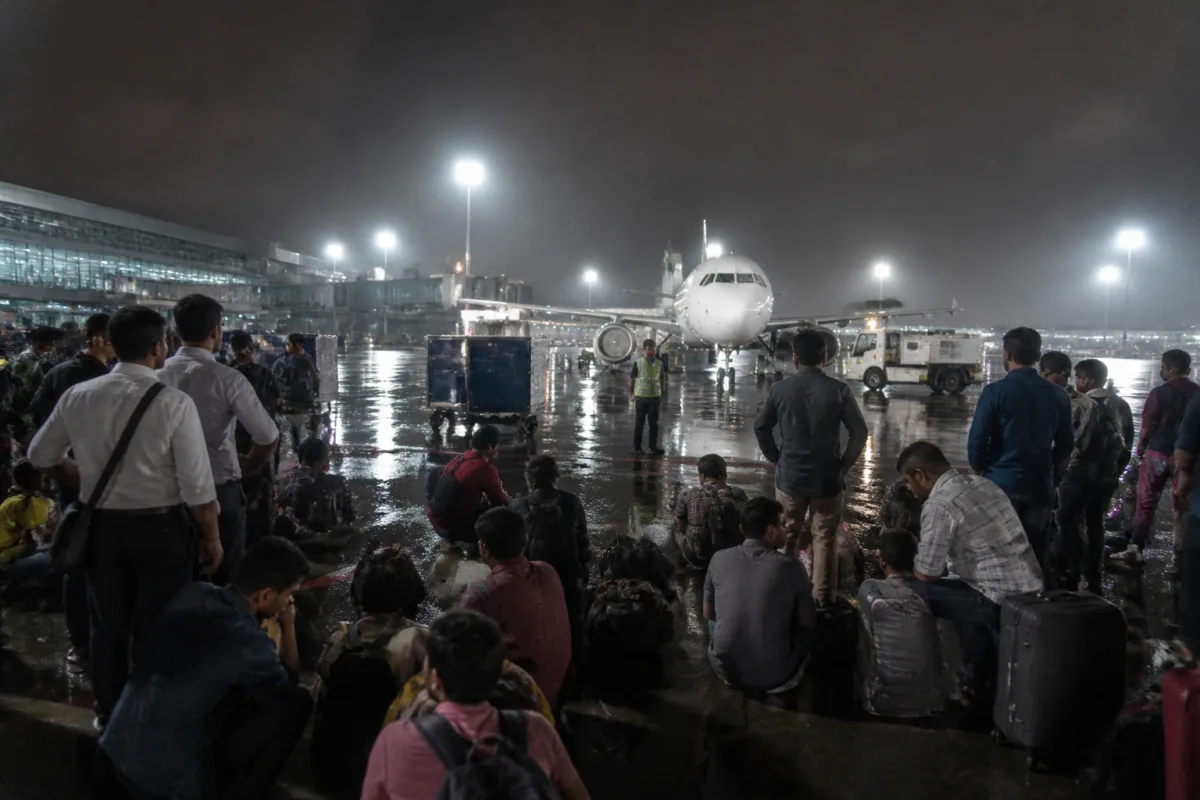
The cancellation of a SpiceJet service from Mumbai to Gorakhpur after passengers had reportedly boarded and completed safety procedures has raised questions about how airline schedules are coordinated with operating restrictions at destination airports. The incident, reported by Navbharat Times, also highlights the practical consequences for passengers when a flight disruption is communicated only after they have entered the aircraft.
The flight was cancelled late on 1 November after repeated delays, according to the report. Passengers were asked to leave the aircraft and were seen waiting on the airport apron near the plane. Videos shared on social media showed travellers sitting or standing near the aircraft, while some passengers described confusion and distress. The report said children were seen crying and passengers were heard objecting to the way the disruption was handled.
SpiceJet attributed the cancellation to operating-hour restrictions at Gorakhpur airport. The airline said Gorakhpur is a defence airport where aircraft operations are not permitted after 9 pm. Because the service could not reach the airport within the permitted operating window, the flight was cancelled, the report said. SpiceJet apologised for the inconvenience and stated that an additional commercial flight had been scheduled for 2 November to carry the stranded passengers.
The stated reason places the incident within a larger operational problem faced by airports that combine civilian passenger services with defence or other restricted-use functions. At such airports, an airline’s departure decision is linked not only to aircraft availability and crew scheduling but also to the remaining operating time at the destination. A delay in Mumbai can therefore become a cancellation when the arrival airport has a fixed closing time.
The supplied report does not establish when SpiceJet first became aware that the flight might miss Gorakhpur’s operating window. That question is central to understanding the passenger experience. One passenger alleged that the departure time had been changed several times, after which travellers were permitted to board, attend the safety briefing and remain inside the aircraft for about an hour before the cancellation was announced. This allegation has not been independently confirmed in the supplied material.
The distinction between a legitimate operating restriction and the handling of that restriction is important. A destination airport may be unable to accept a flight after its permitted hours, but passengers still need timely information about the risk of cancellation, alternatives for travel and arrangements for food, accommodation or onward transport where applicable. The report focuses on the fact that passengers were allowed to board before being asked to disembark, but it does not provide a detailed account of what assistance was offered at Mumbai airport.
The videos described in the report offer a ground-level view of the disruption. Passengers were not simply waiting for a delayed departure inside a terminal. They were shown near the aircraft on the apron after being removed from the flight. The report says that a passenger alleged the pilot and crew members left after announcing the cancellation. That allegation is attributed to the passenger’s social-media post and is not presented as independently verified evidence of the crew’s actions.
This difference between official explanation and passenger experience is common to airport disruptions. Airlines generally communicate cancellations through operational reasons such as weather, technical issues, crew constraints or airport restrictions. Passengers experience the same event through waiting time, uncertainty, missed connections and the availability of immediate support. When the explanation arrives after boarding, the operational cause may be technically clear while the administrative process remains difficult for travellers to understand.
The incident also raises questions about coordination between the airline, the departure airport and the destination airport. If a service is repeatedly delayed, the airline must assess whether the remaining time is sufficient for departure, flight duration, landing and any restrictions applicable at the destination. The report does not contain the flight’s original departure time, the revised timings, the expected flight duration or the precise time at which the cancellation decision was taken. Without those details, it is not possible to determine whether the decision was made at the earliest practical point or after the operational margin had already narrowed.
The report further contains inconsistent references to the flight number. Its headline identifies the service as SG533, the main article refers to SG553, and a passenger is quoted in a video as referring to SG335. This discrepancy affects the identification of the flight and prevents the incident from being treated as fully established without checking the airline’s flight records, airport information or passenger documents. The article also uses differing spellings for the passenger whose video was cited, creating an additional attribution issue.
No passenger count is supplied in the report, and the total number of people affected is not established. The material also does not state whether passengers were provided with hotel accommodation, meals, refunds, rebooking or ground transport. It says only that SpiceJet scheduled an additional commercial flight for 2 November and apologised for the disruption. The operating status and passenger load of that replacement service are not included.
The event is therefore significant less because it represents an unusual flight delay than because it exposes the chain of decisions that connects airport operating restrictions to passenger protection. A restriction at the destination can be a fixed institutional condition, particularly where defence-airport rules apply. The airline’s responsibility lies in incorporating that condition into scheduling decisions and communicating changing risks before passengers complete the boarding process.
For passengers, the most visible failure is the absence of certainty. A delayed flight can be managed when travellers receive regular updates and clear alternatives. A cancellation after boarding produces a different situation: passengers have already surrendered time, may have travelled to the airport, and may be carrying children, medicines or checked baggage. If they are then moved to an apron or another waiting area, the quality and timing of assistance become as important as the original operational reason.
The available evidence does not establish whether any aviation regulator, airport operator or passenger-rights authority reviewed the incident. It also does not include a detailed statement from Mumbai airport or Gorakhpur airport. Those responses would be necessary to determine how the operating-hour restriction was communicated, whether the flight was cleared to depart within the available window and what procedures governed the passengers’ movement after cancellation.
What the supplied material confirms is that SpiceJet attributed the cancellation to Gorakhpur’s 9 pm operating restriction, passengers had reportedly boarded before the cancellation was announced, videos showed travellers waiting near the aircraft, and the airline said an additional flight would operate on 2 November. What remains unresolved is the correct flight number, the exact sequence of revised timings, the assistance provided to passengers and whether the airline’s planning complied with applicable passenger-handling requirements. Those details should be verified through the airline, airport authorities and official flight records before the incident is treated as conclusively documented.

