


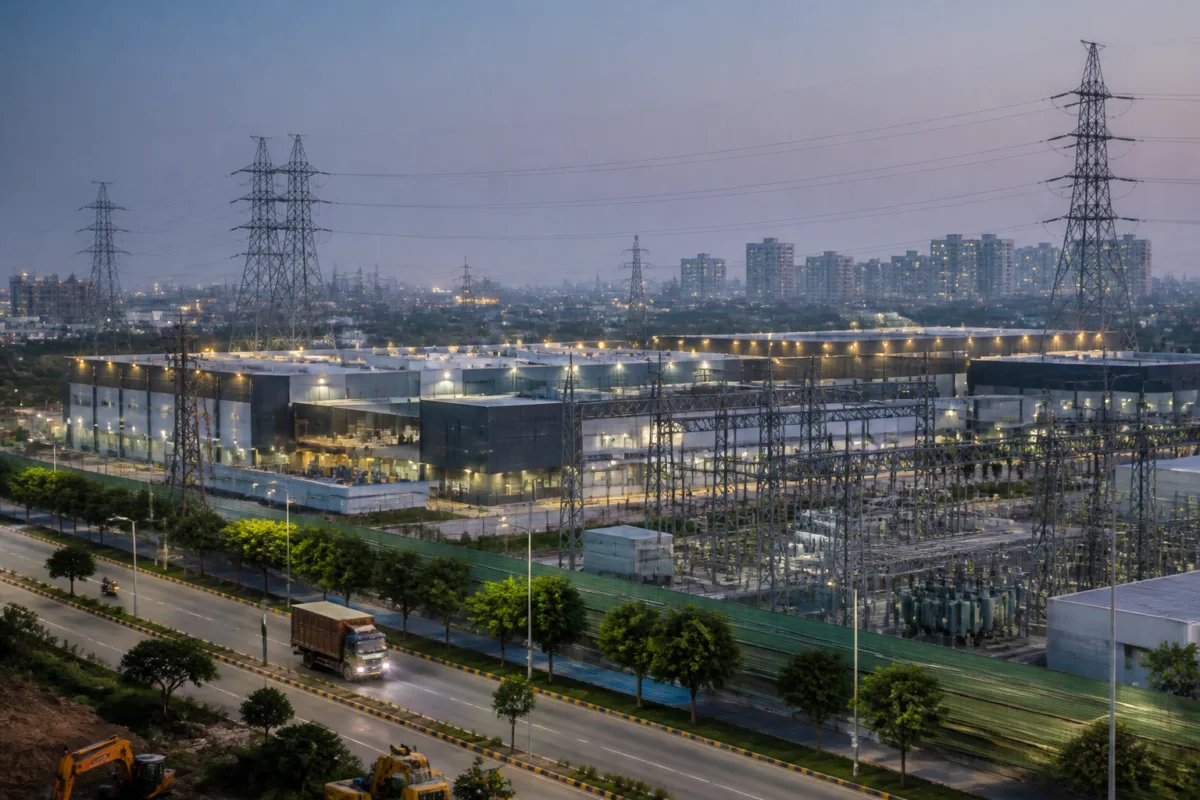
Adani Group’s reported effort to raise about $1.5 billion for data-centre expansion is more than a corporate financing story. It is a signal of how India’s next infrastructure cycle is being assembled around computing capacity, energy supply and access to large pools of capital. The proposed loan, if completed, would help AdaniConneX expand its facilities at a time when conglomerates are competing to build the physical backbone for cloud services and artificial intelligence.
According to the Economic Times report, AdaniConneX Pvt., the joint venture between Adani Group and data-centre operator EdgeConneX, is discussing an offshore facility with several lenders. The talks reportedly include DBS Group Holdings, First Abu Dhabi Bank and Mitsubishi UFJ Financial Group, as well as Natixis, ING Bank and Societe Generale. The people familiar with the matter asked not to be identified because they were discussing private information.
The proposed financing has not been finalised. Discussions over pricing are continuing, and the loan could have a tenor of five to seven years, the report said. The banks named in the report either declined to comment or did not respond to requests for comment, while Adani Group also did not reply to emails seeking comment. That makes the reported transaction a financing proposal rather than a completed investment commitment.
Even at that stage, the size and structure of the proposed borrowing point to the capital intensity of data-centre development. These facilities require more than server halls. They depend on reliable electricity, cooling systems, land, fibre connectivity, backup capacity and long-term operating arrangements. Financing therefore becomes a central part of the infrastructure question: whoever can mobilise capital at scale can pursue larger sites, build more capacity and secure supporting energy and network systems.
AdaniConneX’s latest reported funding effort follows an $800 million data-centre loan secured months earlier, according to the report. That earlier facility had an 18-month duration. The new proposal, with a possible five-to-seven-year tenor, would represent a different financing horizon if it proceeds. Longer-tenor debt can be aligned more closely with large infrastructure projects, although the supplied material does not establish the final terms, pricing or intended allocation of the proposed facility.
The company’s reported financing plan sits within a much larger expansion ambition. Adani Group plans to invest about $100 billion in data centres and other digital infrastructure by 2035, building on its existing energy business. Reliance, led by Mukesh Ambani, is separately reported to be planning as much as $110 billion over seven years for artificial-intelligence-related infrastructure. Together, these plans show that India’s data-centre market is increasingly being shaped by diversified conglomerates with interests spanning energy, telecommunications, industrial assets and finance.
That combination matters because data centres are unusually dependent on the wider urban and regional infrastructure system. A conventional commercial building can often be evaluated primarily through land, construction and occupancy. A data centre must also be assessed through its power demand, cooling requirements, network redundancy and ability to operate continuously. The expansion of such facilities can therefore alter demand for electricity generation, transmission links, industrial land and high-capacity fibre routes, even when the server buildings themselves are located outside major city centres.
The Economic Times report says the Indian government expects data-centre capacity to rise to nearly 8 gigawatts by 2030, from about 1.57 gigawatts in August 2026. It also cites estimates that the sector could attract roughly $200 billion of investment over the next seven to eight years. These figures describe a market moving from a relatively specialised digital-services segment towards a major infrastructure category. They also indicate the scale of the gap between existing capacity and the capacity being contemplated.
The reported numbers should be read as projections and market estimates rather than evidence that the capacity or investment has already been delivered. The proposed Adani facility remains under discussion, and the supplied report does not provide a project-by-project breakdown of the government’s capacity estimate, the geographic distribution of future facilities or the source of the projected investment total. Those details will be important for understanding how the national expansion translates into local construction and infrastructure demand.
The most immediate institutional issue is the relationship between digital growth and energy planning. Adani Group’s data-centre ambitions build on its energy business, while the report separately describes a broader corporate focus on digital infrastructure. This linkage reflects the operational reality of data centres: their value depends on uninterrupted power, and their costs and environmental footprint are closely connected to the energy systems serving them. The report does not specify the power sources, locations or electricity arrangements for the proposed expansion, so the infrastructure consequences cannot yet be assessed in detail.
Financing also shapes who can participate in the market. The proposed offshore facility would involve international lenders, while the list of banks reportedly in discussions spans institutions headquartered in Asia, the Middle East and Europe. Such a structure suggests that data-centre development is being treated as an infrastructure-finance opportunity rather than solely as a technology-sector investment. For Indian cities and regions, that can bring faster access to capital for large projects, but it also means that decisions about land, power and network capacity may be made through long-duration financial commitments.
The market is being driven by demand for cloud services and artificial intelligence. The report describes the broader push as a race among conglomerates to build the computing capacity required for those services. This makes data centres part of the physical foundation of the digital economy. Artificial intelligence may be experienced through software applications, but the underlying systems require buildings, electricity, cooling, data transmission and maintenance networks. The construction and operation of these facilities therefore connect technology policy directly with the built environment.
There is also a geographic question that the supplied material leaves open. The report does not identify the locations of the proposed AdaniConneX expansion or explain whether the new capacity would be concentrated in established data-centre markets or distributed across additional regions. That distinction would affect local planning requirements, water and power demand, road access for construction and maintenance, and the availability of supporting digital networks. A national capacity target alone cannot show how evenly these pressures will be distributed.
India’s projected increase from about 1.57 gigawatts of data-centre capacity in August 2026 to nearly 8 gigawatts by 2030 represents an expansion of roughly five times over the period described in the report. The comparison illustrates the scale of the proposed market transformation, but it does not by itself establish how much capacity will be built by AdaniConneX, Reliance or other operators. It also does not clarify how much of the expected investment would go into new construction, equipment, energy systems or related digital infrastructure.
For municipal and regional authorities, the growth of data centres raises an administrative challenge: these projects may look like private technology developments while relying on public systems. Their operation depends on roads, transmission infrastructure, telecommunications networks, water or cooling arrangements and approvals for industrial or commercial land. The supplied report does not detail the approval framework or public incentives involved, but the scale of the investment estimates indicates that coordination across energy, land-use and digital-infrastructure institutions will be significant.
The central urban question is therefore not simply how much computing capacity India can add. It is how that capacity will be physically supported, financed and distributed. Adani’s reported $1.5 billion financing discussions show the role of debt in accelerating the build-out, while the company’s longer-term investment plan and Reliance’s parallel ambitions show the competitive scale of the market. But the information currently available does not establish the final financing terms, project locations or implementation schedule.
The next useful evidence will be a completed financing announcement, details of the facilities covered by the proposed loan and clearer information on the energy and network systems serving them. Until then, the report confirms a major financing push and a rapidly expanding national ambition, while leaving the local infrastructure consequences to be established through project-level disclosures.

