


The arrest of Pimpri-Chinchwad Municipal Corporation’s water supply chief engineer Pramod Ombhase in a bribery case has shifted attention from one alleged transaction to a much larger question: how the city plans, distributes and certifies access to water. Housing societies, activists and ruling BJP corporators are now seeking a comprehensive inquiry into the water department’s functioning, including tanker dependence, permissions for new construction and the financial management of civic works.
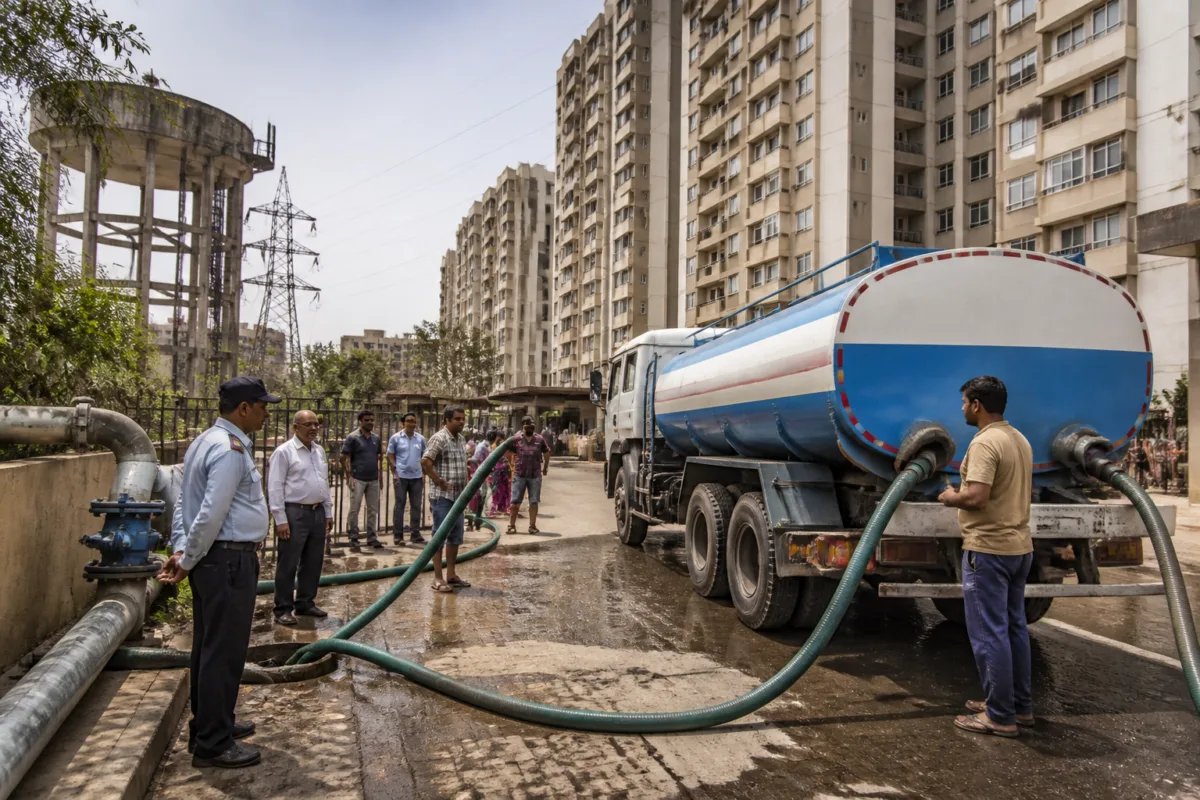
The immediate controversy is significant because water scarcity in Pimpri-Chinchwad is not being described only as a seasonal inconvenience. The Pimpri-Chinchwad Housing Societies Federation has said several societies have depended on private tankers for years because civic supply is inadequate. PCMC is supplying water on alternate days, while some housing societies are reportedly spending lakhs of rupees every month to meet daily requirements through private suppliers.
That combination creates two parallel water systems within the same city. One is the formal municipal network, governed by civic schedules and distribution arrangements. The other is a privately purchased emergency network used by residents when the first system does not meet demand. The source report does not establish the precise share of households dependent on tankers, but the demands for a white paper indicate that residents and civic representatives believe the existing public information is insufficient to explain how available water is being allocated.
## Why the demand for a white paper matters
The federation has written to the chief minister and the municipal commissioner seeking a white paper on Pimpri-Chinchwad’s water supply system. It wants the document to detail the city’s available water resources, supply arrangements and distribution network. It has also sought scrutiny of water supply planning over several years, the distribution of available water, permissions granted to new construction projects and financial transactions within the department.
A white paper, if ordered and made public, would move the debate beyond the conduct of individual officials. It could provide a consolidated account of how much water the civic body has access to, how that water moves through the distribution network, which areas receive scheduled supply and where gaps persist. The report does not say that such a document has been commissioned, nor does it provide the city’s total water availability or demand. Those absences are central to the current dispute because they make it difficult for residents to assess whether the problem is inadequate supply, weak distribution, rapid growth, poor monitoring or a combination of these factors.
The federation president, Sachin Londhe, questioned the basis on which the civic body issues affidavits and certificates assuring water availability to new construction projects while the city faces what he described as acute water scarcity. This raises an important planning issue: whether approvals for additional housing and construction are being assessed against actual, deliverable water capacity or against administrative assurances whose implementation is not visible at the neighbourhood level.
The source report does not establish that any certificate was improperly issued or that a particular project lacked lawful water approval. Londhe’s demand is for an investigation into the process itself. That distinction matters. The current public record, as supplied, contains allegations and demands for inquiry, not findings that construction permissions or water certificates were illegal.
## Tankers turn a civic shortfall into a household expense
Private tankers are often treated as a temporary response to a supply disruption. The account from Pimpri-Chinchwad, however, describes a longer-running dependence among several housing societies. When societies purchase water for years, the cost is no longer merely an emergency expense. It becomes part of household maintenance charges and shifts the financial burden of water provision from the public system to residents.
The report does not provide the number of tankers operating in the city, the price per delivery, the volume supplied, or the societies that rely on them. It does, however, identify tanker operations and water distribution as areas that the housing federation wants examined. That demand points to a basic governance requirement: a city must know not only how much water enters its system but also how much is delivered through formal networks and how much is procured privately because the formal network is insufficient.
The absence of those figures limits any conclusion about the scale of the crisis. It also shows why a public account of the system would be valuable. Without information on sources, capacity, schedules, distribution zones and tanker demand, residents cannot easily distinguish between a city-wide shortage and uneven service delivery between localities.
The allegations also connect the water issue to the city’s growth. Londhe has sought an investigation into permissions given to new construction projects, while activist Maruti Bhapkar has demanded scrutiny of works undertaken under Ombhase’s supervision. Bhapkar has put the value of those projects at between Rs 2,500 crore and Rs 3,000 crore. The report attributes this figure to him and does not independently establish the value, scope or performance of those works.
That attribution is important because the figure should not be treated as a confirmed finding of wrongdoing. The demand for an audit nevertheless broadens the policy question. Water infrastructure is not only about building pipelines or managing daily supply. It is also about ensuring that the approval of new development, the expansion of networks and the allocation of public funds are aligned with the city’s ability to provide reliable service.
## The arrest has exposed an accountability chain
The arrest has also prompted criticism from within the ruling BJP. Corporator Sheetal, alias Veejay Shinde, alleged that corruption was not confined to the water supply department and demanded an inquiry into 12 instances in which he claimed irregularities had occurred. He further said that at least 12 PCMC officials had been arrested by the Anti-Corruption Bureau for allegedly demanding or accepting bribes since the current municipal commissioner took charge.
These claims are attributed to Shinde. The supplied report does not provide the names of the other officials, the dates of the alleged arrests, the departments involved or the status of those cases. They therefore require separate verification before being used as a complete assessment of PCMC’s institutional integrity. What can be established from the report is that the arrest has led to a wider political and civic demand for an impartial inquiry.
Shinde alleged a nexus involving civic officials, contractors and builders and called the administration unaccountable. He also demanded punitive and criminal action against those found guilty, along with stop-work notices against unauthorised activities. The report does not establish such a nexus or identify specific unauthorised projects. Those are allegations that would need to be tested through official investigations, records and due legal process.
The institutional question is therefore not whether the arrest alone proves a systemic failure. It does not. The more relevant question is whether the city’s existing oversight mechanisms can examine the complete chain connecting planning, approvals, infrastructure works, water distribution, contractor payments and citizen complaints. Bhapkar said he had raised concerns about alleged irregularities involving Ombhase and his associates in 2024, but that the matter was not pursued despite an initial inquiry. That claim, too, is presented in the source as his allegation and is not accompanied by the earlier complaint or an official response.
## What remains unestablished
The current account identifies several areas requiring clarification but does not resolve them. It does not state the total volume of water available to PCMC, the city’s assessed demand, the reason for alternate-day supply, the number of affected housing societies or the distribution losses in the network. It also does not establish whether the alleged irregularities occurred, whether any construction project received an improper water assurance, or whether the works cited by Bhapkar contain financial or technical violations.
There is also no response in the supplied report from PCMC, the municipal commissioner, the Anti-Corruption Bureau or the chief engineer addressing the allegations and demands. Their responses would be necessary to establish what action has already been taken, whether internal records are being reviewed and how the civic body assesses water availability for new development.
That gap is especially relevant because the debate is moving rapidly from an individual bribery case to the credibility of the entire water administration. A public inquiry should distinguish confirmed facts from allegations, identify the documents examined and state which officials or agencies are responsible for each decision. Without that separation, the city risks treating every water problem as evidence of corruption, or treating an individual arrest as sufficient accountability for a wider service failure.
For Pimpri-Chinchwad, the immediate public-interest issue is whether residents can obtain a clear account of the water system they depend on. The demands now before the chief minister, municipal commissioner and Anti-Corruption Bureau seek that account through a white paper, investigations into departmental functioning and scrutiny of past works and approvals. The next significant developments will be whether the civic administration orders an impartial inquiry, responds to the allegations and publishes verifiable information on supply, distribution, tanker dependence and construction-related water assurances.

