


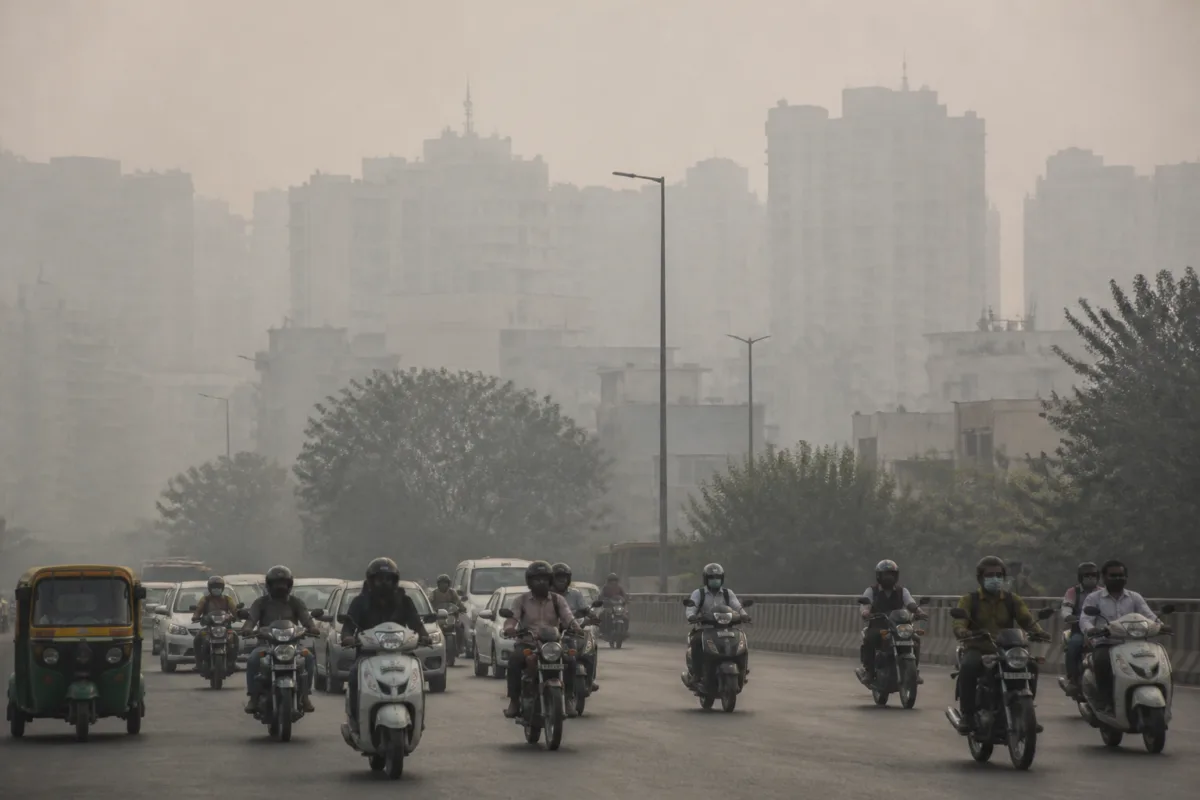
Delhi’s air quality deteriorated sharply on Sunday, with the Air Quality Index (AQI) reaching 349 near Akshardham and ITO and 335 around India Gate and Janpath, according to the latest Central Pollution Control Board (CPCB) readings issued before 7 am. The deterioration came just before Diwali and on the first day of new pollution-control restrictions in Delhi-NCR.
The AQI readings placed several parts of the capital in the ‘very poor’ category. Under the CPCB classification, an AQI between 301 and 400 is considered very poor, while readings from 401 to 500 fall in the severe category. The levels recorded around Akshardham and ITO were therefore close to the upper limit of the very poor band.
Delhi’s average AQI rose to 261 on Sunday, an increase of 144 points from 117 recorded a day earlier. The report said this was the most polluted day of the season so far and the highest reading in the capital since July 12, when the AQI stood at 261. On October 21, Delhi’s air index had been recorded at 245.
The deterioration was reported despite rainfall over the previous two days, which had temporarily brought relief from pollution. Of Delhi’s 57 monitoring stations, 23 recorded AQI levels above 300 on Sunday. The CPCB said pollution was expected to increase further during the week, with air quality likely to reach the very poor category.
The change coincided with the implementation of new restrictions to address pollution in Delhi-NCR from November 1. The available report does not specify the individual measures covered by the restrictions, but the timing places the latest deterioration at an early test of the region’s pollution-control response before the festival period.
Weather conditions also reflected the seasonal transition that can affect visibility and the movement of pollutants. Delhi began November with light fog and a slight reduction in visibility. Visibility was recorded at 1,600 metres at Safdarjung and 1,500 metres near Palam at the Indira Gandhi International Airport.
The minimum temperature on November 1 was 18 degrees Celsius, 1.9 degrees below normal and the lowest for the date since 2023, when it was 16.4 degrees Celsius. The maximum temperature was 29 degrees Celsius, two degrees below normal and the lowest for November 1 since 2021, when it reached 27.2 degrees Celsius. The India Meteorological Department said no significant temperature change was expected over the following week.
The CPCB’s monitoring figures show how quickly Delhi’s air quality shifted from the moderate range to very poor conditions. With pollution expected to rise further and Diwali approaching, the next set of monitoring readings and the implementation of the restrictions will determine whether the deterioration continues across the capital.

