


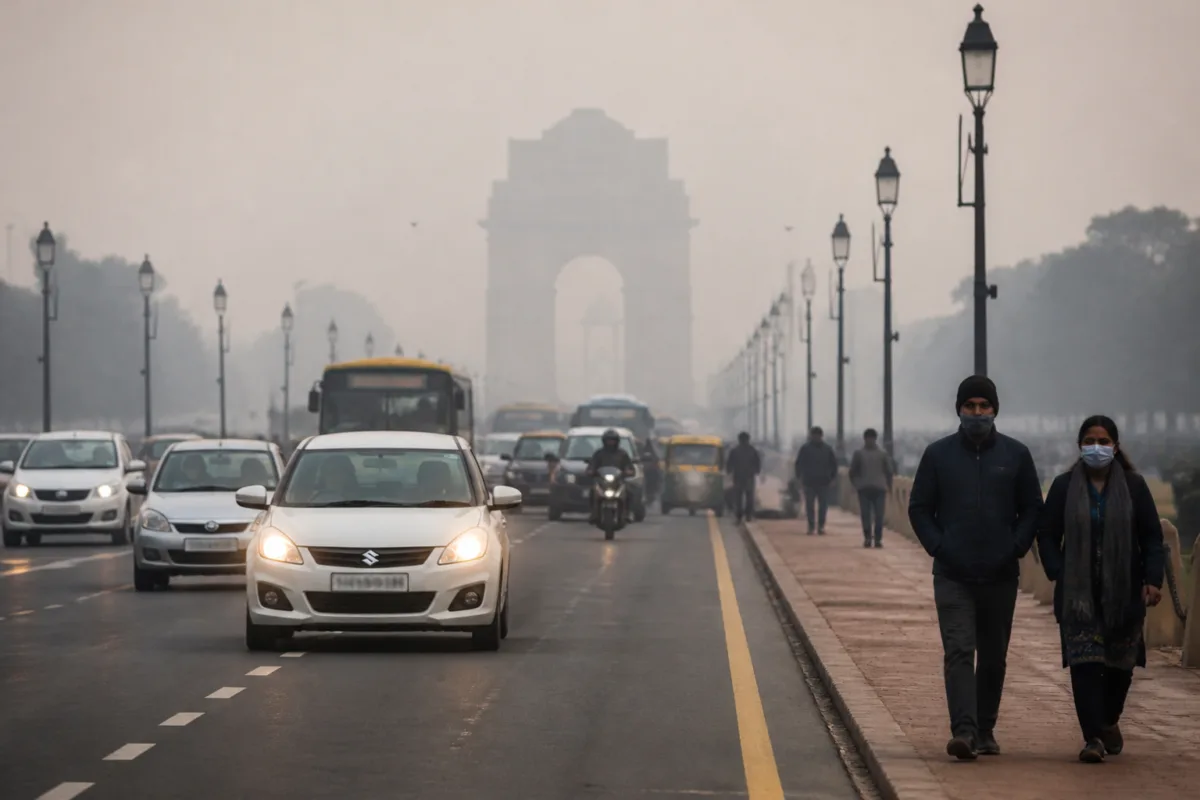
Delhi’s air quality deteriorated sharply on Sunday, with the AQI reaching 349 around Akshardham Temple and ITO and 335 near India Gate and Janpath, according to the latest readings issued by the Central Pollution Control Board (CPCB). The deterioration came on the first day of new pollution restrictions in Delhi-NCR and after two days of relative relief caused by rain.
The readings recorded before 7 am placed air quality in the CPCB’s ‘very poor’ category, which covers AQI levels from 301 to 400. The agency classifies an AQI of 0-50 as ‘good’, 51-100 as ‘satisfactory’, 101-200 as ‘moderate’, 201-300 as ‘poor’, 301-400 as ‘very poor’ and 401-500 as ‘severe’.
Delhi’s average AQI rose by 144 points in a single day, from 117 a day earlier to 261 on Sunday, according to the report. Of the capital’s 57 monitoring stations, 23 recorded AQI readings above 300. The Sunday reading was described as the highest of the season so far and the highest since July 12, when Delhi’s AQI was recorded at 261.
The deterioration followed a broader rise in pollution levels during the start of November. On October 21, Delhi’s air index was 245. CPCB data cited in the report indicated that pollution could increase further during the week, potentially pushing the city’s air quality deeper into the ‘very poor’ category.
The change was particularly sharp because Delhi had experienced some improvement after rainfall during the preceding two days. The return of high AQI readings shows how quickly the city’s air-quality conditions can worsen when seasonal weather conditions change and pollution dispersal becomes less effective. The supplied report does not identify the contribution of individual emission sources to the latest rise.
New restrictions to address pollution in Delhi-NCR came into force on November 1. However, air quality had already worsened on the first day of their implementation. The report does not specify which individual restrictions were enforced or provide details of any enforcement action linked to the readings.
Weather conditions also contributed to the morning’s urban environment. Light fog reduced visibility across parts of Delhi, with visibility recorded at 1,600 metres at Safdarjung and 1,500 metres near Palam, close to Indira Gandhi International Airport. The minimum temperature on November 1 was 18 degrees Celsius, 1.9 degrees below normal, while the maximum temperature was 29 degrees Celsius, two degrees below normal.
The minimum temperature was the lowest recorded for November 1 since 2023, when it was 16.4 degrees Celsius. The maximum temperature was the lowest for the date since 2021, when it stood at 27.2 degrees Celsius. The weather department said temperatures were not expected to change significantly over the following week. The next stage of the pollution episode will therefore be reflected in CPCB’s daily station-level readings and the implementation of the restrictions already announced for the region.

