


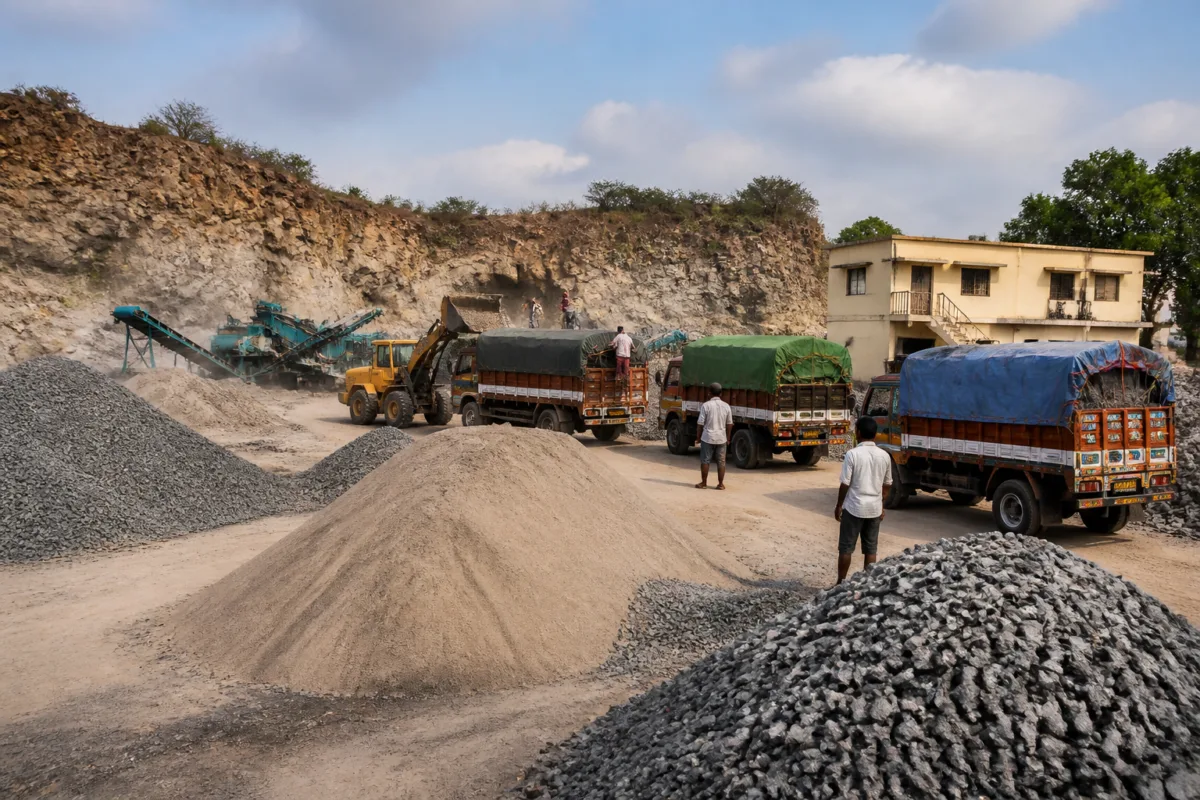
Tamil Nadu’s plan to create a public-sector company for selling sand, M-sand, crushed stone and gravel is more than a new procurement channel. As reported by Dinamalar, the Mineral Resources Department intends to bring mineral sales under an online system and use a government-controlled corporate structure to manage quarry selection, extraction, value addition, marketing and distribution. The proposal places the state’s construction-material supply chain at the centre of a wider administrative question: can digital sales and a new institutional framework reduce leakage without creating another layer of bureaucracy?
The proposed company follows a period of uncertainty around the sale of river sand. Tamil Nadu had earlier created a dedicated online platform under the Water Resources Department, allowing lorry owners to pay online and collect sand at an allotted time. According to the report, the system was intended to organise access and reduce uncertainty for vehicle operators. However, the movement of sand from quarries to yards relied on private contractors, and alleged irregularities led to legal cases that affected the operation of sand quarries.
That history is important because the proposed company is not being presented as a standalone commercial venture. It is being designed against a background of disputes over extraction, transport, permits and sales. The Water Resources Department has not yet taken a clear decision on the next phase of the river-sand system, the report said. The Mineral Resources Department’s proposal therefore appears to address a broader group of materials rather than river sand alone.
M-sand, crushed stone and gravel currently move through more fragmented channels. The report said M-sand is sold directly by producers, while crushed stone and gravel are sold from quarries through private owners. The Mineral Resources Department believes irregularities can arise at several stages, beginning with the issue of permission slips. Its proposed response is to shift the entire sales process online and place the commercial functions within a new public-sector company.
The institutional design described by the department combines administrative control with corporate-style operations. An unnamed department official told Dinamalar that the company would remain under the administrative control of the Mineral Resources Department but would operate like a corporate entity in response to market conditions. Its responsibilities would include selecting quarry locations, extracting minerals, adding value, marketing and selling the materials.
This division of roles will determine whether the new system can meet its stated objectives. A department-controlled company could allow the government to coordinate decisions that are currently distributed among quarry owners, contractors, producers, transporters and separate administrative processes. It could also create a single point through which material availability, pricing, payments and dispatches are recorded.
At the same time, centralisation does not automatically resolve the problems identified in the existing system. The report does not provide details of the company’s proposed capital structure, pricing formula, procurement model, quarry-wise production capacity, tendering process, technology architecture or enforcement mechanism. It also does not state whether private quarry owners and M-sand producers will sell through the company, supply it under contracts or continue to operate independently within the online platform.
Those details matter because construction materials are not interchangeable commodities from an administrative perspective. Sand, M-sand, crushed stone and gravel have different production processes, sources, transport requirements and quality considerations. A system that treats them as a single sales category may simplify administration but could leave important operational differences unresolved. The supplied report establishes the proposed scope of the company but does not specify how these material-specific rules will be designed.
The plan also reflects the state’s attempt to connect mineral governance with construction-market access. The department’s stated objectives, as reported by Dinamalar, are to ensure that materials required by the public are available without opportunities for bribery and that government revenue is received without leakage. These are administrative and fiscal goals as much as commercial ones. The proposed company is expected to manage the chain from identifying extraction sites to selling processed or extracted materials, giving the state a wider role in the movement of construction inputs.
The online component is central to that shift. In principle, digital ordering and payment can create records for transactions, vehicle movements and material dispatches. The earlier river-sand platform already introduced online payment and scheduled collection for lorry owners, according to the report. The proposed expansion would apply online sales to M-sand, crushed stone and gravel as well. However, the article does not establish whether the new platform will integrate with the earlier river-sand portal or replace it, nor does it identify the authority that will operate the digital system.
That unresolved relationship between departments is one of the most significant issues in the proposal. River sand sales were handled through a platform under the Water Resources Department, while the new company is being planned under the Mineral Resources Department. The report says the Water Resources Department has yet to reach a clear decision on the river-sand issue. Unless responsibilities are defined, buyers and transporters could face separate rules for materials that are often moved through the same construction and logistics networks.
The proposed company may also change the role of private participants. Dinamalar reported that discussions are planned with lorry owners, quarry owners and M-sand manufacturers. This indicates that the government has not yet finalised the operating model. Consultation with these groups could clarify how supply will be booked, how transport will be assigned and how producers will be paid. It may also reveal whether the new structure is intended to compete with private sellers, regulate them or act as an intermediary between producers and buyers.
The proposal’s next stage is therefore administrative rather than operational. The government has approved the creation of the company and preliminary work has begun, the department official said. The administrative structure and company rules are still being prepared. The report does not provide a launch date, list of proposed quarries, expected sales volumes or a timeline for the online system.
For Tamil Nadu’s construction sector, the significance of the announcement lies in this transition from scattered transactions to a planned state-managed supply chain. The government is attempting to address alleged irregularities not only by digitising payments but also by reorganising who controls extraction, processing, marketing and sales. Whether that produces more reliable access and better revenue collection will depend on the rules now being drafted, the separation of oversight from commercial operations and the transparency of the new company’s dealings.
The evidence currently confirms the direction of policy, not its final design. Tamil Nadu has approved a public-sector company under the Mineral Resources Department, begun preliminary work, and proposed online sales for sand, M-sand, crushed stone and gravel. The unresolved questions are how the company will be structured, how it will coordinate with the Water Resources Department, and how private quarry owners, manufacturers and transporters will participate. The planned consultations with these stakeholders are the next identifiable step in the process.

