


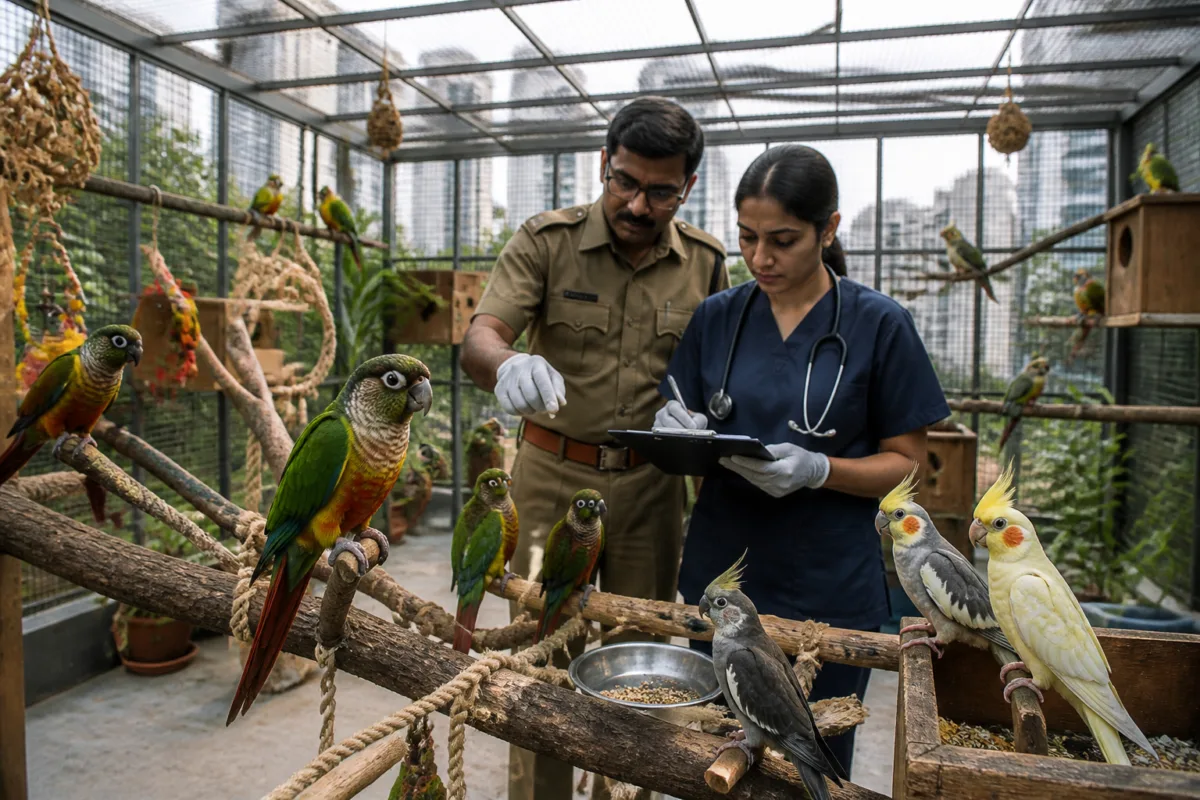
The rescue of 50 exotic birds from a flat in Wadala has exposed a problem that extends well beyond one case of poor animal care: Mumbai’s growing fascination with unusual pets is connecting private homes to wildlife trafficking, weakly understood regulation and ecological risks that can reach the city’s lakes and other habitats.
The birds were recovered from a residence in Bhakti Park, Wadala East, after officials inspected the premises on suspicion that exotic species were being kept illegally. The Mumbai Range of the Thane Forest Department Territorial conducted the operation with assistance from a wildlife conservation non-governmental organisation on October 18. The rescued birds included 18 Sun Conures, three Cockatiels, 28 Green-cheeked Conures and one Pineapple Green-cheeked Conure.
The Forest Department registered a forest offence against the person under the Wildlife Protection Act, 1972, as amended in 2022. The case therefore sits at the intersection of three responsibilities that cities often handle separately: enforcing wildlife law, preventing cruelty and protecting urban ecosystems from species that do not belong in them.
The immediate concern was the condition in which the birds were found. The residence was described as cockroach-infested, raising questions about hygiene, enclosure standards, nutrition and access to veterinary care. But wildlife experts quoted in the report say that individual rescues are only the visible end of a much larger chain involving demand, breeding, sale, ownership and abandonment.
Advocate Pawan Sharma, honorary wildlife warden of Mumbai and president of the wildlife conservation NGO RAWW, described the exotic wildlife trade as a complex crisis that extends beyond cruelty into organised crime. He said buying, selling or exchanging exotic wildlife can support illicit networks, while demand can encourage unregulated breeding and the production of unusual colour variations, commonly known as morphs.
That demand is partly sustained by the way exotic animals are presented to urban consumers. Rare birds, reptiles and mammals are frequently treated as lifestyle objects whose visual appeal is more apparent than their biological needs. The Wadala case demonstrates the gap between acquisition and care: ownership may begin with fascination, but the animal may require specialised food, supplements, physical space, environmental controls, enrichment and medical attention for years.
Dr Priti Sathe, an independent veterinary practitioner and associate veterinarian with RAWW, said exotic animals often appear easy to keep because their difficulties are not immediately visible. In captivity, she said, their quality of life depends on a suitable enclosure, enrichment, specialised food, additional nutrition and access to appropriate veterinary intervention.
The problem is also institutional. Owners who are uncertain about the legal status of an animal may avoid approaching a veterinarian because they fear scrutiny over its possession. Sathe said some owners instead attempt to treat exotic pets themselves. That can leave animals without proper diagnosis or treatment and may prolong suffering. It also makes the regulatory system less visible at precisely the point where early intervention could prevent a rescue or seizure.
The legal position is not identical for every exotic species. The report notes that the Wildlife Protection Act and its 2022 amendments introduced provisions for the regulation and reporting of certain exotic species, including species covered by the Convention on International Trade in Endangered Species of Wild Fauna and Flora, or CITES. Possession and trade depend on the species, its legal status and the circumstances in which it was acquired.
The import of live animals listed under the Wildlife Protection Act and CITES is strictly regulated under the Export-Import policy. The report says that importing such animals without a valid CITES export permit, a Directorate General of Foreign Trade licence, no-objection certificates from the Chief Wildlife Warden and the Ministry of Environment, Forest and Climate Change, and an Animal Quarantine Certificate is prohibited. Commercial trade in species listed in CITES Appendix I and Schedule IV of the Wildlife Protection Act is also prohibited.
For urban residents, the practical difficulty is that legal compliance is often treated as a paperwork issue rather than as part of animal welfare. A permit or declaration cannot by itself ensure that a bird has enough space, that a reptile is kept at the right temperature or that a mammal’s behavioural needs are being met. Conversely, an owner’s claim to have bought an animal legally does not remove the need to provide appropriate care or prevent abandonment.
The ecological consequences become more serious when exotic pets are released. Animals that become too large, difficult to manage, expensive to feed or less novel to their owners may be abandoned or put into forests, lakes and other open spaces. Such releases may not be humane: an animal may fail to survive, carry pathogens or compete with native species for food and habitat.
Mumbai’s water bodies illustrate why this is an urban planning and environmental management issue rather than a private household matter. Powai Lake has been reported to host nonnative species including Red-eared Slider turtles and Alligator Gar. Wildlife experts have raised concerns about the possible effects of such species on native turtles and fish. If a nonnative population becomes established, it can alter food chains and introduce infections or diseases to native wildlife.
The city’s lakes, mangroves, gardens and forest edges are already shared spaces where human activity, native wildlife and introduced species interact. An animal released by one household can therefore become a problem for municipal bodies, forest officials, conservation groups and residents. The costs of detection, rescue, treatment and rehabilitation are transferred from the owner to public institutions and non-governmental organisations.
Trishala Ashok, a conservation filmmaker, said social media has helped normalise exotic animal ownership by presenting rare species as accessories or entertainment. Videos showing animals being unboxed, dressed up or handled may conceal their origins and the specialised conditions required to keep them. She said animals can need specific temperature, humidity, diets, space and behavioural conditions, sometimes for decades.
That observation points to a major information failure in the market. Prospective owners may understand the purchase price but not the lifetime cost of care, the availability of specialised veterinary services, the legal obligations attached to the species or the consequences of surrender. The absence of that information allows the transaction to be framed as a consumer choice while shifting the risks to animals and public ecosystems.
The regulatory system must also operate across institutional boundaries. The Forest Department handles wildlife offences and enforcement. Customs, the Directorate General of Foreign Trade, quarantine authorities and the Chief Wildlife Warden have roles in import and documentation. Veterinarians are critical to early detection and treatment, while municipal and lake-management agencies may encounter the consequences when nonnative animals enter public water bodies.
The Wadala rescue shows how these responsibilities can converge in a single residential premises. An inspection leads to the recovery of animals, a forest offence and the involvement of a conservation organisation. But it does not, by itself, reveal how the birds entered the city, whether they were bred or imported, how they were sold or whether similar holdings remain undetected. Those questions are central to understanding whether enforcement is addressing supply, ownership or only the cases that become visible.
The evidence supplied in the report confirms the immediate risks but does not establish the scale of Mumbai’s exotic pet market. It does, however, identify several connected pressures: demand for unusual species, inadequate knowledge of care, fear of regulatory scrutiny, illegal or unregulated trade, abandonment and the possibility of invasive species establishing themselves in local ecosystems.
The larger urban question is how a city should govern animals that move through private homes, commercial markets and public habitats. Mumbai’s built environment does not end at apartment walls. Homes, veterinary clinics, lakes, forests and transport networks are part of one ecological system. When exotic animals are treated as decorations or accessories, the consequences eventually become visible in that shared system.
The Wadala case confirms the need to examine exotic pet ownership through animal welfare, enforcement and ecological protection together. The next developments to monitor are the Forest Department’s action in the registered offence, the legal status and rehabilitation of the rescued birds, and whether authorities and conservation groups identify broader patterns in the trade or in the release of nonnative animals into Mumbai’s natural spaces.

