


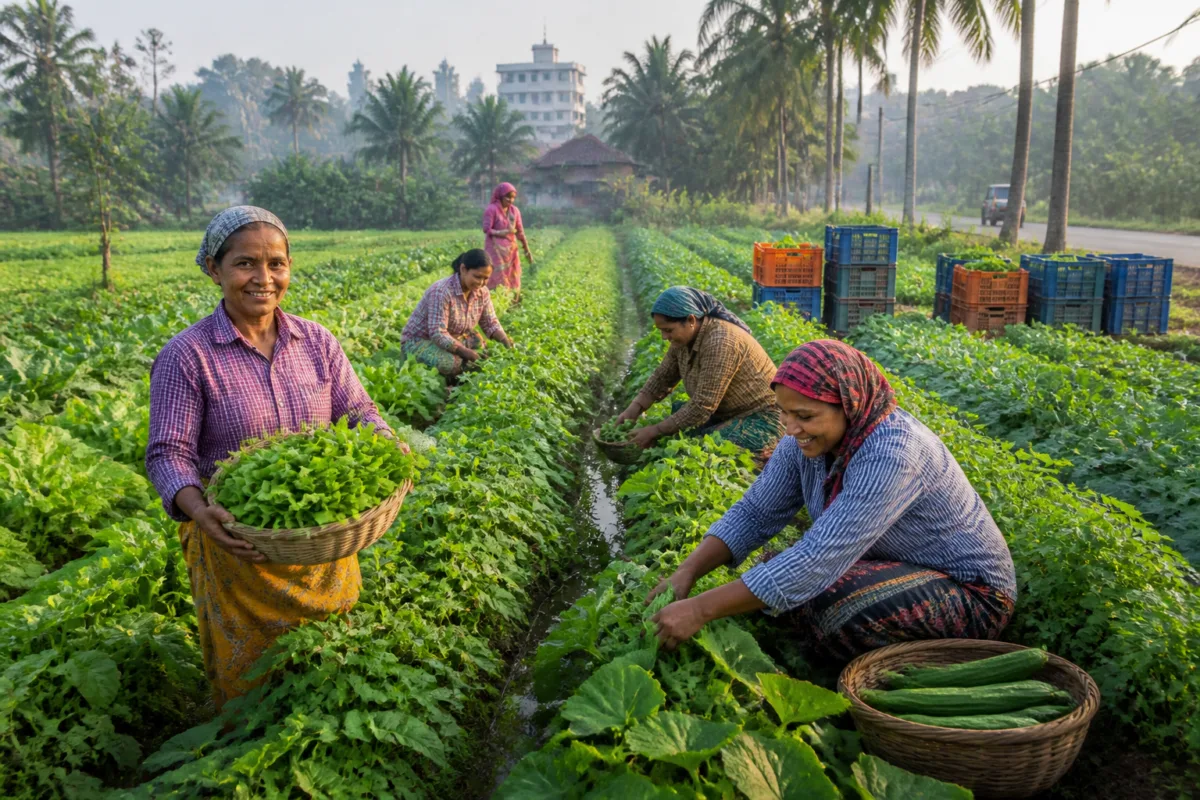
The story of Mangaluru women farmers growing vegetables for nearby markets is also a story about how a city gets its food. At Permude in Mangaluru taluk, nine members of the Siri Sanjeevini self-help group are cultivating vegetables across about six acres, selling to local traders and residents, and building a collective livelihood around agriculture. Their work has now been recognised through selection for the Skill Karnataka Award under the National Rural Livelihoods Mission.
The group’s experience offers a useful view of the connection between the city and its surrounding production landscape. The report published by Prajavani says that much of the vegetables consumed in Mangaluru and Dakshina Kannada comes from outside the district. At the same time, urban residents often complain that locally available vegetables are not sufficiently fresh. The Permude group is responding to both conditions by producing vegetables close to the market and creating direct channels through which consumers and local sellers can buy them.
This is not a story about a large agricultural enterprise. It is a small, organised production system run by women who combine farm work with domestic responsibilities. The group’s members cultivate seasonal vegetables, lease additional plots with irrigation facilities when required, sell directly from the farm and take produce to the monthly Sanjeevini market. In this arrangement, production, marketing and income generation are managed collectively rather than treated as separate activities.
The model matters because urban food systems are often discussed only through the lens of prices, transport and wholesale markets. The Permude example draws attention to the less visible layer underneath: who grows the food, where that land is located, how producers reach consumers and whether small producers can secure a reliable share of the value created between the field and the city.
According to group leader Vandana, the women currently grow amaranth greens, red amaranth, ridge gourd, bottle gourd, pointed gourd, cowpea, bitter gourd, ivy gourd and basale greens, along with other seasonal crops. The group also undertakes value addition by preparing and selling local products such as kette puli, described in the report as unde huli. During periods of free time, members sell greens and vegetables door to door.
The range of crops is significant for the way the group operates. It indicates that the women are not dependent on a single harvest or one seasonal product. Instead, they are maintaining a mixed cultivation system in which different vegetables are grown according to the season. The report does not provide crop-wise output, production costs or sale prices, so it is not possible to assess the profitability of each crop. It does, however, record the group’s statement that demand for its organic vegetables is strong in the surrounding area.
That demand is currently greater than the group’s ability to supply it. Vendors from Permude and surrounding Bajpe villages purchase vegetables in larger quantities, while consumers also visit the fields to buy produce. The group supplies Mangaluru mainly during festivals and other special occasions, the report says, because it cannot yet meet the full demand. This gap between local demand and production capacity is one of the clearest urban signals in the story.
It also shows the limits facing small-scale local supply. Access to land, irrigation, labour, transport, storage and market information determines whether a group can move from occasional sales to consistent supply. The women cultivate their own fields and lease irrigated fields when necessary, but the supplied report does not establish the total area available to them throughout the year, the terms of the leases, or whether they have access to cold storage or organised transport. Those missing details are important because perishability can quickly erase the advantage of being geographically close to a city.
The group’s reported income provides another measure of the model’s importance. Vandana says the group earns an average of ₹60,000 a month. The source does not clarify whether this is gross revenue or income after expenses, nor does it state how the amount is divided among the nine members. It therefore cannot be treated as a per-member monthly earning figure. Even with that limitation, the group’s account shows that collective farming has become an organised income-generating activity rather than an informal extension of household work.
The women describe their daily schedule as beginning after household work. They reach the fields at around 6.30 in the morning and work for two to three hours before returning in the evening to water the crops and apply farmyard manure. They say that working together makes the activity feel less like a burden and more like a source of satisfaction. Their account places the economic question alongside a social one: collective organisation gives women control over a productive activity and a stronger sense of independence.
The institutional support described in the report comes through the Sanjeevini network at the gram panchayat level. The Siri Sanjeevini group functions under the Hosachiguru Sanjeevini Village Panchayat Level Federation. Agriculture Sakhis and Pashu Sakhis provide technical information and advice on disease control. The group attributes its success in disease-free farming partly to this support.
This structure is important because it demonstrates how livelihood programmes can operate beyond credit or group savings. In this case, the support system connects women to technical advice, collective organisation, cultivation and markets. The report identifies the group’s integrated farming practices as a reason for its selection for the Skill Karnataka Award. The award is being given by the Department of Skill Development, Entrepreneurship and Livelihoods under the National Rural Livelihoods Mission.
The award itself is not proof that the model can be replicated everywhere. The source gives no comparative data on other self-help groups, no assessment of the group’s production efficiency and no independent evaluation of its disease-control practices. It does establish that the department selected Siri Sanjeevini as one of eight self-help groups in Karnataka for its performance and management of integrated agriculture. The award ceremony is scheduled at the Skill Summit in Bengaluru on November 5.
For Mangaluru, the larger question is whether local food production can become a more dependable part of the urban region’s supply chain. The report establishes that outside-district supplies are important and that a nearby women-led group has found demand for its produce. It does not establish how much of Mangaluru’s vegetable demand could be met by farms within Dakshina Kannada, or whether consumers would consistently pay a premium for locally grown vegetables. Those questions require data that is not included in the source.
The story nevertheless reveals several conditions that shape the rural-urban food connection. Local producers need land that can be cultivated, water for irrigation, technical support, labour arrangements and access to buyers. They also need the ability to move small quantities to multiple markets without losing value. The Permude group has built some of these links through direct sales, local vendors, door-to-door selling and the monthly Sanjeevini market. Its current inability to supply the full demand suggests that market access exists, but production scale remains constrained.
The gender dimension is equally central. The women are combining farm production with household work, and their collective structure allows them to share labour and responsibility. The group’s statement that “equal participation and equal share” helped it progress reflects an internal governance principle, although the report does not provide the group’s formal rules or financial records. What is clear is that the women see independent work and collective earning as a source of confidence rather than merely supplementary employment.
The evidence also cautions against presenting local food as automatically secure or self-sufficient. The group depends on seasonal cultivation, and its supply is not yet large enough to meet all demand. It leases irrigated land when needed, which indicates that access to suitable plots is part of its operating model. The source does not discuss the risks of water shortages, crop disease beyond the group’s control measures, extreme weather, price fluctuations or competition from outside suppliers. Those risks remain outside what can be concluded from this report.
What the Permude example confirms is narrower but valuable. A women’s self-help group has converted local land, technical support and collective labour into a functioning vegetable enterprise. It is supplying nearby markets, attracting consumers to the farm, adding value to local products and generating reported monthly group income. Its recognition under the National Rural Livelihoods Mission places that work within a public livelihood and skills framework rather than treating it as an isolated success story.
The next test is whether the group can strengthen the systems that connect its fields to the city without losing control over production and income. The available report does not say what expansion plans, market agreements or financial arrangements will follow the award. Those developments, along with the group’s participation in the Skill Summit in Bengaluru on November 5, will show whether recognition leads to stronger institutional and market support for a local food enterprise already serving the Mangaluru region.

