


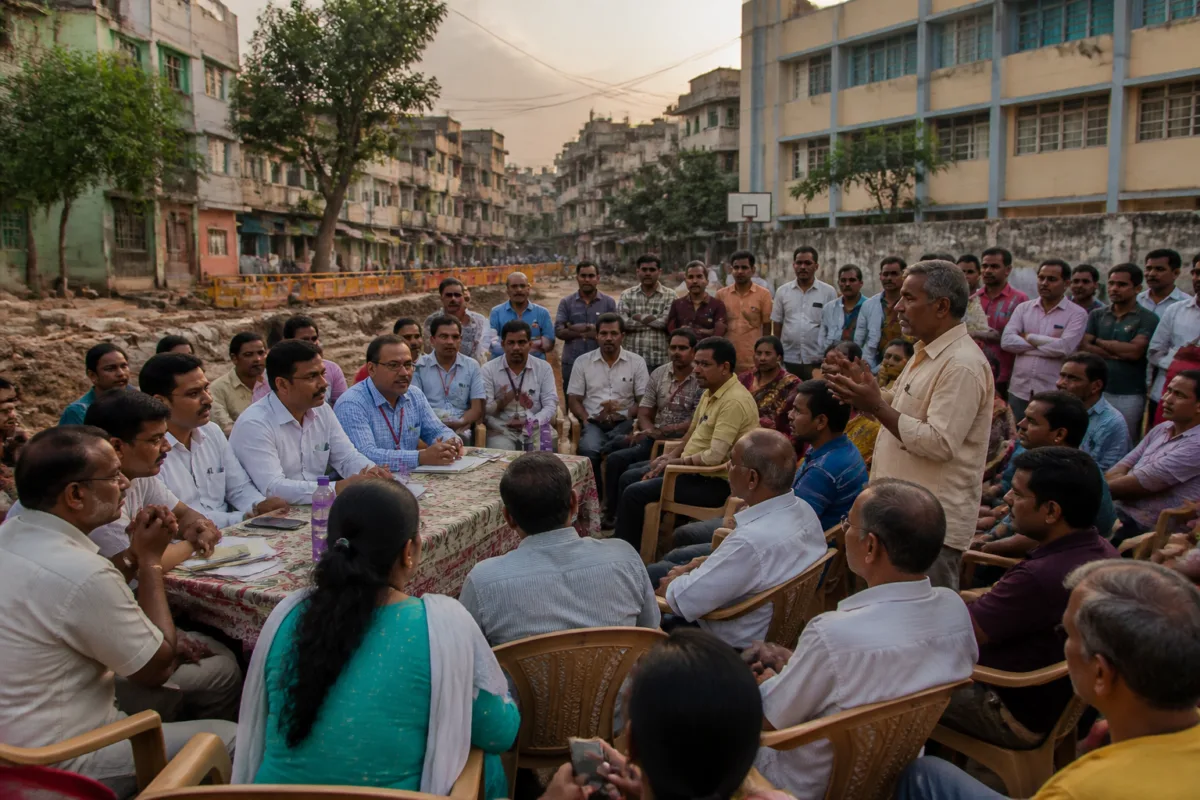
A public grievance meeting in Bengaluru’s Pulukeshinagar constituency has exposed how ageing networks, delayed infrastructure work and fragmented civic responsibility continue to shape daily life in some of the city’s oldest neighbourhoods. Residents described months and, in some cases, years without reliable piped water, repeated sewer overflows, damaged roads, unsafe drains, inaccessible public offices and blocked footpaths.
The meeting, organised on Saturday by Prajavani and Deccan Herald at the municipal ground near St Charles School, brought residents face to face with MLA A.C. Srinivas and officials from the Bruhat Bengaluru Mahanagara Palike, Bengaluru Water Supply and Sewerage Board, Bengaluru Electricity Supply Company, the horticulture department and the police. Instead of accepting general assurances that complaints would be resolved soon, the MLA asked officials to provide specific timelines for action.
That format is important because the complaints were not isolated service requests. Together, they described a connected urban infrastructure problem across Fraser Town, Pottery Town, Richards Town, Coles Park, East Railway Station, Kaval Byrasandra, K.G. Halli, D.J. Halli, L.R. Bande and the St Charles School area. The constituency sits close to Bengaluru’s central districts and includes some of the city’s older settlements. Residents told the meeting that the age of the built environment had not been matched by systematic renewal of the networks beneath and around it.
The water crisis was the clearest example. Residents said water supplied from the High Grounds overhead tank did not reach a large part of the constituency even when valves were opened for four hours. According to the account presented at the meeting, the old distribution network loses about half the supplied water through leakage. Some neighbourhoods have depended on tankers for four to five months, while some homes have reportedly not received BWSSB water for six or seven years.
The problem is therefore not only one of inadequate supply. It is also a network and distribution problem. Water may be available at a source, but an ageing pipeline system, pressure limitations and leakages determine whether it reaches individual homes. This distinction matters in older urban areas, where new storage capacity alone may not correct failures in the last-mile network.
Srinivas said a ground-level reservoir with a storage capacity of 5 million litres was being constructed near the meeting venue at a cost of ₹45 crore and was nearing completion. He also said the state Cabinet had approved another reservoir of similar type at a cost of ₹22.5 crore. The MLA told residents that the two facilities would address the constituency’s water shortage once completed, while asking them for time until the projects were operational.
The report also records plans to replace approximately 50 kilometres of water-supply pipelines and 50 kilometres of sewerage lines. Srinivas said the existing water and sewer networks were 50 to 60 years old. If implemented as described, the pipeline replacement would be more consequential than a short-term tanker response because it would address the physical system responsible for leakage, low reliability and repeated blockages.
Sewerage complaints showed the health and safety consequences of network failure. Residents said drains became blocked every two or three days, forcing wastewater into homes. In Shakthinagar, residents reported that a retaining wall along a stormwater drain had been damaged, causing sewage to enter the road during rain. They also said snakes, scorpions and rodents entered nearby homes. The complaints point to an overlap between sewerage maintenance, stormwater management and public health that is often obscured when agencies handle each issue separately.
Road work adds another layer to the problem. Residents described many roads in the constituency as narrow, damaged and difficult for traffic. Srinivas said ₹250 crore had been sanctioned for white-topping and asphalting across the constituency, with 50 per cent of the work completed. Elsewhere in the same report, he referred to white-topping works costing ₹150 crore. The two figures were presented in different parts of the meeting account and are not reconciled in the supplied report.
The sequencing of road work is also significant. The MLA said white-topping and asphalting on some roads would be completed only after BWSSB installed its pipelines. This is a familiar problem in Indian cities: roads are repaired before underground utilities are renewed, only to be cut open again for water, sewerage or electricity works. Coordinating the order of construction can reduce repeated excavation, but it requires agencies to share schedules and accept joint accountability for the final condition of the street.
Residents raised complaints beyond major engineering projects. They reported shortcomings in tanker-water delivery, footpath construction and street-light installation. Footpaths were said to be occupied by commercial activity, forcing pedestrians to walk on carriageways. Unauthorised parking near the Navakies Hotel was reported to obstruct movement. School-hour congestion around Shakthinagar was attributed partly to school vehicles and parents driving against the direction on one-way roads, creating risks of traffic stoppage and accidents.
These complaints show why urban infrastructure cannot be assessed only through the value of sanctioned projects. A reservoir, pipeline renewal or road package may improve capacity, but the everyday quality of a neighbourhood also depends on valves, drain walls, footpaths, parking enforcement, street lights and safe access to public buildings. Small operational failures can make large capital investments less visible to residents.
Accessibility was another unresolved part of the discussion. A resident said public offices lacked facilities for persons with disabilities and that people had to struggle up staircases before officials failed to listen to them. The complaint links physical access with administrative access. A public service is not fully accessible when a resident cannot enter the office independently or cannot obtain a response after reaching it.
The meeting also included concerns about safety around a government school in D.J. Halli, where residents sought CCTV cameras and action against alleged drug activity near the campus after dark. The MLA said the police had already brought the situation under control to some extent and urged residents to inform the police rather than confront suspected offenders themselves. The account does not provide independent crime data or details of a specific police operation, so the claims remain statements made at the meeting rather than an established measure of neighbourhood safety.
The administration of the constituency’s problems is spread across several institutions. BWSSB is responsible for water and sewerage networks, the municipal corporation handles roads, drains, footpaths and civic maintenance, BESCOM is responsible for electricity infrastructure, the horticulture department manages public greenery, and the police handle traffic and public safety. Residents experience the combined outcome, however, as one neighbourhood environment. When agencies respond separately, a complaint can move between departments without producing a complete solution.
The reported decision to seek precise deadlines from officials is an attempt to make that system more answerable. A time-bound response does not by itself guarantee implementation, but it creates a basic measure against which residents can follow up. The next test will be whether the commitments made at the meeting are converted into work orders, site inspections, completed repairs and publicly visible progress.
The constituency’s reported infrastructure programme also includes social and housing-related commitments. Srinivas said a ₹40 crore plan had been prepared to improve infrastructure at a government school in D.J. Halli, where 1,700 students were reported to be studying, and that ₹16 crore had already been sanctioned. He also said the government had sanctioned ₹20 crore for a high-tech hospital, that 536 economically vulnerable people had received individual houses, and that a proposal had been submitted for another 1,000 houses. The supplied report does not provide implementation schedules or project documents for these announcements.
Street vending presents another governance challenge. The MLA said long-standing vendors would not be removed without identifying vending space and arranging rehabilitation, while new vending would not be permitted. This position recognises the tension between pedestrian access and livelihoods. The problem is not resolved by treating footpaths only as encroachment zones or vendors only as enforcement targets; it requires a functioning relocation or designated vending arrangement, followed by consistent regulation.
The evidence from the grievance meeting does not establish that every proposed project will be completed on schedule. It does establish the scale and duration of the complaints being brought before local authorities. Water shortages lasting months or years, sewer networks described as half a century old, roads awaiting coordinated utility work and footpaths made unusable by commercial activity all point to a maintenance deficit layered onto an ageing urban fabric.
For Bengaluru, the larger question is whether neighbourhood-level grievance hearings can become part of a measurable service-delivery system rather than remain one-time forums. The answer will depend on what happens after the meeting: whether agencies publish timelines, inspect the locations named by residents, coordinate excavation and resurfacing, and report which commitments have been completed. Until then, the meeting has documented the gap between announced infrastructure investment and the daily reliability of the city’s basic services.

