


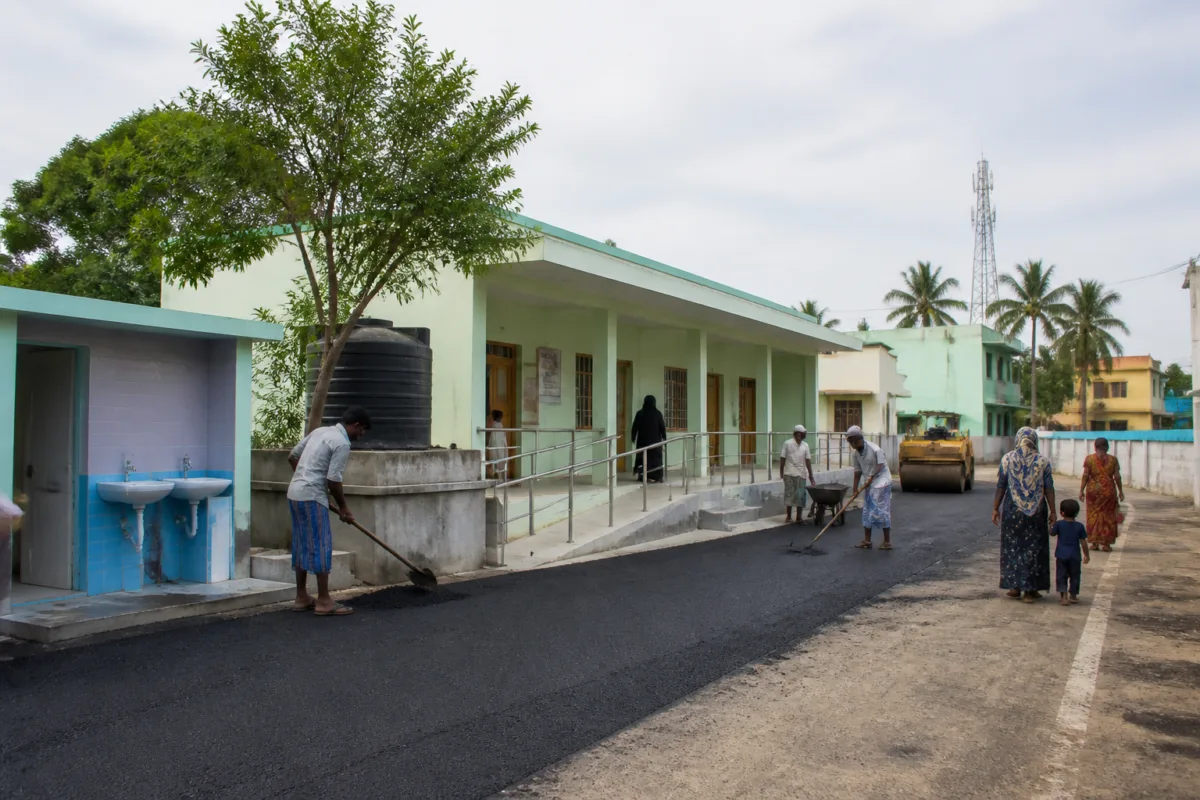
Tamil Nadu’s Minorities Welfare Minister A.M. Shahjahan has said the Union government has agreed to reconsider the sanction and release of Rs. 900 crore for 374 pending welfare schemes in the state, including projects linked to community infrastructure, education, health, drinking water and sanitation.
Shahjahan made the statement to mediapersons in Tiruchy on Saturday after meeting Union Minister for Minority Affairs Kiren Rijiju in New Delhi. He said he had urged the Union government to sanction and release the pending schemes and hoped approval would be given shortly. The minister’s statement indicates that the funds had not yet been released and that the schemes remained subject to the Centre’s approval.
The pending proposals cover infrastructure and social-sector interventions for minority communities. The schemes include development of educational and health facilities, skill-development initiatives, women-centric projects, drinking-water supply, sanitation, sports infrastructure, renewable energy, tourism and animal husbandry, according to the minister.
Shahjahan also urged the Union government to implement the Pradhan Mantri Jan Vikas Karyakram, or PMJVK, more fully in Tamil Nadu. The programme is intended to create community infrastructure in areas with significant minority populations. The minister said PMJVK had been implemented in other southern states, including Kerala, Karnataka and Andhra Pradesh, and called for similar implementation in Tamil Nadu.
The announcement places the focus on the administrative process behind centrally supported welfare infrastructure. While the proposed projects span several sectors, their implementation would depend on the sanction of individual schemes, the release of funds and coordination between Union and state authorities. The minister did not provide a project-wise list, district-wise allocation or specific timeline for the release of the Rs. 900 crore.
Shahjahan said he had also requested an increase in Tamil Nadu’s quota for the Haj pilgrimage. He said around 13,000 people apply from the state, while only 5,500 are selected. According to the minister, Rijiju assured him that he would examine the request.
The minister referred to the recommendations of the Rajindar Sachar Committee on the social and economic status of India’s Muslim community. He appealed to the Union government to implement the recommendations, including measures relating to minority participation in public bodies, employment opportunities and recognition of madrasa degrees for eligibility in defence, civil and banking examinations.
Tamil Nadu has separately announced measures for minority welfare, Shahjahan said. These include an initial state allocation of Rs. 20 crore to provide full undergraduate tuition-fee support for Muslim female students admitted under the government quota. The state also plans to extend scholarships for Muslim girls from Classes 1 to 8 to Classes 9 and 10 and provide an annual grant of Rs. 2,000 to 41,384 students.
Another proposed measure is a Rs. 100-crore interest-free revolving fund managed through the Waqf Board. The fund is intended to support income-generating assets, including commercial complexes and marriage halls, on Muslim Waqf and Christian religious properties. The next formal milestone for the central schemes is the Union government’s decision on their sanction and release.

