


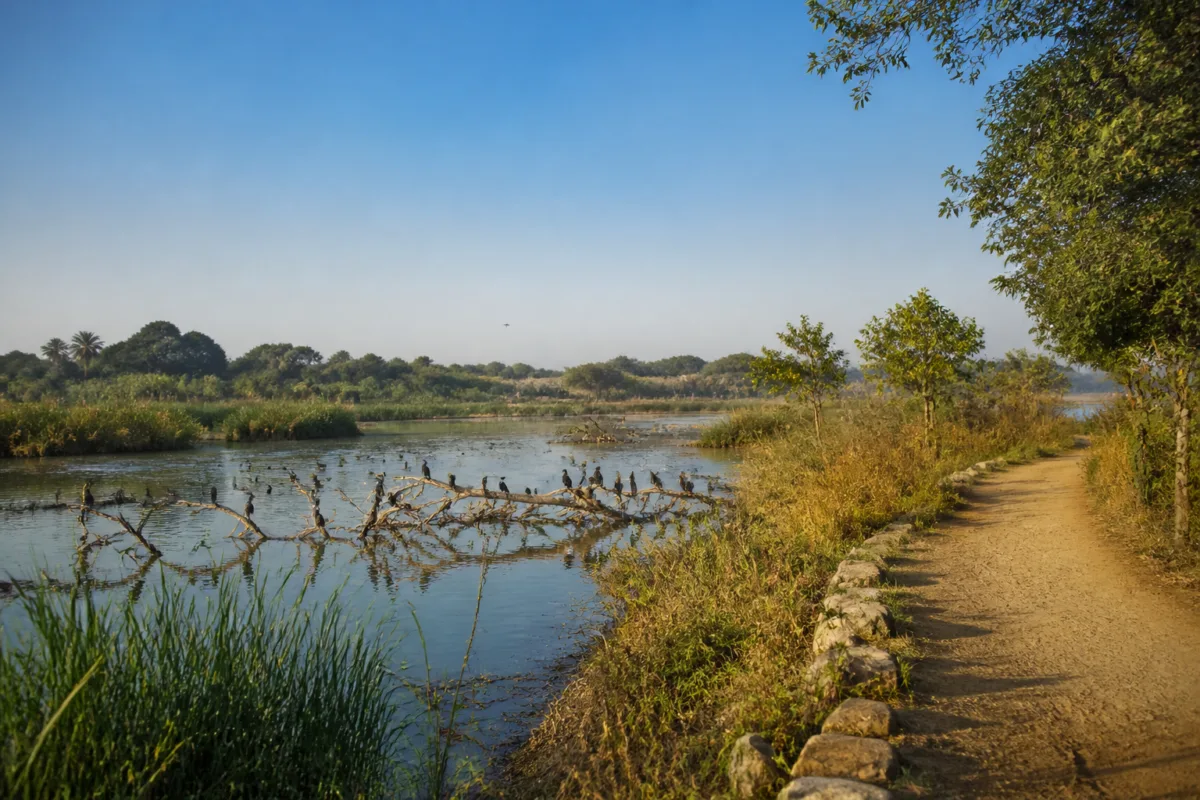
The Yamuna Biodiversity Park near Wazirabad is more than a green escape from north Delhi’s traffic and disorder. Spread across 457 acres of the Yamuna’s upstream landscape, it is evidence that degraded urban land can be rebuilt into a functioning ecological system when scientific knowledge, public administration and long-term management work together.
The park’s significance begins with what the site was before restoration. Two and a half decades ago, the land was described as degraded, highly alkaline, extremely saline and low in nutrients. Only salt-tolerant bushes and weeds could survive there. Today, the same landscape contains wetlands, grasslands, trees, a medicinal plant garden and a butterfly conservatory. It supports 1,017 plant species, 203 bird species, 82 kinds of butterflies, 18 reptiles and 22 mammals.
That transformation was not presented as the result of a conventional beautification project. The initiative was conceptualised in 2002 by ecologist R C Bahuguna, then pro-Vice Chancellor of Delhi University, and backed by Lt-Governor Vijay Kapoor. Delhi University became the nodal authority and fully funds the programme, while its Centre for Environmental Management of Degraded Ecosystems, or CEMDE, provides the scientific knowledge used to shape and maintain the park.
This institutional arrangement is central to understanding the park. Urban ecological projects often depend on a short construction cycle, a landscaping contract or a single administrative push. The Yamuna Biodiversity Park instead developed through an academic-administration partnership in which restoration was treated as a continuing process. The park became functional in 2012, while the biodiversity park programme also expanded to sites including the Aravalli landscape.
The restoration method was based on studying the ecological history of the site rather than imposing an unrelated landscape design. Faiyaz Khudsar, a biodiversity expert associated with the programme for more than two decades, said the team surveyed the Yamuna basin, nearly 1,400 kilometres long, to identify the closest possible ecological equivalent for the area being restored.
That approach shaped the choice of plants and the treatment of the soil. Leptochloa fusca, commonly known as brown-bottle grass, was used to help address saline conditions. Dhaaincha, a leguminous plant often used as green manure, helped improve soil fertility. Alongside other ecological measures, these interventions supported the rejuvenation of land and water and allowed a self-sustaining ecosystem to develop.
The result is a landscape organised around ecological functions rather than only visual appeal. Wetlands form a critical part of the park. Khudsar described wetlands as being to rivers what kidneys are to the body because they help flush toxins and clean water. That explanation places the park within the larger functioning of the Yamuna basin, rather than treating it as an isolated recreational garden.
The biodiversity figures provide the clearest measure of the change. The park’s reserve includes hog deer, civet, wild hare and pig, nilgai and an itinerant leopard. Winter visitors include the Red-crested Pochard, which travels from Siberia and Central Asia and stays for around four months. Great Cormorants and Snakebirds can be seen around the waterbody, while butterflies, dragonflies, water lilies and other species occupy the grasslands, wetlands and wooded areas.
These numbers do not by themselves establish the full ecological health of the Yamuna or demonstrate that the park has solved the river’s wider pollution problems. They do, however, show the scale of biodiversity that can return when a landscape is restored over time. The evidence supplied about the park points to a functioning habitat within a larger river system that remains under intense urban pressure.
The park also demonstrates the importance of maintaining ecological variety inside a rapidly urbanising city. Its 457 acres include wetlands, grasslands and other habitat types rather than a single manicured lawn. That mosaic creates different conditions for plants, insects, birds, reptiles and mammals. The presence of a medicinal plant garden and butterfly conservatory adds an educational dimension, while the wider reserve functions as a field site for observing a restored ecosystem.
Public access is part of the model. The park receives about 100 visitors a day, including civil servant trainees. Entry and a guide are free. Visitors can reach it by taking the Pink Line to Jharoda Majra station and then travelling by e-rickshaw for about five minutes. The route links a public transport network to an ecological site, although the supplied account does not establish how many visitors use public transport or whether the connection has been formally planned as part of the park’s management.
The park’s educational role is equally important. Khudsar describes speaking to students about the responsibility to protect natural resources and encouraging them to become future conservationists regardless of their profession. This is not a minor function in a city where natural areas can remain invisible to residents unless they are converted into conventional public parks. Direct contact with wetlands, birds, butterflies and native vegetation can make ecological systems legible to citizens and administrators alike.
The history of the project also shows why specialised institutional knowledge matters. Khudsar’s field experience includes work at Kanha National Park and research in Kuno Wildlife Sanctuary, where he studied the needs of forest communities facing relocation. His account of learning from Gond, Baiga and Sahariya communities reflects a wider conservation principle: ecosystems are not understood only through maps and species lists, but also through sustained field engagement and knowledge of how people interact with natural resources.
For Delhi, the larger question is whether biodiversity restoration can be treated as urban infrastructure. The park’s wetlands perform environmental functions, its vegetation supports habitat, and its open landscape provides a public setting for learning and recreation. Unlike a conventional park whose success may be judged mainly by appearance and visitor numbers, a biodiversity park must also be understood through soil recovery, water systems, habitat diversity and the return of species.
The project’s administrative design offers another lesson. Delhi University is responsible for funding and overall authority, while CEMDE supplies scientific expertise for the park’s development and upkeep. That division gives the initiative a continuity that can be difficult to sustain when ecological restoration is separated from research institutions or managed only through short-term works contracts. The supplied account does not provide the park’s annual budget, staffing strength or detailed performance indicators, so the financial and operational sustainability of the model cannot be assessed fully here.
What is clear is that the Yamuna Biodiversity Park represents a long transition rather than a quick intervention. The project was conceived in 2002, became functional in 2012 and continues to evolve. Its history suggests that urban ecological restoration requires time, site-specific science and institutions capable of maintaining the work after the initial transformation has attracted public attention.
The park therefore matters on two levels. At the immediate level, it offers Delhi residents access to a functioning natural landscape near Wazirabad, with free entry, guided visits and a substantial range of species. At the systemic level, it shows that land damaged by salinity, alkalinity and nutrient depletion need not remain permanently unusable. The evidence from the park confirms the possibility of ecological recovery, while leaving open larger questions about how similar methods could be applied elsewhere in the city and across the Yamuna basin.

