


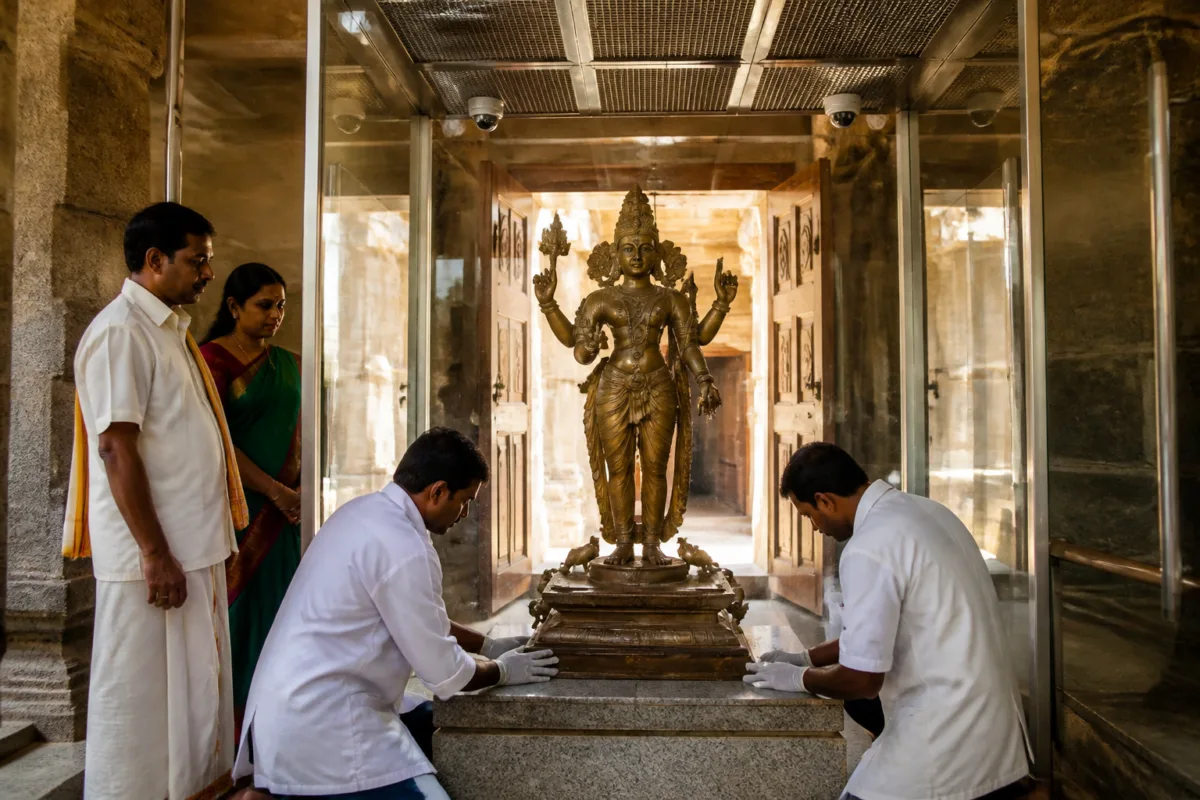
Tamil Nadu temple idols held in conservation centres will be returned to their respective temples after dedicated security rooms are completed, the Hindu Religious and Charitable Endowments Department has told the Madras High Court. The department said construction has already been completed in 1,782 of the 1,881 temples covered by the programme.
The undertaking was made in a response filed on behalf of the HR and CE Commissioner before a bench comprising Chief Justice S.A. Dharmadhikari and Justice G. Arul Murugun. The case was filed by T. Sureshbabu, a devotee from Coimbatore, who sought directions for metal idols kept in conservation centres to be shifted back to the temples concerned.
Tamil Nadu has established conservation centres at several locations across the state to protect ancient metal idols belonging to its temples. The facilities were created as part of efforts to secure the idols, but the petitioner argued that idols kept away from their temples were not receiving worship and rituals in accordance with Agama practices.
In its response, the HR and CE Department said worship and rituals were being conducted at the conservation centres in accordance with Agama practices. It also said that dedicated priests had been appointed at some of the centres for this purpose.
The department further informed the court that separate rooms were being constructed in 1,881 temples to secure the idols. Construction has been completed in 1,782 temples, leaving 99 temples where the work is still pending. Once the remaining rooms are built, the metal idols currently kept in conservation centres will be sent back to the temples to which they belong, according to the department’s filing.
The response places the movement of the idols within a broader administrative process involving security infrastructure, temple management and ritual practice. Rather than transferring the idols immediately, the department’s stated plan links their return to the completion of dedicated facilities at the individual temples.
The case also highlights the operational challenge of protecting valuable and historically significant temple objects across a large network of religious institutions. Conservation centres provide centralised security, while the department’s plan requires each temple to have an appropriate protected space before the objects are moved back.
The department’s filing does not specify a common deadline for completing the remaining 99 rooms or a date by which all idols will be returned. Its position before the High Court is that the transfers will take place after construction is completed at the respective temples.

