


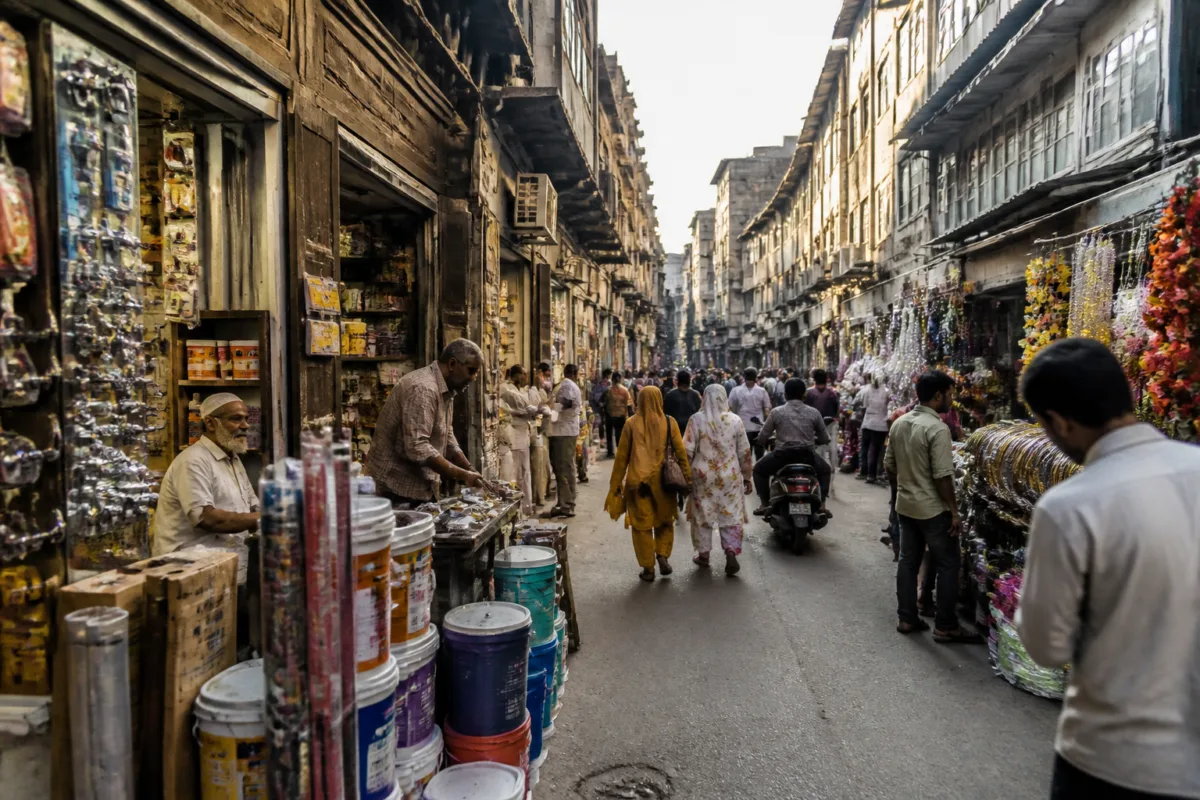
Bohri Ali market, a roughly 200-year-old commercial lane in Pune’s Raviwar Peth, is undergoing a quiet but visible transformation. Shops once identified with hardware, paints, tools, stationery and utility goods are increasingly sharing space with businesses selling festive decorations, plastic goods, perfumes and other consumer products. The change is not simply about new signboards. It shows how an old trading district responds when its traditional customer base, wholesale networks and commercial incentives begin to shift.
The market derives its name from the Bohra community, whose merchants settled in the area during the Peshwa era. Over generations, Bohri Ali became a specialised destination for goods that were essential to households, workshops, farms and construction-related activity. Customers came for nuts and bolts, valves, pipes, paint, household fittings, industrial and agricultural tools, stationery and other utility products. Its identity was built around that concentration of specialised shops.
That identity is now becoming less fixed. The change has taken place within a narrow stretch of road only a few hundred metres long, but the implications are larger than the size of the lane. Historic markets survive not only through old buildings or long-running family businesses, but through the economic relationships that bring customers, suppliers and traders to them. When those relationships weaken, the market’s physical continuity can remain while its commercial function changes.
The experience of long-established shopkeepers provides a record of that transition. Shabbir Mulla, a third-generation member of the family that runs E. M. Mulla, said around 70 per cent of shops earlier dealt in hardware, including nuts and bolts, valves and household fittings. The lane also had 15 to 20 shops selling wheat and grains, along with dry-fruit stores, paint shops and businesses known for distinctive red notebooks.
Mulla’s account also points to the importance of destination-based shopping in the older market. Customers travelled from across Pune to buy the red notebooks sold by particular shops. That kind of trade depends on memory, reputation and product specialisation. It allows a small market to draw customers beyond its immediate neighbourhood, even when the lane itself is congested or difficult to navigate.
Today, many of those businesses have disappeared or been replaced. Shops selling plastic goods, perfumes and decorative products have become more prominent, while several decoration stores have emerged during the past eight to 10 years. The rise of festive commerce is especially visible around Ganpati, Diwali and Christmas, when demand for decorative items increases. Some traditional hardware stores also change their merchandise during the festive season, indicating that adaptation is not limited to new entrants.
This seasonal flexibility is one of the clearest signs that the market is responding to changing demand rather than simply losing activity. Traders are using the same premises and the same customer-facing location to serve different consumption cycles. A shop that once depended mainly on hardware or paint sales can use the festive period to sell decorations. The commercial address remains valuable, but the product mix becomes more fluid.
At the same time, the accounts from older businesses suggest that the shift is not only seasonal. Huzaifa Chopdawala’s family has run Gulamhusen Mohammedbhai for more than 150 years, and the store continues to sell specialised red notebooks and yearly diaries. Its survival illustrates how some older trades retain value when they remain associated with a distinct product and a reliable customer base. But Chopdawala also says Diwali decoration shops have become increasingly prominent across the lane.
The more fundamental change is described by Taizoon Hakim, a fourth-generation member of the family behind H. A. Hakim Paints. The shop has operated for more than 150 years and was once part of a thriving wholesale trade in paints and hardware. Hakim said new shops began appearing around five to seven years ago as people started selling their original shops. He also said customers who once came specifically for hardware and paints now go elsewhere, while wholesale business has almost ended.
These observations identify two connected pressures. The first is demand: the market is no longer the same destination for hardware and paints that it once was. The second is property and business turnover: the arrival of new traders after original shops were sold changes what the lane offers. The source does not establish why customers shifted elsewhere or who acquired the premises, but the shopkeepers’ accounts show that commercial succession is altering the market’s identity.
That distinction matters. A historic market can remain busy while losing the specialisation that made it important. Footfall alone does not reveal whether an old commercial ecosystem is intact. A lane filled with customers buying decorations may be economically active, but it serves a different function from a lane where tradespeople, households and institutions came for tools, fittings, paint and industrial supplies.
Bohri Ali’s location also reflects the layered administrative geography of Pune’s older core. Although the market is commonly associated with Raviwar Peth, shops on the opposite side of its narrow road fall within Shukrawar Peth. Such overlapping identities are common in historic urban districts, where neighbourhood names, ward boundaries, property records and public understanding do not always align neatly. For traders and customers, the market is experienced as one commercial place even when its administrative or postal descriptions may differ across the street.
The market’s history is therefore carried through more than individual buildings. It exists in family-run shops, product knowledge, community connections and the expectation that a particular lane will provide a particular category of goods. The long operating histories cited by the shopkeepers—more than 150 years for some businesses and since 1910 for E. M. Mulla—show how commercial memory can outlast several generations. But they also reveal the vulnerability of such memory when the underlying trade becomes less profitable.
There is no evidence in the supplied account of a formal heritage-conservation plan, market redevelopment proposal or municipal intervention for Bohri Ali. The reported transformation is being driven primarily by traders, property transactions and customer preferences. That makes the change different from a planned redevelopment project. The market is not being remade through a single public decision; it is changing incrementally through many private commercial decisions.
This incremental process can be difficult to recognise and even harder to manage. A major redevelopment project produces a notification, a plan or a construction schedule. A market’s gradual transition appears through changing merchandise, shop sales and the disappearance of specialised businesses. By the time the change becomes visible as a question of heritage, the commercial ecosystem that gave the place its identity may already have weakened.
The evidence from Bohri Ali does not support the conclusion that the market is disappearing. It remains a bustling marketplace, and older establishments continue to operate. Nor does it establish that newer businesses are inherently incompatible with the area’s history. Festive decoration shops and other retailers provide income and respond to current demand. The tension lies in whether the old and new uses can coexist without erasing the specialisation, knowledge and community associations that made Bohri Ali distinctive.
The market also raises a broader question about what cities preserve. Heritage is often discussed through façades, monuments and protected structures. In trading districts, however, heritage can also be embedded in use: the kinds of goods sold, the families that operate the stores, the customers who travel there and the relationships linking the market to the wider city. When those uses change, the physical lane may survive while its economic heritage becomes less visible.
For Pune, Bohri Ali is a small but revealing example of how older commercial areas adjust to a changing urban economy. The market demonstrates that adaptation can keep premises occupied and streets active, while simultaneously weakening the specialised identity that once drew customers. It also shows why the future of historic markets cannot be assessed only through building age or present-day footfall.
What the available evidence confirms is a gradual commercial transition: hardware, paints, tools, stationery and wholesale activity have declined in prominence, while festive decorations, plastic goods, perfumes and other products have expanded. What remains uncertain is the scale of the change across the entire market, the reasons customers moved to other locations and whether any public or community effort exists to document its commercial heritage. Those questions will determine whether Bohri Ali is understood merely as a changing retail lane or as a historic urban institution adapting to a new chapter.

