


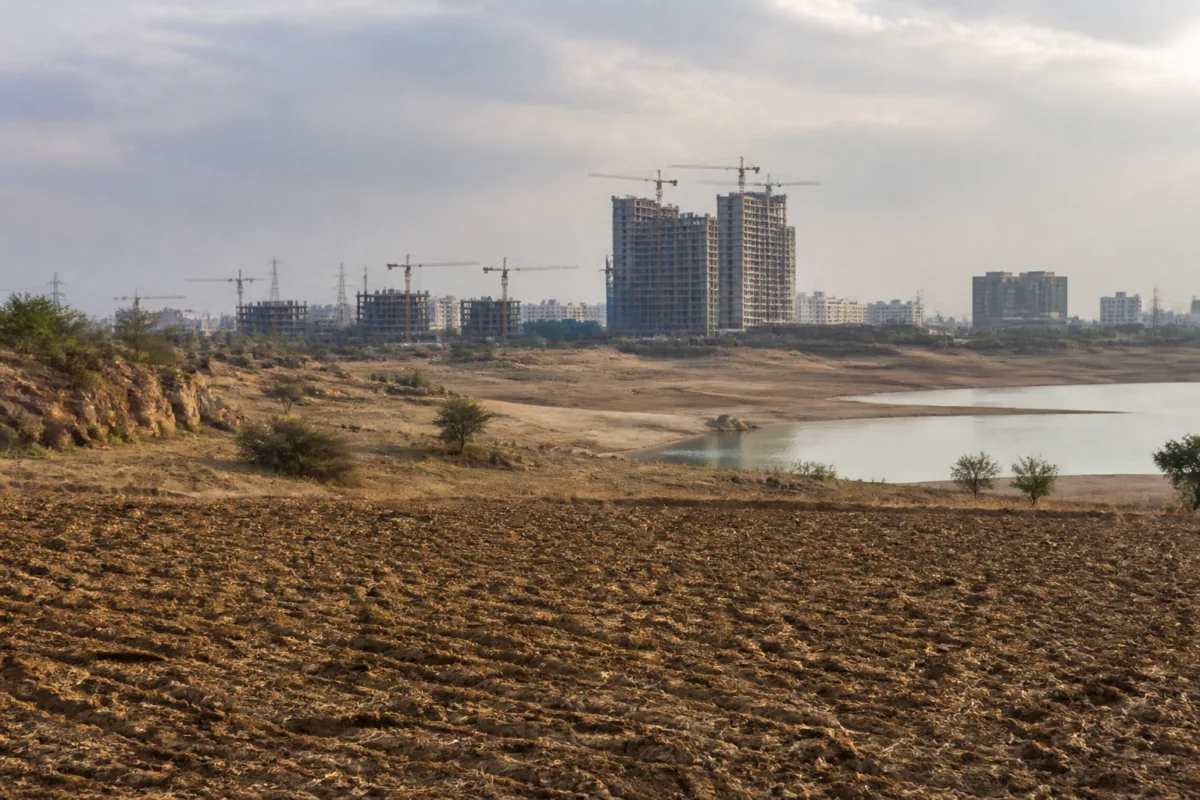
Telangana’s El Niño-linked rainfall deficit is no longer only an agriculture problem. A government-appointed multidisciplinary expert committee has warned that weaker farm output, declining rural incomes and reduced water availability could spread through consumption, construction, real estate, banking and state finances, putting 1.5 to 2 percentage points of the state’s projected GSDP growth at risk.
The committee submitted its report to the state government on October 28 after being constituted to assess the likely impact of El Niño and suggest measures to protect agriculture and allied sectors. Its assessment places the state’s current economic vulnerability at the intersection of climate, water, household demand and public revenue. That connection is important for a state where more than 60 per cent of the workforce depends on agriculture and allied activities, according to the report.
The projected impact is significant because Telangana’s GSDP growth for the current financial year has been estimated at 10 to 10.7 per cent. The committee said this growth could be reduced by 1.5 to 2 percentage points if the rainfall deficit weakens agricultural production and rural purchasing power. The report does not present the rainfall shortfall as a sectoral shock that ends at the farm gate. Instead, it describes a chain in which lower agricultural incomes reduce cash circulation, weaken demand and affect businesses that depend on rural transactions.
That chain begins with the southwest monsoon and the availability of water for the next cultivation cycle. The committee warned that declining groundwater levels and reduced storage in reservoirs and irrigation projects could restrict Rabi cultivation to 30 to 40 per cent of the 70 lakh acres normally brought under crops during the season. The agriculture department’s advisory against water-intensive crops could further reduce paddy and other irrigated crop cultivation.
The immediate consequence would be lower agricultural output. But the report also identifies a wider supply-chain effect. Rice mills and food-processing units could face shortages of raw materials, while reduced activity in market yards could affect loaders, transport workers and drivers. These are urban-linked and semi-urban livelihoods whose earnings depend on the movement, processing and sale of agricultural produce, rather than on cultivation alone.
The committee’s assessment suggests that rural purchasing power is the key transmission mechanism. When farm incomes decline, households reduce spending and businesses experience fewer transactions. The report specifically identified automobiles, electronic goods, fast-moving consumer goods and other discretionary products as sectors that could face weaker demand. A reduction in these purchases would also affect the state’s tax receipts.
The committee estimated that Telangana’s share of Goods and Services Tax collections could decline by 15 to 20 per cent if the consumption slowdown persists. This warning comes despite the government having achieved its revenue collection targets during the first six months of the current financial year. The report cautioned that collections could come under pressure in the following months as the rainfall deficit begins to affect household spending and business activity.
This distinction between past collections and future pressure is central to the report. Revenue performance during the first half of the year does not necessarily indicate that the state’s finances are insulated from an agricultural slowdown. If weaker farm incomes reduce consumption over subsequent months, the effect could appear in tax receipts with a lag. The committee therefore connects the water and crop situation to the government’s ability to maintain revenue flows.
The report also brings the property market into the climate-risk picture. Agricultural land transactions have declined by around 10 per cent compared with previous levels, putting the government’s annual revenue target of ₹18,000 crore from stamps and registrations at risk. This is a direct connection between rural economic stress and a major public revenue stream associated with land and property transactions.
The construction sector could face a second-round effect. The committee said weaker construction activity would reduce demand for cement, steel, bricks, hardware and other building materials, affecting business transactions worth lakhs of crores of rupees. It estimated that nearly 20 lakh workers, including construction labourers, masons and plumbers, could face employment uncertainty if construction activity weakens.
This matters to Telangana’s cities because construction is not an isolated industry. It connects land transactions, building-material supply, informal and formal employment, transport, household income and state revenue. A slowdown in one part of this chain can affect workers who may live in urban areas but depend on projects, suppliers and property transactions linked to rural and peri-urban markets. The report’s warning broadens the understanding of climate exposure from crop losses to the built environment and its labour markets.
The banking system is another channel identified by the committee. It warned that lower industrial production and weaker business activity could affect borrowers’ repayment capacity, particularly those dependent on agriculture and allied sectors. This could increase the possibility of banks witnessing a rise in non-performing assets. The report therefore treats the rainfall deficit as a potential credit-quality issue as well as a production issue.
The risk of rising non-performing assets would emerge through declining incomes and weaker business cash flows. Farmers, allied-sector workers and businesses that depend on agricultural activity could find it more difficult to service loans if production and transactions fall. The supplied report does not quantify the possible increase in NPAs, but its inclusion of the banking channel indicates that the committee sees the potential impact extending beyond government budgets and household consumption.
The committee has proposed a response built around maintaining income and cash circulation. It called for a comprehensive contingency plan, a special financial package and an expansion of employment guarantee works. It also recommended special financial assistance through direct benefit transfers to farmers, tenant farmers and rural artisans.
The focus on tenant farmers and rural artisans is significant within the report’s proposed framework. A response limited to landowners would not cover all workers and households affected by weaker agricultural activity. By identifying these groups separately, the committee’s recommendations recognise that rural economic exposure extends beyond formal farm ownership.
The report also cautioned that the existing employment guarantee programme alone may not be sufficient to revive rural demand. Wages paid under the programme would largely be spent on essential household requirements and might not generate enough additional demand to sustain rural markets. This is an institutional point about the difference between preventing severe distress and restoring the wider economic circulation on which local businesses depend.
Employment guarantee works could provide additional income and help maintain cash flow in villages, but the committee’s assessment indicates that their economic effect may be limited if household spending remains concentrated on basic needs. The proposed financial assistance package and direct benefit transfers are therefore presented as complementary measures rather than substitutes for broader rural recovery.
The report’s data points describe a feedback loop. Reduced rainfall can lower groundwater and reservoir storage, which restricts cultivation. Lower cultivation can reduce farm incomes and the supply of raw materials to mills and processors. Weaker incomes can reduce demand for goods and services, affecting GST collections. Declining transactions in agricultural land can weaken stamp and registration revenue. Slower construction can reduce demand for materials and threaten employment. Lower business activity can then weaken loan repayment capacity.
The exact scale and timing of each effect remain uncertain in the supplied material. The committee has projected a possible 1.5 to 2 percentage-point setback to GSDP growth, a 15 to 20 per cent decline in the state’s SGST collections if consumption weakness persists, a roughly 10 per cent fall in agricultural land transactions and Rabi cultivation at only 30 to 40 per cent of the normal 70 lakh acres. These figures are projections or estimates contained in the committee’s assessment, not reported outcomes already recorded across all sectors.
That distinction will matter for implementation. The state has to respond to an immediate agricultural and water stress while also preparing for effects that may appear later in consumption, property transactions, construction employment and loan repayment. The committee has called for a contingency plan, financial support and expanded employment works, but the supplied report does not specify the size, funding source or implementation schedule of the proposed package.
For Telangana’s urban system, the larger question is whether economic planning treats agriculture, water, land markets, construction and municipal growth as connected systems. The committee’s warning shows that rural climate exposure can quickly become an urban economic issue through workers, supply chains, property markets, consumption and public finances. Cities may be the visible centres of construction, services and revenue collection, but their economic activity remains tied to conditions outside their administrative boundaries.
The report confirms a broad risk pathway rather than a single-sector crisis: rainfall deficit can affect cultivation, household income, market activity, state revenue, construction employment and bank assets. What remains to be established is how much rainfall and water availability will affect actual Rabi acreage, whether the proposed assistance measures will be approved, and how the state’s revenue and employment indicators move in the coming months. Those milestones will determine whether the committee’s projected shock remains a warning or becomes a measurable slowdown.

