


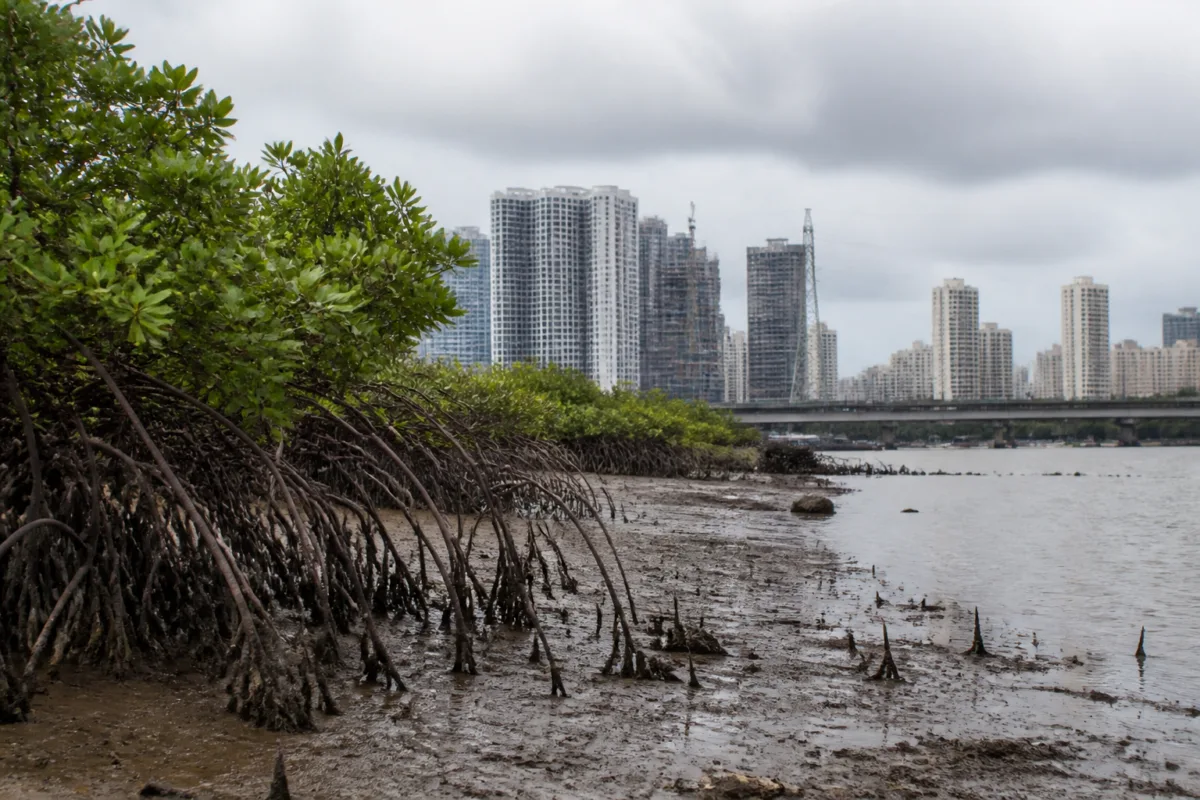
Mumbai mangrove cover declined by 17.41% between 2006 and 2024, according to a study that maps the changing condition of the city’s coastal ecosystems and raises a larger question: is Mumbai measuring restoration by the number of saplings planted, or by whether functioning mangrove habitats are returning?
The study, published online on October 26 in Elsevier’s Total Environment Advances, assessed mangrove dynamics across four coastal sectors—Versova-Madh Island-Malad, Gorai Creek, Thane Creek and Sewri-Chembur-Trombay. Using satellite imagery and machine-learning methods, researchers Vinod Kumar Yadav and Durgesh Kumar Jha found that the mapped mangrove area fell from 75.07 sq km in 2006 to 61.99 sq km in 2024.
The result is not simply a story about the disappearance of green patches from Mumbai’s coastline. Mangroves are working infrastructure: their root systems hold sediments, stabilise shorelines and create sheltered nursery habitats for juvenile fish, prawns, crabs and other aquatic organisms. Their condition therefore connects land-use change, coastal protection, fisheries and the everyday economy of communities that depend on nearby waters.
The researchers recorded 30.20 sq km of mangrove loss against 11.32 sq km of new growth in their common-resolution transition analysis. That produced a net reduction of 18.89 sq km. The largest net decline occurred between 2012 and 2018, while the study also found that the decline continued in the later period.
This distinction between loss and gain matters for urban planning. A city may report new vegetation in one location while losing older, denser or more ecologically connected mangrove stands elsewhere. The aggregate area can conceal the quality and continuity of the ecosystem. In Mumbai’s case, the study found that open mangrove cover declined by 76.80% and sparse mangrove cover by 19.28%, indicating changes not only in extent but also in vegetation density and structure.
That makes the findings more significant than a simple land-cover inventory. Mangrove ecosystems do not provide their full range of services merely because some vegetation remains visible from above. Their ecological functions depend on factors such as density, continuity, tidal conditions and the ability of the system to regenerate. The study establishes the geographical pattern and scale of change, but it does not measure fish populations, species diversity or fishing catches.
The fisheries connection is consequently an important area for further investigation rather than a proven causal outcome in the study. Mangrove roots provide shelter and food for aquatic organisms in their juvenile stages, while adjoining creeks receive nutrients and organic matter from these ecosystems. If suitable nursery habitats decline, fish recruitment could be affected, but the extent of any impact on fish stocks or fishing yields would require independent fisheries surveys.
The study’s methodology also shows why the precise percentage should be read alongside the broader trend. The researchers used four machine-learning techniques—Classification and Regression Trees, Random Forest, Gradient Boosted Trees and Support Vector Machine—to classify satellite imagery. They examined imagery from 2006, 2012, 2018 and 2024 and assessed the effect of differences in satellite resolution.
Between 2018 and 2024, the estimated decline was 5.03% at the native 10-metre resolution of Sentinel-2 imagery and 6.75% after the data was aggregated to a common 30-metre resolution. The estimates differ because the resolution changes how small patches and boundaries are classified. But both approaches point in the same direction: Mumbai’s mangroves continued to decline during the period.
That consistency is more important for governance than the apparent disagreement between two estimates. Monitoring systems must be able to distinguish genuine ecological recovery from changes created by mapping methods. A reliable baseline is necessary for decisions on protection, restoration and enforcement, particularly in a coastline where mangroves exist alongside dense settlements, transport infrastructure, industrial areas, creeks and development pressure.
The coastal protection value of mangroves adds another layer to the issue. The study notes that mangroves help stabilise shorelines, trap sediments, regulate nutrient cycles and reduce the force of waves and storm surges. Their degradation can leave coastal stretches more exposed to erosion and flooding. For Mumbai, where intense rainfall and coastal risks already place pressure on drainage and shoreline systems, the loss of natural buffers has implications beyond biodiversity conservation.
This does not mean mangroves can replace engineered flood-control infrastructure, nor does the supplied evidence quantify how much additional flooding or erosion the loss has caused. It does show that coastal resilience is not only a matter of concrete structures, pumping capacity or drainage expansion. The condition of natural ecosystems forms part of the city’s wider protective network, and damage to that network can be difficult to reverse once tidal connections and sediment processes are disrupted.
The study also brings attention to the performance of restoration. A previous assessment cited in the paper found that 13 of 25 mangrove restoration sites assessed in Mumbai showed no growth between the start of restoration and 2022. That finding challenges a narrow, activity-based definition of conservation in which success is counted through planting targets or the number of sites announced.
Mangrove restoration is tied to physical conditions. Tidal connectivity, suitable sediment and the ecological processes that support natural regeneration can determine whether planted or recovering vegetation survives. If those conditions are absent, planting may produce limited growth without recreating a functioning ecosystem. For administrators, this shifts the relevant question from how many saplings were planted to whether restored sites are connected to the coastal processes that mangroves need.
The institutional challenge is therefore twofold. Existing mangrove forests must be protected from further loss, while restoration programmes must be assessed against ecological outcomes. These are related but different tasks. Preventing destruction protects an established ecosystem; restoration attempts to rebuild one after its structure, hydrology or habitat functions have already been damaged.
Dr Nehru Prabakaran, a scientist at the Wildlife Institute of India and an expert on mangrove ecosystems, said mangrove decline worldwide has reduced in recent years because of local and global initiatives, but mangroves near densely populated urban centres continue to experience degradation despite management interventions. He described addressing the factors influencing Mumbai’s decline as an urgent need for safeguarding coastal ecosystems and their services.
His observation places Mumbai’s results within a wider urban pattern identified in the supplied report: mangroves close to large settlements remain under pressure even where conservation and management measures exist. The central governance issue is not simply whether a policy has been announced, but whether it changes the conditions that cause habitat loss and degradation on the ground.
The study does not identify every driver of the decline, and it does not establish the contribution of individual projects, land-use decisions or enforcement failures. That limitation is important. Satellite mapping can show where and how much cover has changed, but explaining why each patch was lost requires additional documentary, ecological and administrative investigation.
What the evidence does establish is substantial enough to demand that next phase of coastal planning. Mumbai’s mapped mangrove area declined from 75.07 sq km to 61.99 sq km over 18 years. The loss exceeded measured new growth, surviving vegetation became less dense in key categories, and restoration outcomes were uneven across the sites assessed. These are not isolated indicators; together they describe an ecosystem under sustained pressure.
The larger urban question is whether Mumbai’s natural coastal systems are being treated as active infrastructure or as leftover land awaiting another use. Mangroves support biodiversity, contribute to shoreline stability and sustain ecological processes linked to fishing waters. Their value is distributed across the city, but their loss is often localised and gradual, making it less visible than a flooded road or a damaged seawall.
The study provides a scientific basis for tracking that gradual change. It also identifies what remains unresolved: how mangrove decline is affecting fisheries, which local factors are driving habitat loss, and why some restoration sites have failed to grow. Those questions will require fisheries surveys, site-level ecological assessments and closer examination of the administrative measures governing Mumbai’s coast. Until then, the clearest conclusion is that conservation cannot be judged by mapped area or planting activity alone; it must be judged by whether Mumbai retains functioning mangrove ecosystems.

