


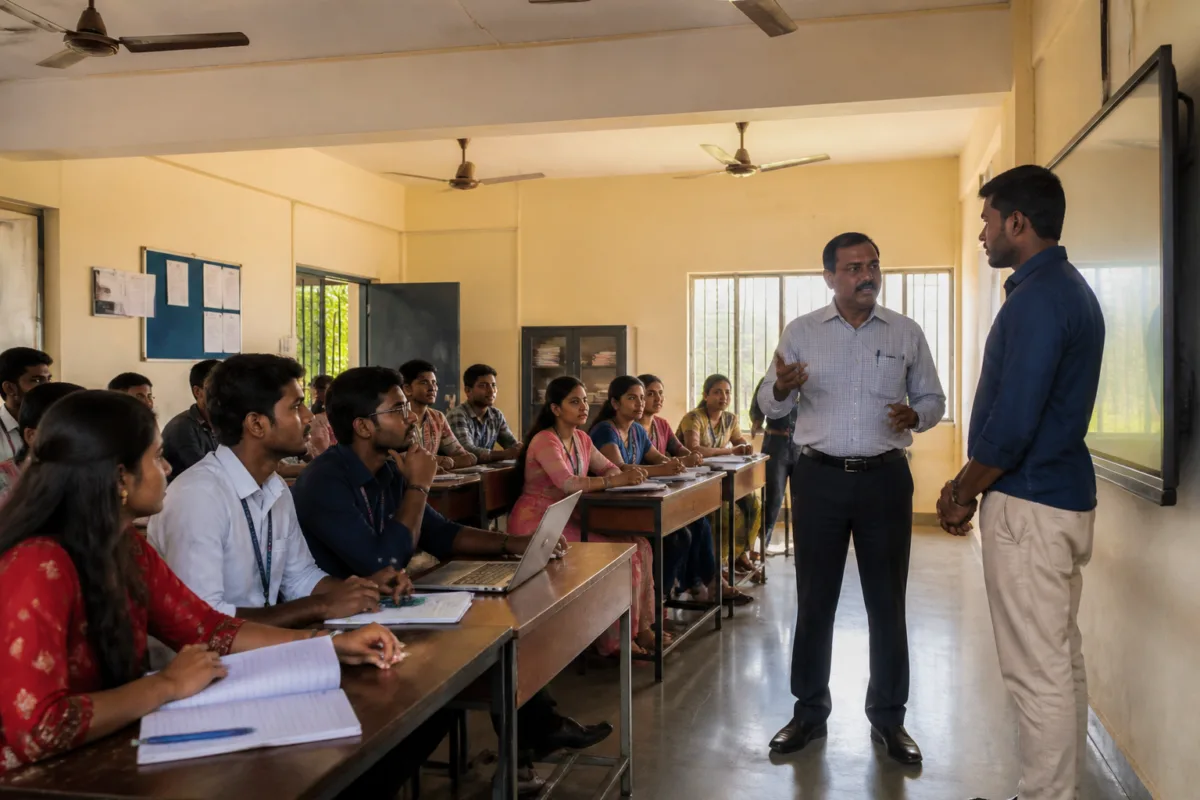
Tamil Nadu has assigned heads of departments in colleges and universities primary responsibility for student skilling and placements, shifting the centre of the state’s employment-readiness effort from placement coordinators to academic departments.
The change was set out in a circular issued by higher education secretary Dheeraj Kumar to state universities and colleges. Under the revised system, HoDs will coordinate training, identify industry requirements and lead efforts to connect students with job opportunities. Placement coordinators will continue to support students with CV preparation, interview skills, aptitude tests and mock interviews.
The circular said institutions had traditionally focused largely on theoretical learning, but students also needed skills that were relevant to industry. Each department has been directed to establish links with three to five relevant industries. These relationships are expected to be formalised through memorandums of understanding for regular interaction, curriculum feedback, industry-related assignments and mini projects.
The department has also instructed institutions to arrange internships of at least three months after students complete foundational training. The circular cautioned that students should not be sent to companies without basic preparation, as industries may be reluctant to accept candidates who do not have the required skills.
The initiative will cover all departments, including science and commerce. Language and social science departments may introduce generic skills such as digital marketing. Each HoD has been asked to identify two to three skill-training verticals, with six skills under each vertical.
The revised responsibilities extend beyond placements to the way departments engage with employers and adapt academic preparation. Industry tie-ups are expected to provide feedback on curricula and create opportunities for assignments and mini projects, although the circular does not specify a common state-wide format for measuring the outcomes of these partnerships.
Institutions have also been asked to nominate five members for placement training by the Tamil Nadu State Council for Higher Education, or TANSCHE. The details were to be communicated by November 16. TANSCHE will review the initiative alongside the “one degree, six skills” programme and monitor efforts to improve higher-order thinking skills in semester examinations.
The directive has drawn opposition from teacher associations, which have questioned whether colleges have enough staff to take on the expanded responsibilities. S Suresh, general secretary of the Tamil Nadu Government Collegiate Teachers’ Association, said skilling alone should not be the objective of education and claimed that government arts and science colleges had more than 7,000 vacancies.
Suresh said the state government should prioritise appointing permanent assistant professors because staff shortages were already making routine work difficult. The reported disagreement places the implementation of the new placement framework alongside a staffing issue within the state’s public higher education system.
The Higher Education Department’s circular requires HoDs to treat the responsibility as a substantive institutional task rather than a routine formality. The next formal steps are the nomination of institutional representatives for TANSCHE training and the department-level identification of industry partners and skill-training verticals.

