


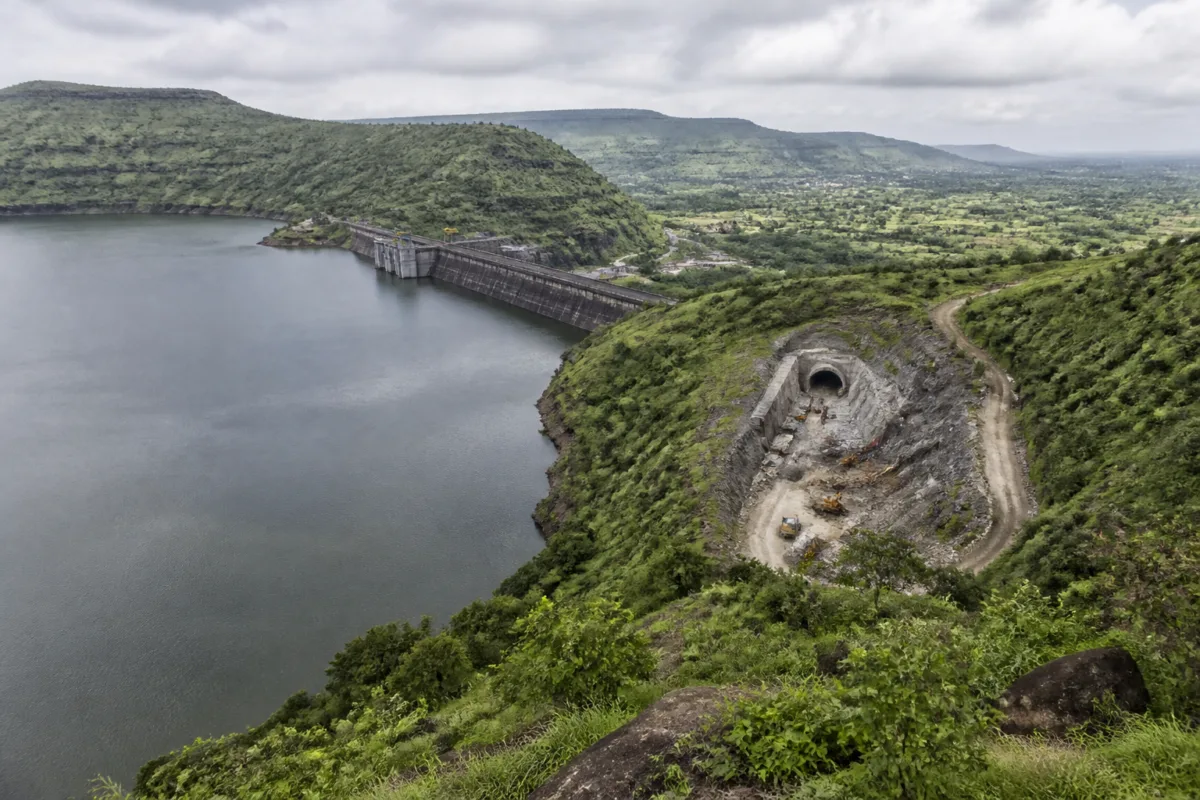
The proposed Mulshi Dam water diversion project is not yet a sanctioned water-transfer scheme, but it has already opened a larger question for Maharashtra: should water currently released westward after power generation be redirected towards drought-prone areas of eastern Pune and Solapur? The proposal under discussion involves a tunnel estimated to cost between ₹400 crore and ₹500 crore and could make about 5 TMC of water available for drinking water, irrigation and livestock needs, according to a report by Pudhari – Pune.
The reported plan is significant because it concerns more than the construction of a tunnel. It would alter how water stored in Mulshi Dam is allocated between hydropower generation and the needs of settlements and farms in the eastern river basins. The source says the water is primarily used for electricity generation and, after generation, flows westward. The proposal would reduce the discharge used for power generation and bring the water eastwards into the Mula-Mutha and Bhima river basins.
That arrangement creates the central administrative issue. Water infrastructure is rarely governed by engineering cost alone. A diversion project must reconcile the purpose for which a reservoir is operated, the requirements of downstream users, the interests of power generation, the rights and needs of drought-affected communities, and the state’s responsibilities across district boundaries. In this case, the source does not establish that any of those competing claims have been finally settled.
The reported proposal has received in-principle support from Chief Minister Devendra Fadnavis and Water Resources Minister Radhakrishna Vikhe Patil, according to Daund MLA Rahul Kul, who has been pursuing the issue. However, in-principle approval is not the same as administrative sanction, financial approval or permission to begin construction. The report does not provide a final government order, a detailed project report, a construction schedule or a confirmed implementation agency.
The tunnel is being considered as the permanent or longer-term mechanism for moving Mulshi water eastwards. Its estimated cost is reported at ₹400 crore to ₹500 crore. The funding question remains open. The state government may provide the money, but another possibility under discussion is to mobilise resources through transferable development rights, or TDR. The absence of a settled funding model is important because the choice would determine who carries the project’s financial burden and how the infrastructure is linked to urban development or land-based value capture.
TDR is generally associated with the transfer of development potential from one location to another. In the reported context, its possible use for a regional water tunnel suggests that the government is examining whether development-linked instruments can help finance public infrastructure. But the source does not explain the proposed mechanism, the locations from which TDR would be generated, the institutions that would administer it or whether the legal and planning framework permits this specific application. Those details will be essential before the funding model can be assessed.
The proposal also has an interim dimension. Since final approval and construction of a tunnel would take time, efforts are reportedly under way to release water directly into the river system. Kul has pursued this option, and meetings have been held at the state level, the report says. This indicates that the immediate policy objective is not limited to a future capital project. Authorities are also examining whether existing river channels or release arrangements can provide relief before a new tunnel is built.
That distinction matters for drought management. A tunnel can create a new physical connection between a reservoir and receiving basins, but it also requires design, land access, environmental and technical clearances, tendering, construction and operating rules. Direct release may appear faster, but it would still require decisions on the quantity, timing and destination of water, as well as the effect on power generation and downstream users. The supplied report does not establish whether the direct-release option has been approved or how much water it could deliver.
The reported 5 TMC figure is the most important quantitative detail in the proposal. It represents the amount of water that the plan is expected to make available for the eastern areas. The source links this volume to drinking water, irrigation and livestock needs in Daund and parts of Pune and Solapur districts. It also reports water shortages in several eastern villages and difficulties faced by farmers because irrigation water is unavailable.
At the same time, the report does not provide a village-level distribution plan, a command-area map, seasonal availability figures or an assessment of current demand. It therefore establishes the scale claimed by the proponents but not the precise number of people, farms or livestock units that would receive water. Nor does it establish whether 5 TMC would be a one-time seasonal allocation, an annual volume or a quantity available under particular reservoir conditions. These questions will determine the project’s actual public value.
The geography of the proposal is central to its politics and administration. Mulshi Dam is in the western part of Pune district, while the intended beneficiaries are described as being in eastern Pune and eastern Solapur, areas identified in the report as drought-prone. The water would be brought towards the Mula-Mutha and Bhima basins. This makes the proposal an inter-basin and inter-district allocation issue, rather than a local municipal supply project.
Such transfers can create benefits for areas with water deficits, but they also require transparent allocation rules. The source reports that the water is currently associated primarily with power generation and flows westward after generation. Any reduction in that discharge could affect the way the existing system is operated. The report does not quantify the power generation that could be affected, identify the operator responsible for the current releases or explain how the proposed water allocation would be balanced against electricity requirements.
The state Water Resources Department is likely to be central to the project’s next stages, given the involvement of the water resources minister and the reference to state-level meetings. Yet the supplied material does not identify a formal nodal agency, a project authority or the department responsible for coordinating the tunnel, river releases, funding and beneficiary districts. That institutional gap is not a minor detail. Large water projects often move through several approvals, and responsibility for construction may differ from responsibility for reservoir operation and distribution.
The proposal also illustrates the difference between announcing a water solution and delivering one. The reported political support may move the issue onto the state’s agenda, but the project still needs a defined technical option, a cost estimate supported by a detailed design, a funding decision and a formal approval process. The source does not state whether a feasibility study has been completed or whether the ₹400 crore to ₹500 crore estimate is based on a preliminary assessment.
For residents of drought-affected areas, the immediate concern is access to reliable drinking and irrigation water. For farmers, the value of a 5 TMC allocation would depend on when the water arrives and how it is distributed. For livestock-dependent households, reliability during dry periods would matter as much as the total volume. These ground-level questions are not answered by the announcement, but they define whether the proposal becomes a functioning public utility or remains a political and engineering concept.
The Mulshi proposal therefore marks an important shift in the water debate: from simply identifying drought-prone regions to considering whether existing water uses and river-basin flows should be reorganised. Its significance lies in the choices that must now be made about hydropower, irrigation, drinking water, inter-basin transfers and public finance. The supplied report confirms that the proposal is under discussion and has received reported in-principle political support. It does not confirm final approval, funding, construction or implementation.
The next decisive steps are a formal decision on the tunnel, clarification of whether the state government or TDR will fund it, and a documented plan for any interim direct release of water. Until those decisions are recorded, the 5 TMC figure and the ₹400 crore to ₹500 crore tunnel remain proposal-stage commitments rather than delivered water infrastructure.

