


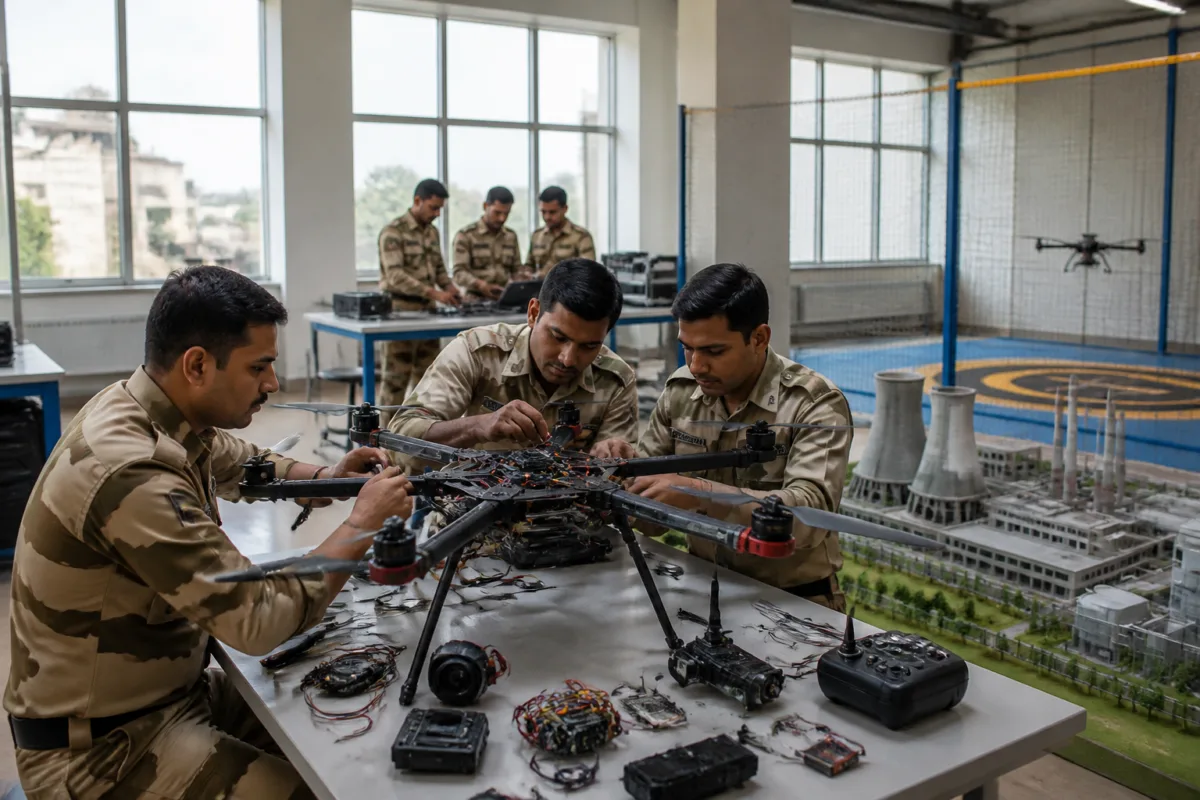
The Central Industrial Security Force’s agreement with IIT Hyderabad’s Technology Innovation Hub on Autonomous Navigation (TiHAN) marks a shift in how India’s critical infrastructure security is being organised: protection is no longer limited to physical perimeters, access control and conventional surveillance, but is increasingly being linked to expertise in drones, autonomous systems and cyber-physical risks.
The Memorandum of Understanding, formalised at the IIT Hyderabad campus on October 31, 2026, will give CISF trainees access to specialised instruction in drone assembly, flight operations and autonomous systems research. The partnership will also support the force’s proposed Centre of Excellence for Drone and Anti-Drone Technology at its Recruit Training Centre in Behror, Rajasthan.
The immediate announcement is about training. Its larger significance lies in the institutional problem it attempts to address: industrial and transport assets are becoming more technically complex, while the risks around them are no longer confined to people entering restricted premises. Power facilities, petroleum installations, coal operations, ports and other critical assets are interconnected systems. A disruption, intrusion or surveillance breach involving one layer can have consequences across operations, logistics and public services.
The CISF is responding by building technical capacity inside its training system rather than treating drone threats as a narrow equipment requirement. Under the agreement, Assistant Commandant probationers and Sub-Inspector trainees at the National Industrial Security Academy will attend short-duration capsule courses at TiHAN. The trainees are expected to receive hands-on exposure in laboratories, giving the arrangement an applied component rather than limiting it to classroom instruction.
That distinction matters for a force whose personnel operate across very different infrastructure environments. A drone threat near an airport, port, power plant or petroleum facility may involve different operating conditions, restricted zones, surveillance requirements and emergency responses. The supplied report does not specify the equipment or operational protocols that will eventually be deployed, but it makes clear that the CISF is seeking a common institutional base of knowledge that can be adapted to multiple sectors.
The collaboration also coincides with a structural change within the force. According to the report, the CISF has shifted from a traditional territorial command arrangement towards dedicated, sector-specific commands covering areas such as power, petroleum, coal and ports. This functional pattern places greater emphasis on the characteristics of the asset being protected rather than only on its geographical location.
That shift can be read as an administrative response to the changing nature of infrastructure risk. A port security unit, for example, must understand maritime operations and cargo movement. A power-sector unit must work around facilities whose disruption can affect wider networks. A petroleum installation presents different hazards and operating constraints. Sector-specific supervision is intended to create deeper knowledge of these environments, and the TiHAN partnership supplies one technical layer to that broader specialisation.
Harpreet Kaur Sohi, Inspector General and Director of the National Industrial Security Academy, said the MoU would increase specialisation within the force and support the newly formed functional sector pattern of supervision. She described the objective as embedding academic research into training so personnel could develop technical expertise alongside their security responsibilities.
The arrangement therefore joins three institutional functions that are often separated: security operations, professional training and academic research. TiHAN contributes expertise in autonomous navigation and laboratory-based technology work. NISA becomes the channel through which that knowledge reaches new officers and personnel. The proposed centre at Behror is intended to provide a more permanent institutional base for drone and anti-drone capability within the CISF.
The available information does not establish the centre’s launch date, staffing model, procurement plan or technical specifications. It also does not state how the force will measure the effectiveness of the courses or how training will translate into standard operating procedures at individual installations. These details will determine whether the partnership remains primarily an educational initiative or becomes part of a wider operational capability.
The CISF’s decision to work with an academic technology hub is also part of a wider pattern of institutional partnerships. The force has signed or pursued agreements with IIT Kanpur on cybersecurity and anti-drone capabilities, IIT Ropar on a specialised cybersecurity cadre for aviation infrastructure, the National e-Governance Division on artificial intelligence, drone technology and cybersecurity, Kalinga Institute of Industrial Technology on cyber defence training, and the Indian Maritime University on port and maritime security capacity building, according to the report.
Taken together, these agreements indicate that the force is building a distributed knowledge network rather than relying on a single technology provider or training location. The partnerships cover autonomous systems, cyber defence, aviation, maritime operations and artificial intelligence. That breadth reflects the fact that critical infrastructure security now sits across physical, digital and aerial domains.
For cities, the issue is not remote from everyday urban life. Airports, ports, energy facilities, industrial areas and logistics networks are embedded in metropolitan economies. Their security arrangements can affect the continuity of passenger travel, goods movement, fuel supply and essential services. The public may not see the training system behind those operations, but the resilience of urban life depends partly on whether infrastructure agencies can identify and respond to emerging forms of disruption.
The announcement also highlights a governance challenge. Technology-led security cannot be created only by purchasing drones, detection systems or counter-drone equipment. It requires personnel who understand how those systems work, how they interact with existing surveillance and communications infrastructure, and how responses should be coordinated. The MoU’s focus on assembly, flight operations and autonomous systems research suggests that the CISF is seeking foundational technical familiarity, although the supplied material does not describe the final operational architecture.
The move towards functional sector commands may help create clearer accountability for this work. A sector-specific structure can allow training needs, technology assessments and operational lessons to be organised around the infrastructure being protected. At the same time, the model will require coordination across sectors because the same technologies may be used in airports, ports, power facilities and industrial sites. The report does not provide details of that coordination mechanism.
What the evidence confirms is a formal attempt to connect CISF training with IIT Hyderabad’s specialised research environment, along with plans to develop a dedicated drone and anti-drone centre. What remains unclear is the scale of investment, the timeline for implementation, the technologies to be adopted and the performance standards that will govern deployment. Those will be the next important indicators of whether the partnership produces a durable security capability or remains one of several MoUs in a growing institutional network.

