


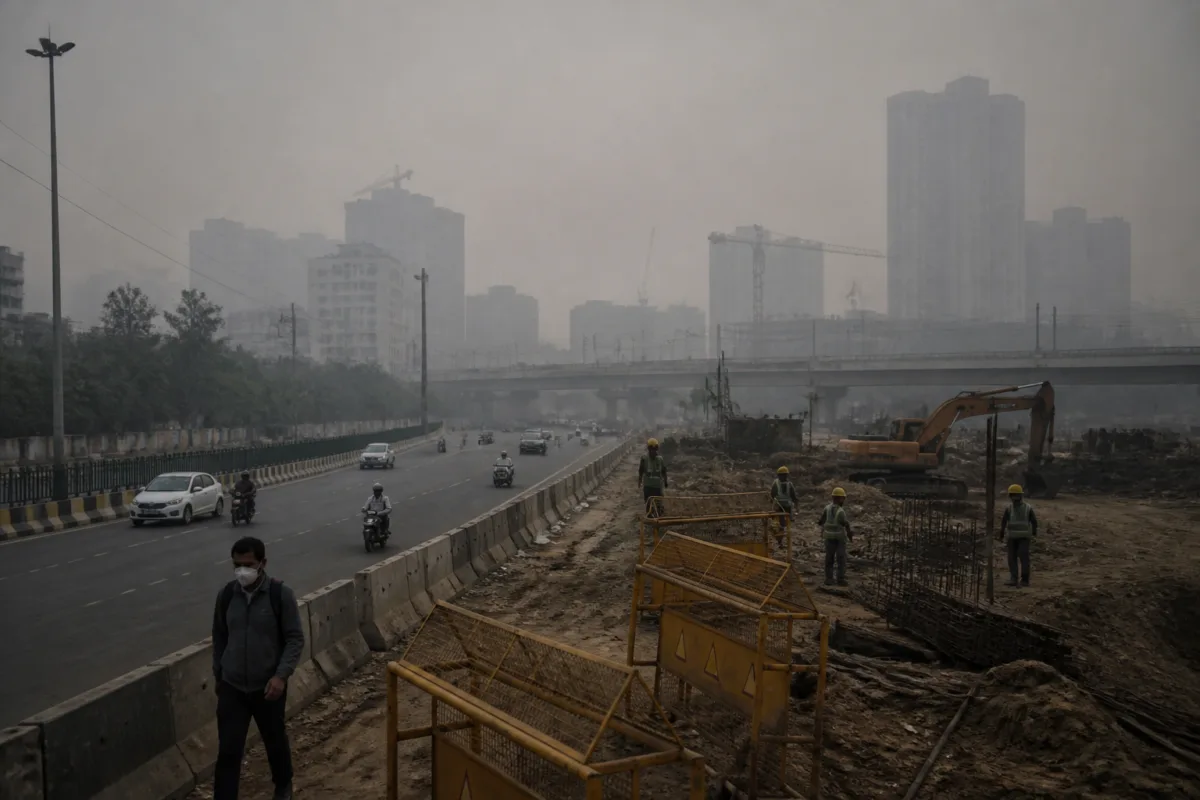
Delhi-NCR air pollution controls will tighten from November 5, with government and private offices in Delhi and five adjoining districts limited to 50 per cent physical attendance and outdoor construction largely suspended until November 20 under a preventive order issued by the Commission for Air Quality Management (CAQM).
The order, issued on October 30 under Section 12 of the CAQM Act, 2021, applies to the National Capital Region, including the NCT of Delhi and the districts of Gurugram, Faridabad, Sonipat, Ghaziabad and Gautam Buddha Nagar. The measures are intended to reduce emissions before the period in which air quality has historically deteriorated sharply.
Government and private offices have been directed to allow up to half their staff strength to attend physically, with the remaining employees working from home. The arrangement excludes industrial establishments and essential services where remote working is not feasible.
The construction restriction covers dust-generating demolition and outdoor construction activity across the NCR. Exemptions have been provided for projects related to Railways, Metro services, airports, inter-state bus terminals, hospitals, water supply and sanitation, national security and defence, and projects classified as being of national importance.
The restriction also applies to linear public infrastructure projects, including highways, roads, flyovers, overbridges, power transmission lines, pipelines and telecommunication works. The order was issued by Tarun Kumar Pithode, Member Secretary of CAQM.
CAQM said its decision was based on an analysis of daily Air Quality Index data for November between 2018 and 2025. According to the commission, Delhi-NCR has shown a recurring pattern of elevated pollution during early to mid-November, with some days reaching the ‘Severe’ and ‘Severe+’ categories.
The commission attributed the seasonal deterioration to a combination of local emission sources, agricultural residue and biomass burning, other episodic emissions and weather conditions that restrict pollutant dispersion. Low wind speeds, a shallow atmospheric boundary layer and reduced vertical mixing can allow pollutants to accumulate over the region.
CAQM said it had revised the schedule of the Graded Response Action Plan in September to provide a framework of preventive and restrictive measures during periods of adverse meteorological conditions. The latest order represents an anticipatory intervention intended to reduce the emission load before peak pollution episodes begin.
In a separate order, the Central Pollution Control Board directed the pollution control authorities of Delhi, Haryana, Uttar Pradesh and Rajasthan to begin issuing show-cause notices for closure to industrial units that have not placed work orders for installing or retrofitting air pollution control devices to meet the revised emission limit of 50 milligrams per normal cubic metre.
The direction applies to units covered under Clause 21(i) of CAQM Direction No. 98 that have also not obtained adequacy assessment reports or exemption certificates. Industries will have five days to provide satisfactory evidence of a work order, a valid exemption or an adequacy report. Units that fail to do so may face closure until they submit a credible compliance timeline accepted by the relevant board.
The CPCB has also directed state pollution control boards and the Delhi Pollution Control Committee to submit weekly status reports on notices and closure orders. The reports may include action such as revocation of consent to operate and electricity disconnection through the concerned distribution company or district magistrate.
The restrictions will remain in force from November 5 to November 20, while essential public infrastructure and critical services covered by the exemptions can continue subject to the applicable pollution-control requirements.

