


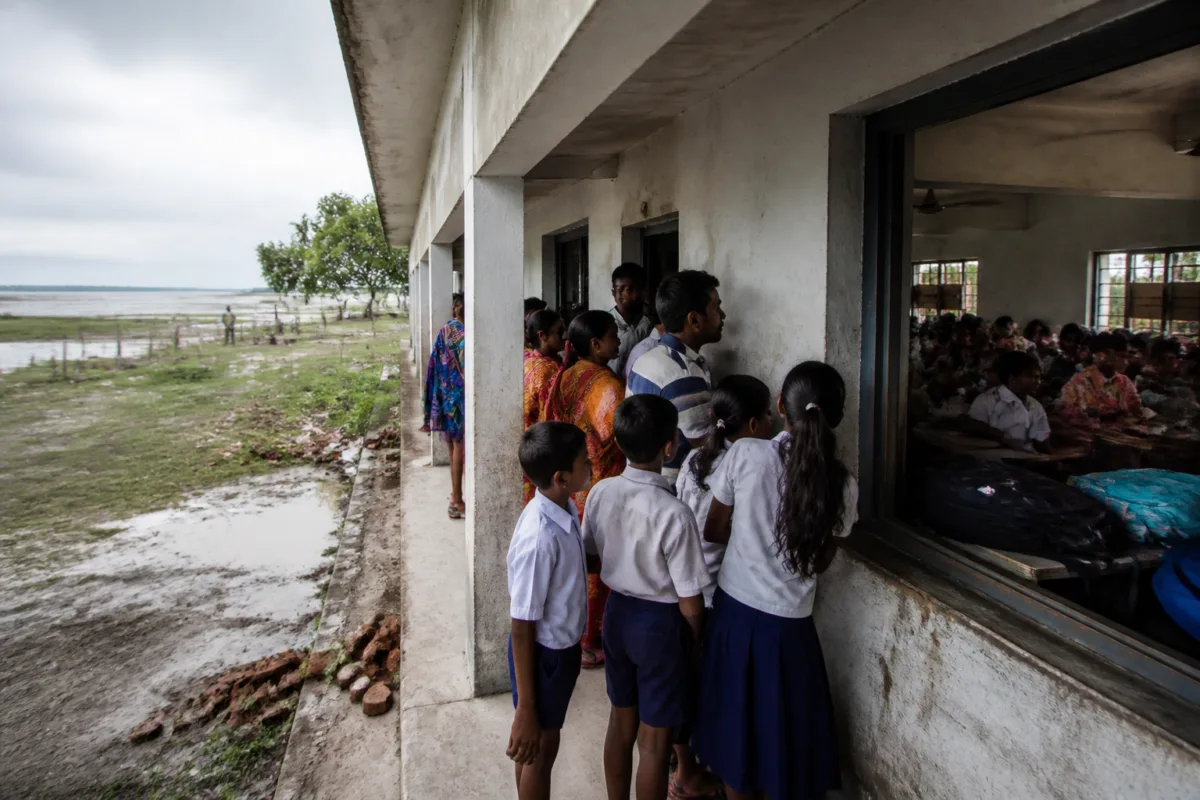
The Murshidabad school crisis is no longer only a dispute over classrooms. It is the result of a rehabilitation arrangement that began as an emergency response to Ganga erosion in 2022 and has since left displaced families in school buildings, teachers without usable classrooms and hundreds of children without normal access to education. The case at Pratapganj in Samserganj shows how temporary shelter can become an extended administrative failure when housing rehabilitation, land suitability and public-service protection are not resolved together.
Twenty-two families displaced by riverbank erosion were accommodated in the buildings of Pratapganj Primary School and the adjacent Pratapganj Junior High School. The arrangement was intended to be temporary. According to the report, most other displaced families eventually left, but nine families continued to occupy all five classrooms at the primary school and another 13 remained in the junior high school. The occupation has continued for nearly four years.
The schools are now functioning in spaces that were never designed to serve as emergency shelters and classrooms simultaneously. At the primary school, only the office room and a corridor remain available for teaching. The headmaster, Chandan Saha, said enrolment had fallen from around 200 students to 75, with parents withdrawing children because the campus was no longer conducive to learning. He also said students were unable to use the toilets.
The junior high school faces a more severe space constraint. All rooms except the office, one classroom and the midday meal kitchen are occupied, according to headmaster Mohan Das. Teachers use the remaining classroom on a rotational basis and sometimes teach multiple classes together. Das said daily attendance had fallen by around 50 per cent and alleged that some occupants had become aggressive towards guardians.
These numbers describe more than declining attendance. They show how the loss of school space can quietly become a loss of educational continuity. A school may remain officially open while its practical capacity collapses. Enrolment can continue to exist on paper even as parents seek alternatives, teachers combine classes and basic facilities become inaccessible. In this case, the reported fall from approximately 200 enrolled students to 75 attending the primary school provides a direct measure of how the conflict has altered the institution’s functioning.
The dispute also exposes a weakness in the way rehabilitation has been treated. The district administration reportedly allotted the families land with pattas and provided financial assistance of ₹1.20 lakh each to build houses. From the administration’s perspective, these measures were intended to create a route out of the schools. But one occupant told the newspaper that the allotted land was far away and unsuitable, and that the families wanted a fresh allotment closer to Pratapganj. The disagreement therefore concerns not simply whether assistance was provided, but whether the rehabilitation offer was usable for families whose social and economic lives remained tied to the area.
That distinction is central to the case. A land title and a construction grant can satisfy the formal elements of rehabilitation without producing an actual move if the location is considered unsuitable or inaccessible. The supplied report does not establish why the land was judged unsuitable, whether alternative sites were assessed, or whether the financial assistance was sufficient to construct homes. It does, however, establish that the families did not accept the arrangement as a workable replacement for the school buildings they occupied.
The institutional chain is also visible in the response to the impasse. School authorities informed the local block development officer and the sub-inspector of schools. The sub-inspector issued a notice asking the occupants to vacate, but they refused, according to the primary school headmaster. Samserganj panchayat samiti chief Payel Das called for immediate district intervention. Jangipur sub-divisional officer Sudhir Kumar Reddy said he was unaware of the situation but would examine it, adding that families who had received land and financial aid could not continue occupying classrooms and would have to be evicted to restore normal school functioning.
This sequence points to an unresolved coordination problem. The schools fall within the education system, while the families’ displacement and rehabilitation involve the district administration and local government. Notices from school authorities have not resolved a housing and land dispute. At the same time, the availability of a rehabilitation package has not restored the schools. The result is an institutional gap in which each side’s immediate problem remains active: families require a location they consider viable, and schools require the return of rooms meant for teaching.
The case also raises a question about the protection of public buildings during disasters. Schools are often among the few substantial structures available in vulnerable areas, making them convenient emergency shelters. But when temporary occupation lasts years, the cost is transferred to children who have no role in the original displacement or the subsequent dispute. The Pratapganj schools illustrate how disaster response can create a second public-service emergency when an exit plan is not implemented within a defined timeframe.
The reported conduct inside the campus further complicates the situation. Teachers said around 100 members of the 22 families had effectively taken control of the campus, leaving teachers and students feeling like outsiders. The report also records that some occupants declined to comment and that another occupant, speaking anonymously, sought a fresh nearby allotment. These accounts indicate a tense environment, but they do not independently establish the full nature of interactions between residents, teachers, students and parents. What is clear is that the shared campus is no longer functioning as a conventional school environment.
The education impact is particularly significant because the disruption has extended over nearly four academic years rather than a short emergency period. The report does not provide examination results, grade-wise attendance, dropout figures or details of alternative schools available to affected children. It therefore cannot establish the long-term academic consequences in measurable terms. It does establish the immediate conditions through which such consequences can develop: reduced attendance, cramped teaching arrangements, limited toilet access and parents looking for alternatives.
The rehabilitation dispute also demonstrates why displacement policy cannot be measured only by the distribution of land documents or cash assistance. The relevant test is whether families can move into safe, acceptable and functional housing without losing access to livelihoods, services and community ties. In the Murshidabad case, the families’ reported objection to the distance and suitability of the allotted land has prevented the formal package from producing a practical settlement. The supplied evidence does not reveal whether the administration conducted a post-allotment assessment or offered mediation before considering eviction.
The immediate choices before the administration are consequently linked. Restoring the schools requires the classrooms to be vacated, but enforcement without resolving the families’ objections may leave the underlying displacement issue unsettled. Conversely, allowing continued occupation protects a temporary shelter arrangement at the expense of students, teachers and the public purpose of the buildings. The statements reported from the panchayat samiti chief and the sub-divisional officer show that officials recognise the conflict, but the report records no completed relocation, negotiated settlement or operational plan.
The Murshidabad school crisis confirms that the failure is not confined to one building or one attendance figure. It lies at the intersection of river erosion, land rehabilitation, public education and administrative responsibility. The families were displaced by a natural process, but the prolonged disruption has been shaped by decisions about where they could live, how suitable that land was and how quickly authorities acted when the temporary arrangement stopped working. The next significant development will be the district administration’s examination of the impasse and whether it produces a viable relocation plan while restoring both schools to full educational use.

