


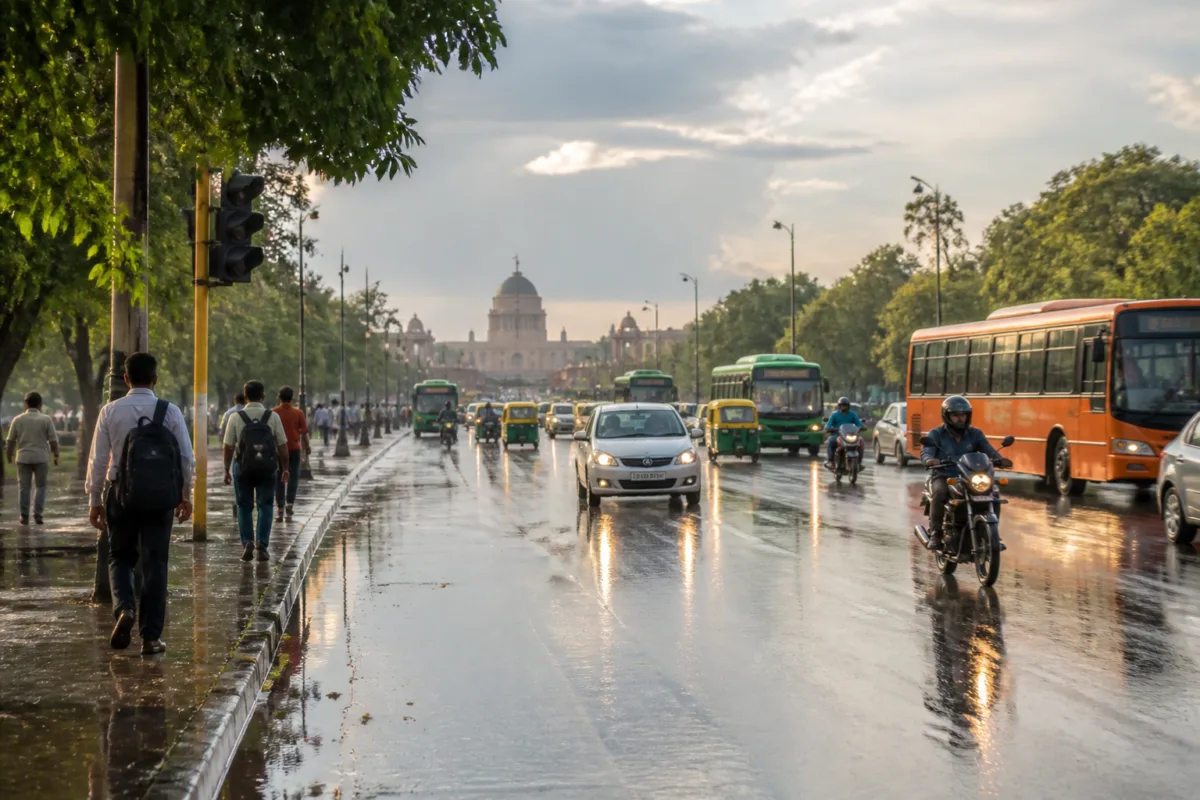
Delhi’s October average AQI has fallen to a record low of 167.2, offering the capital a rare improvement after years in which the month’s average remained above 200. But the data does not yet show that Delhi has solved its pollution problem. It shows that unusually favourable weather, a late Diwali and limited stubble-burning contribution temporarily changed the city’s pollution balance.
The distinction matters because the month’s average AQI is only one measure of air quality. Delhi’s average PM2.5 concentration reached 70.5 micrograms per cubic metre, above the national daily standard of 60 micrograms per cubic metre and 4.7 times the World Health Organization’s daily safe limit of 15 micrograms per cubic metre cited in the report. PM10 reached 175.8 micrograms per cubic metre, exceeding the national standard of 100 and standing at 3.8 times the WHO safe limit of 45.
The record-low October AQI therefore represents relief, not clean air. It also illustrates how strongly Delhi’s urban environment responds to factors beyond the immediate control of municipal agencies: rainfall, atmospheric dispersion, temperature and the timing of seasonal emissions.
The numbers show how unusual this October has been. Delhi’s average October AQI was 223 in 2025, 234 in 2024, 219 in 2023, 210 in 2022 and 173 in 2021. Earlier Central Pollution Control Board data cited in the report put the October averages at 265 in 2020, 234 in 2019, 269 in 2018, 285 in 2017, 271 in 2016 and 264 in 2015.
Against that sequence, 167.2 is a substantial fall. Yet the longer pattern also shows why one favourable month should not be treated as a structural turnaround. Delhi’s October air has repeatedly deteriorated into the poor and worse categories, and the current improvement has occurred before the more difficult winter conditions described by experts in the report.
Rainfall has been the most visible driver this year. Moderate to heavy rain in Delhi and adjoining areas pushed the city’s AQI from 222, in the poor category, to 60, in the satisfactory range, in a single day. That was the cleanest October day in four years. A lower October AQI was last recorded on October 11, 2022, when the reading was 44.
The monthly distribution also reflects the temporary improvement. Delhi recorded five poor days, three satisfactory days and 22 moderate days during the month. The city therefore spent most of October in the moderate category, rather than in the poor category that has characterised several recent Octobers.
Anumita Roychowdhury, executive director-research and advocacy at the Centre for Science and Environment, said excess rainfall scrubbed ambient particulates and helped disperse pollution. She also said the weather reduced the contribution of transboundary smoke from regional farm-stubble burning. Because Diwali arrived later this year, its firecracker emissions did not affect October’s air quality in the same way.
Roychowdhury described the improvement as largely meteorology-driven. That assessment places the October result in a wider institutional context. Delhi’s air quality is not produced by one source or controlled by one authority. It reflects the combined effect of transport, waste burning, industrial emissions, construction-related dust, regional agricultural burning and atmospheric conditions. The month’s figures show what can happen when several seasonal contributors are weaker or dispersed, but they do not identify a permanent reduction in those sources.
Sunil Dahiya, founder of the think tank Envirocatalyst, said measures taken across sectors may also have contributed to the reduction, while identifying meteorology as the major factor. The distinction between possible contribution and dominant cause is important. It means the data supplied in the report cannot establish how much of the improvement came from enforcement or emissions-control measures, even though sectoral action may have played a role.
This creates a familiar governance challenge for Delhi’s pollution-control system. A lower AQI can be recorded at the city level even when particulate concentrations remain above national standards. The city may appear to be improving according to the composite AQI while residents continue to experience exposure to PM2.5 and PM10 at levels that remain unsafe by the standards cited in the report.
The issue is partly one of measurement and communication. AQI is useful for indicating broad air-quality conditions, but its category-based reading can obscure the persistence of specific pollutants. Delhi’s October average of 167.2 is significantly better than the recent October averages listed in the report. It is not equivalent to an absence of health risk, because the underlying particulate concentrations remain elevated.
The timing of Diwali further demonstrates how seasonal comparisons can mislead. Since firecracker emissions did not affect October’s air quality this year, comparing the month’s average directly with years when Diwali fell earlier would mix meteorological change with a different emissions calendar. The lower monthly number is real, but its causes are not limited to policy performance.
The same caution applies to stubble burning. The report states that its contribution to the emission load has so far been low and that rainfall minimised transboundary smoke. This does not remove regional pollution from Delhi’s air-quality equation. It shows instead that the scale of its effect can vary with weather and timing. The city’s pollution burden is therefore shaped by both emissions and the conditions that transport, disperse or trap them.
That relationship becomes more consequential as winter approaches. Roychowdhury warned that falling temperatures and atmospheric inversion would require rigorous ground-level action focused on transport, waste burning and industrial emissions. The warning shifts attention away from the October result and towards whether authorities can control local sources when atmospheric conditions become less favourable.
The policy landscape described by the supplied evidence is consequently broader than emergency action around Diwali or stubble burning. Transport emissions, waste burning and industrial pollution require sustained work across agencies and jurisdictions. The report does not provide details of specific enforcement programmes, budgets, targets or agency performance, so it cannot establish whether existing measures are reducing emissions at source. What it does establish is that favourable weather can deliver a visible improvement even while particulate levels remain above standards.
For citizens, the practical meaning is uneven. A day with an AQI of 60 provides immediate relief compared with a reading of 222. But a monthly PM2.5 average of 70.5 and PM10 average of 175.8 indicates that the improvement cannot be understood simply as a return to safe air. The city’s lived experience may improve temporarily, while the underlying exposure burden remains substantial.
The October data also exposes the difference between resilience and dependence. Delhi’s air quality improved because rainfall helped remove particulates, dispersion weakened pollution accumulation, Diwali occurred later and stubble-burning contribution remained limited. These are favourable conditions, not necessarily durable urban capacity. A pollution-control system that performs well only when weather assists it remains vulnerable to seasonal change.
The evidence confirms three facts. Delhi has recorded its lowest October average AQI, the improvement is associated mainly with rainfall and other favourable conditions, and PM2.5 and PM10 remain above the national standards cited in the report. What remains unestablished is the extent to which sector-specific control measures independently reduced emissions. The next test will come as temperatures fall and atmospheric inversion increases, when transport, waste burning and industrial emissions will face less meteorological help to disperse.

