


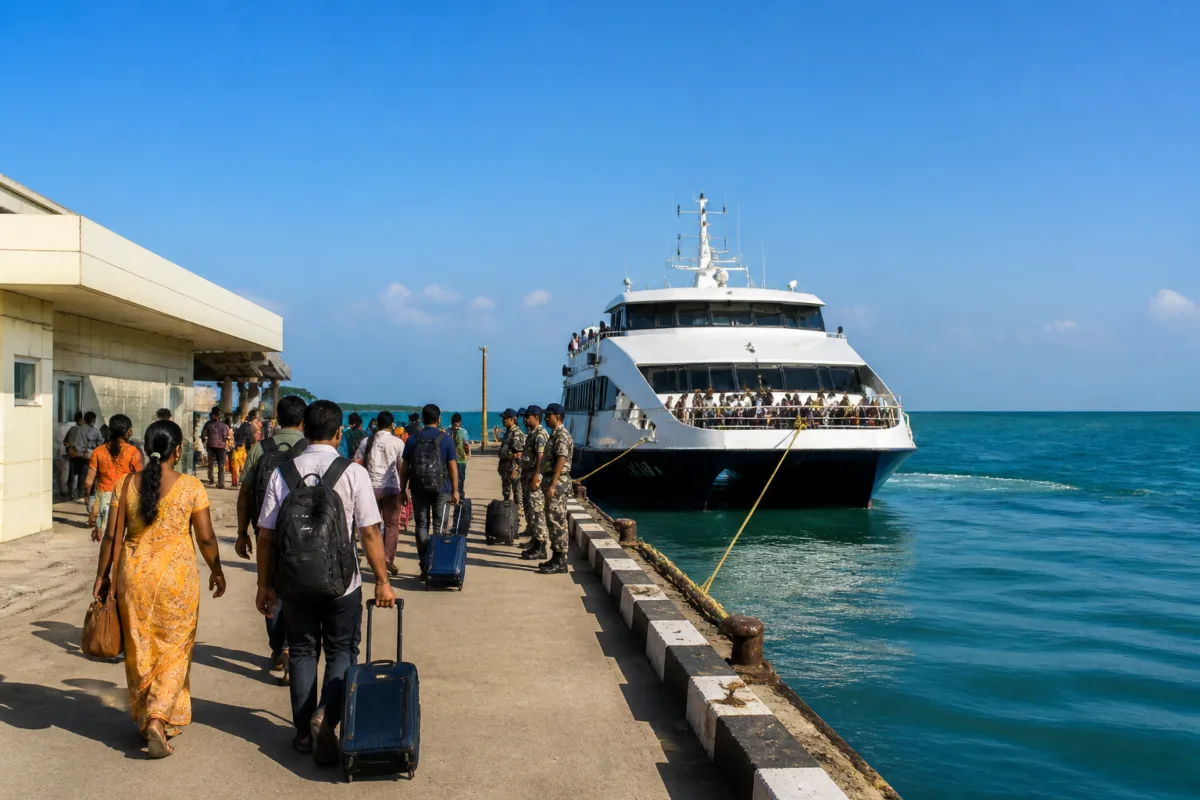
Tamil Nadu’s proposal for a ferry between Rameswaram and Sri Lanka’s Talaimannar is being presented as the next step in India–Sri Lanka maritime connectivity. But the project is not simply a matter of placing a vessel on a short sea route. It requires bilateral arrangements, immigration and customs systems, maritime security, environmental clearances, terminal infrastructure and public financial support. The distance is only around 26 nautical miles; the institutional distance is considerably greater.
The Tamil Nadu government has sought the Centre’s support and ₹100 crore for the proposed service, according to the Times of India report. The Tamil Nadu Maritime Board has urged the Union government to provide the funding, while officials said the project could be considered under Sagarmala 2.0. The proposal follows the operation of the Nagapattinam–Kankesanthurai ferry, which connects Tamil Nadu with a port near Jaffna in Sri Lanka’s Northern Province.
That existing route provides the clearest evidence available in the supplied material about the opportunities and constraints facing a new ferry link. The Nagapattinam–Kankesanthurai service has carried 21,812 passengers from Nagapattinam and 26,242 passengers from Kankesanthurai until September, according to officials. Its 150-seat private ferry operates for nine months, from March to November, six days a week, and records an average occupancy rate of 60%.
The figures show that there is an identifiable passenger market, but they also show why a ferry service cannot be assessed only through its geographic proximity. A route can be physically short and still require significant support to remain operational. The existing service began in August 2024, was disrupted during the monsoon and resumed in February 2025. Its seasonality, weather exposure and dependence on viability-gap funding are central to understanding whether another route can become a stable transport connection.
## A short route with a long administrative chain
The proposed Rameswaram–Talaimannar service would connect two locations separated by about 26 nautical miles. The route’s proximity could support passenger travel, tourism, small-scale trade and cultural links, but the project must first satisfy the requirements that govern an international port connection. Officials cited bilateral arrangements, immigration and customs facilities, maritime security and terminal infrastructure as necessary components.
These requirements place the ferry within several administrative systems at once. Tamil Nadu would be responsible for developing or facilitating port-side infrastructure and coordinating with the Union government. Immigration and customs agencies would need operational facilities and personnel. Maritime security arrangements would also have to be established. The project therefore depends on coordination beyond the state’s transport and ports departments, even though the initial push has come from the Tamil Nadu government.
Environmental approval is another significant stage. Officials said a jetty and passenger terminal would have to be constructed and that environmental clearances would be required. This means the proposal is still at a preparatory stage rather than being an approved or scheduled ferry launch. The supplied report does not establish a construction timeline, an operating date, a final terminal location or the identity of a selected operator.
The proposed ₹100 crore support request is consequently not only a capital demand. It signals that the state expects the Centre to help convert a connectivity idea into an operational international transport facility. Whether that amount will cover the eventual cost of the jetty, terminal, security arrangements and associated systems is not established in the supplied material. What is clear is that the state does not view the route as a purely commercial service that can be launched without public-sector participation.
## The existing ferry shows the viability problem
The Nagapattinam–Kankesanthurai service offers a useful operational reference, although the two routes should not be treated as identical. The private ferry takes about four-and-a-half hours and has carried a combined total of 48,054 passengers from the two terminals until September, based on the figures cited in the report. With 150 seats and an average occupancy rate of 60%, the service has attracted regular use but has not operated at full capacity.
The route also operates within a restricted annual window. The ferry runs from March to November, while the service was disrupted during the monsoon before resuming in February 2025. This makes weather and seasonal continuity part of the business model rather than an incidental operational concern. For any new service, vessel deployment, terminal planning and passenger communication would have to reflect those limitations.
The existing route is also being supported through public funding. The Union ministry of external affairs has sanctioned viability-gap funding for another year, according to officials. The assistance includes ₹6 crore for deploying Central Industrial Security Force personnel and ₹2 crore for terminal staff salaries. The state had earlier sought viability-gap funding for three years.
This funding arrangement reveals the difference between connectivity as public policy and connectivity as a commercially self-sustaining operation. Security and terminal staffing are essential to an international ferry, but they also create recurring costs that passenger fares may not fully cover. The presence of viability-gap funding suggests that the service’s public value is being recognised even where operating economics remain challenging.
The proposed Rameswaram–Talaimannar link would therefore enter an environment in which passenger demand exists, but infrastructure and security costs require continued institutional support. The state’s stated aim of inviting operators from other regions and expanding the existing Nagapattinam–Kankesanthurai service also indicates an attempt to build a broader operating ecosystem rather than rely on a single private provider.
## From passenger movement to coastal trade
The proposal is being linked to maritime connectivity, trade, tourism and historical and cultural ties between India and Sri Lanka. The government also plans to introduce a cargo service with a capacity of 500 tonnes, primarily for the construction, food and textile sectors. That cargo component would broaden the project beyond tourism and passenger travel, but it would also introduce additional operational and regulatory requirements.
A passenger ferry and a cargo service do not place identical demands on a port. Cargo handling requires appropriate storage, loading systems, customs procedures and scheduling. The sectors identified by the government—construction, food and textiles—would also have different requirements in terms of cargo type, frequency and reliability. The supplied material does not specify whether the proposed cargo service would use the same vessel, a separate vessel or a dedicated terminal arrangement.
The proposed capacity of 500 tonnes is therefore an important policy signal but not yet an operating plan. It shows that the state is considering the corridor as a trade connection as well as a passenger route. Its viability will depend on whether cargo demand is regular enough to justify the required facilities and whether customs and port systems can process goods efficiently alongside international passengers.
The existing ferry’s passenger profile offers some indication of the social base for such connectivity. The operator said tourists from Tamil Nadu and small traders from the other side use the service. Each passenger can carry up to 60kg of goods, with the first 10kg free of charge. This allowance already gives the passenger service a limited goods-carrying function, even before the proposed 500-tonne cargo operation is established.
That distinction matters for infrastructure planning. Small traders may value frequency, predictable schedules and affordable baggage rules, while larger commercial users may require formal cargo handling and dependable turnaround times. A ferry corridor can serve both groups, but only if the terminal and regulatory design recognises their different needs.
## The competition question
Tamil Nadu officials have said the expansion is aimed at ending monopoly, creating competition and improving passenger facilities. The state is reaching out to operators from other regions as it works to expand the existing service. Competition could provide more choice in vessels and operating arrangements, but the report does not establish how operators would be selected or what regulatory framework would govern fares, schedules and service quality.
The competition objective also raises a practical question about the balance between public support and private operation. The existing service is privately operated but receives viability-gap assistance for security and terminal staffing. A second route, or additional operators on the existing route, may increase choice while still requiring government funding for facilities and essential services.
This is a recurring institutional issue in transport infrastructure: the private sector may be able to operate a service, but the public sector often has to create the conditions that make the service possible. International ferry links need border-control systems, secure terminals and port infrastructure whether demand is high or low. Those fixed requirements can make early-stage services financially vulnerable.
For Rameswaram–Talaimannar, the immediate challenge is therefore not only demand generation. It is coordinating the authorities, approvals and investments needed before demand can be tested. The project will be taken forward in stages, subject to feasibility studies and approvals from competent authorities, according to officials. That wording leaves the service at the feasibility and approval stage, with no confirmed launch schedule in the supplied material.
The proposed ferry reflects an effort to use maritime infrastructure to create a shorter and more direct connection between southern India and northern Sri Lanka. Its success will depend on whether the route can move from political announcement to a functioning system of terminals, border controls, security, vessels and funding. The existing Nagapattinam–Kankesanthurai service demonstrates that passengers will use such a connection, but its seasonal operation and reliance on viability-gap support also show that connectivity requires more than a route on a map.
The next decisive steps are the feasibility studies, bilateral arrangements, environmental clearances and approvals required for the Rameswaram–Talaimannar project. Until those are completed, the ₹100 crore request, the proposed cargo service and the ferry launch remain components of a developing plan rather than confirmed infrastructure. The evidence so far supports the case for examining the corridor, while leaving its final design, cost, operator and timeline unresolved.

