


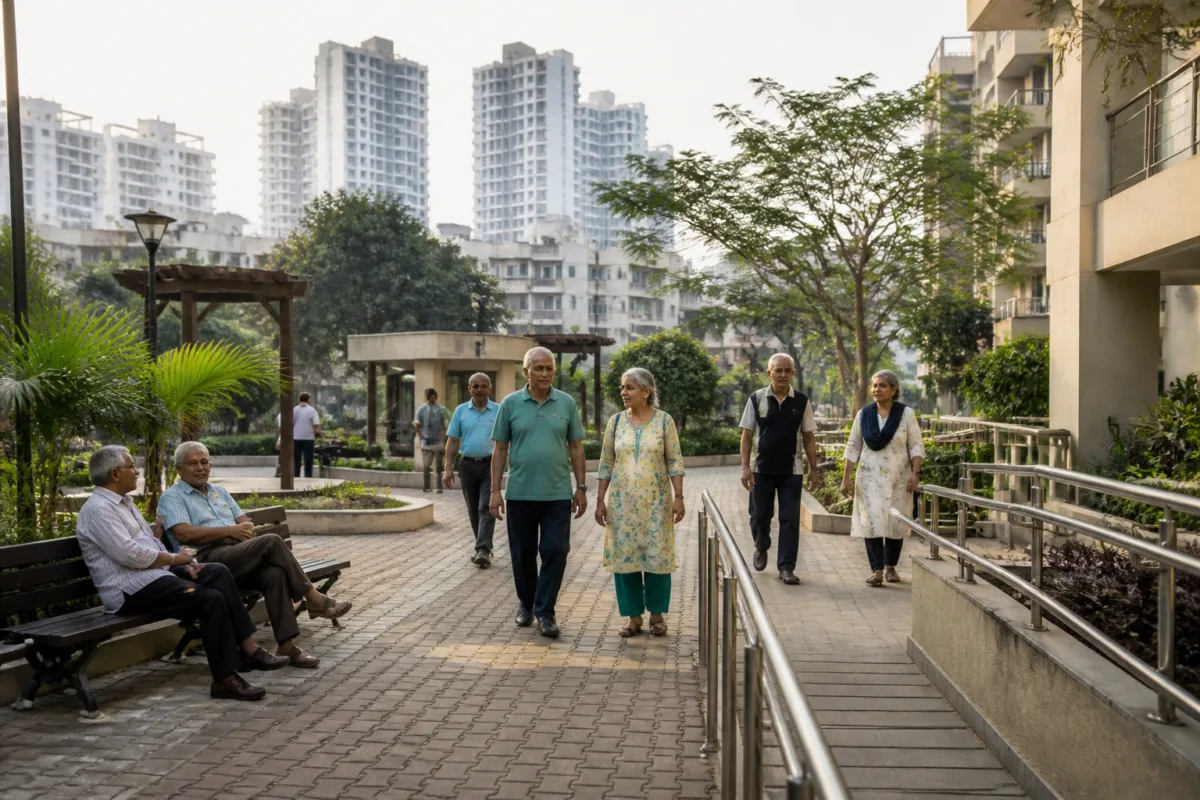
Senior living in India is beginning to move away from the idea that retirement must mean leaving the city. The emerging demand is for homes that provide independence, safety and access to care while keeping older residents connected to familiar neighbourhoods, doctors, friends, family members and everyday urban life.
That shift changes the central question for the sector. It is no longer only about where retirees should live. It is about how cities should accommodate people who want support as they age without being separated from the social and physical networks they have built over decades.
The conventional retirement-community model treated distance from the city as an advantage. Such developments were often imagined as self-contained campuses where older residents could live away from congestion and urban pressures. The model offered a controlled environment, but it could also place residents far from specialist healthcare, established social networks and family members who may live or work in the same metropolitan area.
The city-based model emerging in India responds to a different set of priorities. For many older residents, remaining in an urban area means retaining access to hospitals, neighbourhood services, cultural and social activities, familiar streets and the routines that give structure to daily life. As families become smaller and children increasingly move to other cities or countries for work, a senior-living community within or near a large city can provide support without requiring complete relocation.
This is also a shift in the meaning of independence. Independent living does not necessarily mean managing every need without assistance. It can mean having a private home and control over daily life, with healthcare, mobility support and other services available when required. The distinction matters because many older residents may not want an institutional or hospital-like environment, even when they need access to care.
The JLL-ASLI report titled ‘Elevating the Golden Years’, cited in the source report, found that approximately 85% of India’s existing senior-living inventory is classified as independent living. That figure indicates that the current market is largely oriented towards residents who want to remain active and self-directed rather than move immediately into assisted-care settings.
The statistic also has implications for the way projects are planned. A senior-living development cannot be judged only by the number of units it provides or by the services available inside its gates. Its value is also shaped by the surrounding urban environment: the distance to healthcare, the reliability of transport, the quality of pavements, the availability of shops and daily services, and the ease with which family members can visit.
This makes senior living partly an urban-design question. Buildings need to support easy movement, safe access and clear navigation. Shared spaces must allow residents to meet and build social connections, while private areas must protect autonomy. Healthcare and mobility cannot be treated as later additions to a housing project; they need to be considered at the planning and design stage.
The objective, however, is not to recreate an entire city inside a gated complex. The more significant model is one in which residents remain part of the city around them. That requires a relationship between the project and its neighbourhood rather than a complete separation from it. The source report describes this as a transition from creating isolated retirement destinations to developing urban communities.
India’s demographic trend makes this question increasingly important. According to the UNFPA India ‘India Ageing Report 2023’, the share of India’s population aged 60 and above is projected to rise from 10.5% in 2022 to 20.8% by 2050. The change will increase the need for housing that can accommodate different levels of mobility, healthcare requirements and social support over a longer period of life.
The demographic increase does not automatically translate into demand for one standard form of senior housing. Some residents may seek fully independent apartments with optional services. Others may require assisted living or proximity to specialised medical facilities. Many households may also need flexible arrangements that allow older parents to remain close to adult children without moving into an institutional setting.
The limited reach of organised senior living adds another layer to the challenge. JLL, as cited in the report, estimates that organised senior living has a penetration rate of only 1.3% in India, compared with more than 6% in the United States and Australia. The comparison points to a large gap between the country’s potential need and the supply of professionally planned senior-living options.
JLL also estimates that the potential target market could grow to 2.27 million families by 2030, from 1.57 million families in 2024. These figures describe a substantial real-estate opportunity, but they should not be read only as a case for building more retirement communities. They also raise questions about affordability, location, service quality and the ability of cities to support ageing residents beyond individual projects.
For developers, the market may require a move from a product-led approach to a service-and-place approach. A senior-living home is not defined only by its floor area, finishes or amenities. Its usefulness depends on how well the housing, care systems, public realm and neighbourhood services work together. The operating model may therefore be as important as the building itself.
For urban authorities, the expansion of senior living raises questions about planning permissions, accessibility standards, transport connections and the distribution of healthcare facilities. A project may provide accessible interiors, but residents will still face difficulty if footpaths are broken, crossings are unsafe or public transport is hard to use. Age-friendly housing cannot be separated from age-friendly streets and neighbourhoods.
The issue also exposes a gap in the way housing demand is usually understood. Real-estate planning often divides the market by income, tenure or household size. Ageing introduces another dimension: the ability of a home and its surroundings to support residents as their physical needs change. A city that plans only for the average household may struggle to meet the requirements of a rapidly ageing population.
At the same time, the available figures do not establish how much of the potential market can afford organised senior living, where demand is geographically concentrated or which services residents prioritise most. They also do not show whether existing projects are integrated into their surrounding neighbourhoods or operate as isolated enclaves. Those questions will be important as the sector expands.
The direction of travel is clearer than the final model. The source report’s evidence and the demographic projections point towards greater demand for housing that combines independence with support. The strongest urban response may not be to move older residents away from cities, but to make more parts of cities workable for them through accessible housing, connected communities, reliable mobility and nearby healthcare.
Senior living in India is therefore becoming a test of whether urban development can respond to longer lives without reducing older residents to care recipients. What remains to be established is whether the emerging market will produce inclusive, connected communities or simply a new category of gated real estate. The answer will depend on how developers, city authorities and service providers link private housing to the wider urban system.

