


The proposal to extend Saksham Anganwadi facilities to 568 more centres in Dakshina Kannada highlights both the scale of the district’s early-childhood network and the implementation challenge beneath its technology-led upgrade. The Women and Child Development Department has submitted the proposal to the government after the first phase covered 1,384 anganwadis under the Saksham Anganwadi and Poshan 2.0 programme.
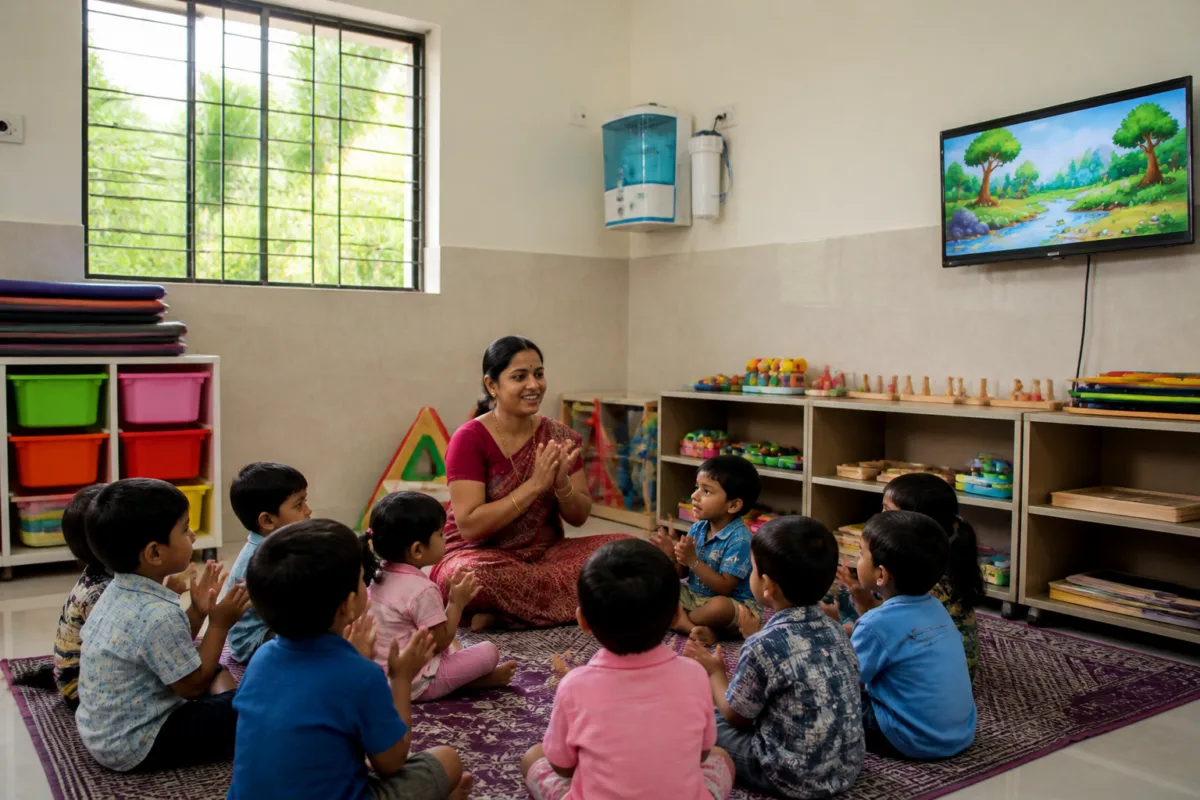
Dakshina Kannada has 2,131 anganwadis, of which 1,937 operate from their own buildings. The first phase selected centres with their own buildings for upgrading during 2025–26. These centres received facilities including LED televisions, pendrives, water purification units, toilets and modern learning materials. The proposed extension would bring more centres into a programme intended to improve the quality of public early-childhood services.
The numbers show why the proposal matters. The 1,384 centres selected in the first phase represent roughly two-thirds of the district’s total anganwadi network. The additional 568 centres would amount to more than one-quarter of the network if approved, although the supplied report does not specify whether every centre outside the first phase is eligible or whether the proposal is based on a further building-level assessment. The department’s stated focus on centres with their own buildings also indicates that physical infrastructure is functioning as an important entry point for programme selection.
Saksham Anganwadi is an upgraded version of earlier Integrated Child Development Services programmes, according to a Women and Child Development Department official quoted by Prajavani. Its beneficiaries include children from six months to six years, pregnant women, lactating mothers and adolescents. The programme combines supplementary nutrition with informal pre-school education for children aged three to six and seeks to upgrade government anganwadis so that their facilities are not considered inferior to those of private schools.
That combination makes the programme more than a building or equipment initiative. An anganwadi is simultaneously a nutrition point, a pre-school setting and a service-delivery location for several groups. The quality of the facility therefore depends not only on whether equipment has been supplied, but also on whether workers can use it, whether essential devices function and whether the department can monitor services consistently.
The first phase has already introduced a technology layer into this system. Anganwadi workers use LED televisions to teach children, while data collection and service monitoring are conducted through the Poshan Tracker mobile application. Seventy anganwadis staffed by workers with graduate and postgraduate qualifications have also started LKG and UKG classes this year, according to the department official. These developments suggest an attempt to widen the educational role of centres and formalise the flow of information between frontline workers and the administration.
However, the report also records a gap between the provision of equipment and its operational use. An anganwadi worker said modern learning materials had been supplied without training on how to use them. Some workers were also reportedly facing problems because pendrives and televisions were not functioning properly. This is a basic but consequential distinction in public infrastructure: installation is a measurable administrative milestone, while regular and effective use is the service outcome experienced by children and families.
The same issue appears in the department’s digital monitoring system. A representative of the anganwadi workers’ organisation said that about 75 per cent of the mobile phones supplied to workers were not functioning properly, forcing workers to use personal phones. The report does not provide the total number of devices affected or specify the technical reasons for the failures. But the allegation points to a practical risk in app-based administration: when official hardware is unreliable, the cost of compliance can shift to frontline workers.
That shift matters because anganwadi workers are expected to deliver services while also recording information about them. If personal devices become necessary for data entry, the boundary between public work and private resources becomes blurred. The supplied report does not establish whether workers are reimbursed for using personal phones or whether replacement and repair mechanisms exist. Those details will be important in assessing whether Poshan Tracker is strengthening monitoring or adding an operational burden at the point of service.
Food preparation presents another implementation concern. The workers’ organisation representative said the food menu had recently changed and that workers had not received mandatory training before the change. The report does not detail the revised menu or identify the authority responsible for the training. It does, however, show that changes in programme design have consequences beyond written instructions. A nutrition intervention depends on the ability of workers to prepare and serve food safely and consistently within the facilities and resources available to them.
The department has described the first phase as an improvement in the quality of services available to children and said that the additional 568-centre proposal is expected to receive approval. The Deputy Director of the Women and Child Development Department, Sridhar N., said the proposal had been submitted and that the centres were expected to receive the facilities. The report does not state the proposed cost, the expected approval date, the number of centres to be covered by taluk or the source of funding for the expansion.
These missing administrative details are significant because the programme’s reach depends on more than the number of centres named in a proposal. Selection, procurement, installation, maintenance, staff training and monitoring all sit within the same delivery chain. The first phase shows that the district can identify a large group of centres and provide a standard package of equipment. The concerns raised by workers show that the next question is whether the system has an equally clear mechanism for training and upkeep.
The district’s own-building figures also reveal the infrastructure context. Of the 2,131 anganwadis, 1,937 have their own buildings, leaving 194 without one according to the figures reported. The selection of centres with dedicated buildings may make installation easier and provide a defined space for toilets, water purification units and learning equipment. At the same time, it means that the condition of centres without their own buildings remains an unresolved part of the district’s early-childhood infrastructure challenge.
The programme’s stated objectives place anganwadis at the intersection of welfare and education policy. Children below six require nutrition and early learning; pregnant women and lactating mothers require supplementary nutrition; adolescents are also included in the beneficiary group. The centres must therefore function as accessible neighbourhood institutions rather than single-purpose classrooms. Their performance depends on the reliability of basic utilities, the usability of teaching materials, the capacity of workers and the quality of administrative support.
The proposed extension to 568 centres is consequently a test of whether expansion can be accompanied by operational readiness. The source material confirms that the department has submitted the proposal and that the first-phase centres have received specified facilities. It also records worker concerns about training, equipment and mobile phones. It does not establish whether those issues have been formally reviewed, how many centres are affected or what corrective measures have been ordered.
For Dakshina Kannada, the larger urban and regional question is how public service infrastructure is measured. A centre can be counted as upgraded once equipment reaches the building, but families encounter the system through functioning televisions, usable learning materials, safe food preparation, working digital devices and trained staff. The difference between those two measures will determine whether the Saksham Anganwadi expansion becomes a durable improvement or remains primarily an equipment-distribution exercise.
The next verifiable milestone is the government’s decision on the proposal for 568 additional anganwadis. Alongside that decision, the department’s response to reported training, device and maintenance gaps will indicate whether the second phase is being designed around the lessons of the first.

