


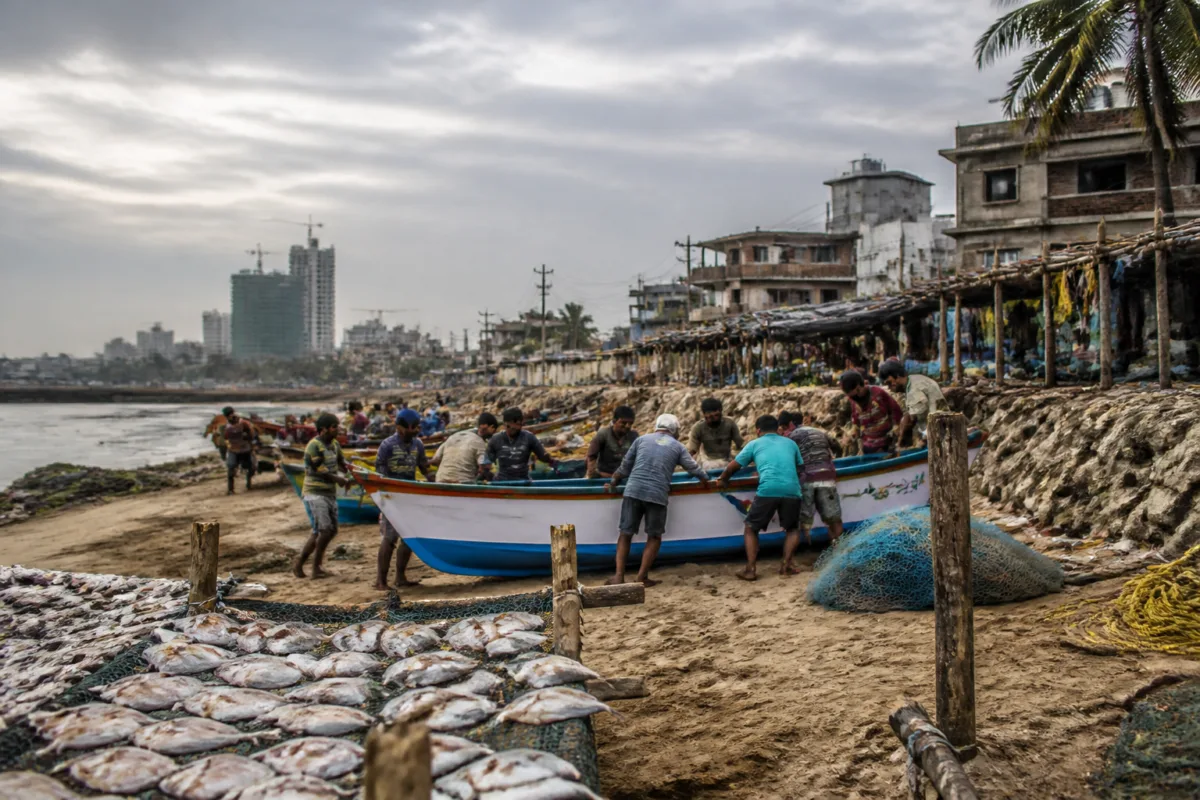
Traditional fishers in and around Mangaluru are warning that the loss of landing, boat-storage, fish-drying and processing spaces is threatening not only their income but the continuity of fishing as a livelihood. The concern, raised at a meeting of small-scale fishing organisations from Dakshina Kannada and Udupi, points to a wider coastal governance problem: development may be taking place faster than public systems can protect the working spaces on which fishing communities depend.
The meeting was held recently at Sasihithlu and brought together representatives of traditional and country-boat fishers, dried-fish producers, net makers, fish processors, vendors and other small-scale fishing groups. According to a report by Prajavani – Dakshina Kannada, participants said that communities had historically used identified sea areas, boat berthing locations, fish-drying spaces and other coastal sites through customary rights. They now say that finding space to continue their occupation in their own villages has become increasingly difficult.
This distinction between access to the sea and access to the shore is central to the issue. Fishing is not completed when a boat returns from the water. Boats must be brought ashore, catches landed, fish sorted and sold, nets repaired, and in some cases fish dried or processed. These activities require physical space close to the coastline. When that space is occupied, restricted or converted to another use, the effect is not limited to a single facility. It can disrupt the chain of work that supports fishers, processors, vendors and allied workers.
The reported concerns also show how coastal development affects communities through cumulative changes rather than one identifiable decision. Participants cited the expansion of tourism, ports, real-estate activity and other coastal development projects as factors reducing the land available for fishing-related work. The report does not provide a project-wise account of the land lost, the number of affected households or the dates on which particular sites were converted. What it does establish is that representatives of multiple small-scale fishing activities see the shortage of working space as a shared regional problem.
For urban and coastal planning, this is an important distinction. A coastline is often treated as a stretch of land available for infrastructure, tourism or commercial activity, while the everyday functions that sustain coastal settlements receive less formal recognition. Boat landing points, drying yards, access paths and small processing areas may not resemble large infrastructure, but they form part of the local economic system. Their removal or fragmentation can make traditional fishing less viable even when the sea itself remains accessible.
The meeting also placed the issue within the framework of the Coastal Regulation Zone, or CRZ, rules and Coastal Zone Management Plans, known as CZMPs. Participants alleged that CRZ violations continue and expressed concern over delays in finalising CZMPs. They also said that protections and opportunities available to fishing communities under existing laws have not been properly implemented. These are significant institutional questions because coastal regulation depends not only on the existence of rules but also on mapped boundaries, clearly identified uses, administrative coordination and enforcement on the ground.
The source report does not establish that a particular authority has confirmed violations, nor does it identify specific projects found to be illegal. The concerns should therefore be understood as demands and allegations made by fishing representatives at the meeting. Their significance lies in the implementation gap they describe: even where legal provisions recognise coastal or livelihood interests, communities may struggle to secure a usable site, obtain basic facilities or prevent competing uses from taking priority.
Participants called for stricter enforcement of existing laws and protection of traditional fishing areas. They also demanded that coastal land used for fishing-related activities be assured on a priority basis for fishing communities through legal and administrative action. This demand is broader than compensation for a lost site. It seeks recognition that access to operational space is itself a livelihood right and that replacement land, where required, must remain functionally connected to the fishing economy.
The infrastructure requested at fish-landing locations was equally specific. Fishers sought boat-pulling machines, sheds, toilets and connecting roads. These facilities are basic, but their absence can increase the physical and financial burden of fishing. A landing site without safe access, storage or sanitation may remain technically available while being difficult to use efficiently. The requests also indicate that the dispute is not only about preventing development. It is about whether public investment and planning are keeping pace with the needs of existing coastal occupations.
The meeting raised another operational concern: the reported use of bull trawling and light fishing at sea. Small-scale fishers said these practices create problems for them. The report does not provide details of the locations, frequency or enforcement action associated with these activities, but their inclusion in the discussion shows that the pressures on traditional fishing are both land-based and marine. Shoreline access, coastal construction and fishing practices at sea interact to determine how much room small operators have to work.
The institutional setting described in the report is also mixed. The programme was hosted by Sneha Kunj Trust of Honnavar and the Dakshin Foundation of Bengaluru, with cooperation from the Bay of Bengal Programme—Inter-Governmental Organisation. Representatives included Sneha Kunj president Ramachandra Bhat, Shobhendra Sasihithlu, Gunakar and Arathi Sridhar. Kumar Swamy, joint director of the fisheries department in Udupi, fisheries officials Divya and Kavitha, and representatives of NETFISH, an organisation under the Union government’s Marine Products Export Development Authority, also participated.
The presence of fisheries officials and a national fisheries-related institution does not by itself amount to a government decision or an approved plan. However, it places the concerns within the administrative system responsible for fisheries support and coastal livelihoods. Any response will require coordination between fisheries authorities, coastal planning bodies, local administrations and agencies responsible for ports, tourism, land development and public infrastructure. The source report does not state that such a coordinated plan has been announced.
The lack of detailed public information is itself relevant to the planning question. The report records concerns about shrinking spaces but does not quantify the total number of landing sites, the area used for drying and processing, or the number of communities affected in Dakshina Kannada and Udupi. It also does not specify which CZMPs remain pending, what stage the plans have reached, or which agencies are responsible for resolving the delays. Without those details, it is not possible to measure the scale of the land shortage or assess whether existing schemes are reaching the affected groups.
That limitation should not obscure the structural signal in the meeting. Coastal development is often evaluated through large projects, investment values or physical construction. Small-scale fishing presents a different planning test because its infrastructure is dispersed, locally used and closely tied to customary practices. A boat landing area, a drying space or a route to the shore may appear minor when considered separately. Together, they support a network of livelihoods and provide the physical interface between marine production and local markets.
For Mangaluru and the wider Karnataka coast, the issue is therefore one of land-use priority and administrative visibility. If traditional fishing spaces are not clearly identified, protected and equipped, they can be displaced by uses that are more formally documented or financially powerful. If coastal plans are delayed or poorly implemented, communities may face uncertainty even when legal safeguards exist. And if marine enforcement is weak, the pressure on small operators can intensify on both sides of the shoreline.
The evidence supplied in the report confirms that fishing representatives from two coastal districts are seeking stronger protection, dedicated working spaces and basic landing infrastructure. It does not establish the extent of alleged CRZ violations, the status of specific development projects or the outcome of the officials’ participation. Those are the facts that need to be clarified as the authorities respond. The immediate policy question is whether coastal governance will treat fishing spaces as essential public livelihood infrastructure, rather than as residual land available after other development priorities have been decided.

