


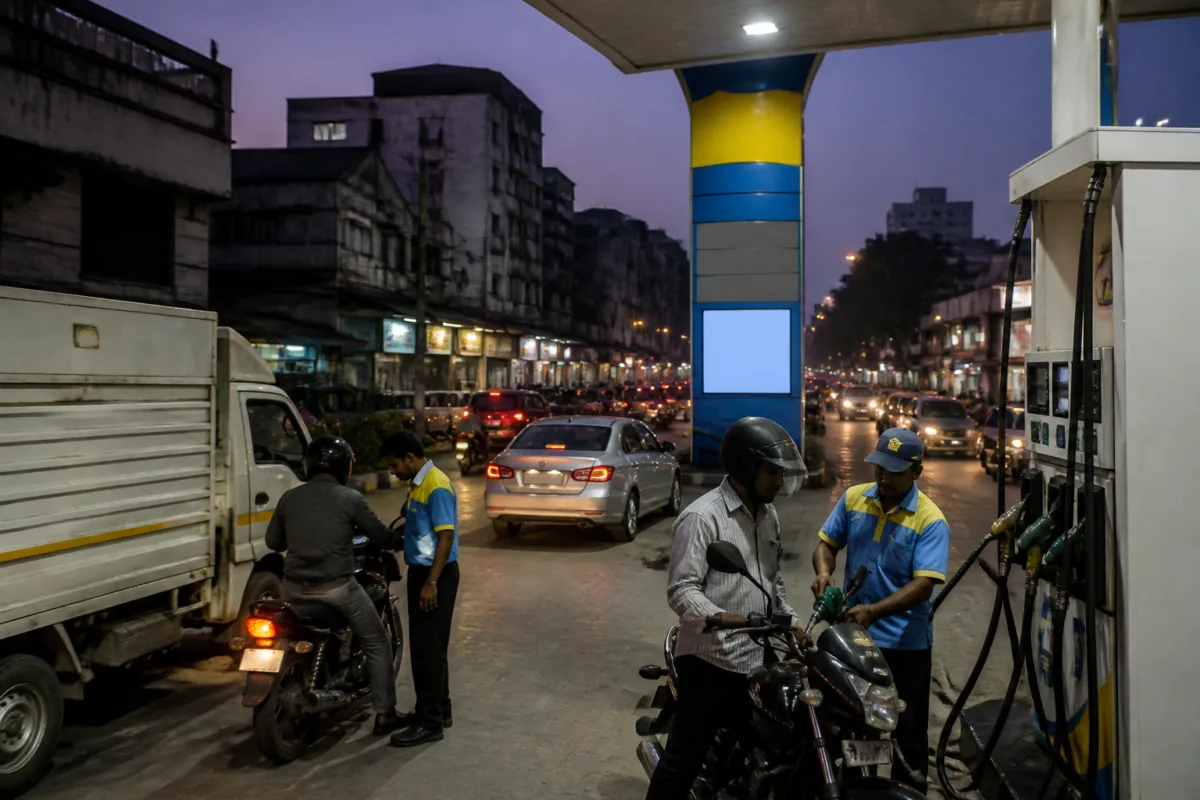
Petrol diesel prices in India could come under renewed pressure after Diwali as the cost of importing crude oil rises sharply, according to comments by energy expert Narendra Taneja cited in the report. The immediate question is not only whether retail fuel rates will change, but how long the government and public-sector oil companies can absorb an import shock without passing more of it to households, businesses and urban transport systems.
Taneja told Business Today TV that domestic fuel prices could change after Diwali and before Christmas. His assessment was linked to elevated international crude prices, higher marine insurance premiums, rising freight rates and continuing geopolitical tension in West Asia. He said consumers could not remain insulated indefinitely from global energy stress, while government and oil companies would find it difficult to absorb rising costs permanently.
The report does not establish that a price increase has been officially announced. It presents the possibility of higher petrol and diesel rates based on the pressure building across the import chain. That distinction matters because Indian pump prices are shaped not only by international crude benchmarks, but also by taxes, refining costs, freight, insurance, exchange-rate movements and the pricing decisions of oil marketing companies.
The cost pressure is particularly significant because India depends heavily on imported crude. Between April and September, the country’s crude oil import bill rose 46.3% year-on-year to $90.6 billion, according to the figures cited in the report. A higher import bill can affect the external sector directly, while an increase in retail fuel prices can spread through the cost of commuting, goods movement, construction activity and essential services.
### Why the landed cost matters
A central point in the report is the difference between the headline international crude price and the price Indian refiners actually pay when the oil reaches the country. Taneja said freight, marine insurance and tanker-manning costs were adding to the landed cost. Depending on the refiner and the source of crude, he estimated that India could face an additional cost of about $25-$27 per barrel over the headline price.
This distinction is important for cities. Fuel is not consumed only by private vehicle owners. It is embedded in bus operations, taxis, three-wheelers, delivery fleets, construction equipment, municipal services and the movement of food and building materials. A rise in the landed cost can therefore affect urban life even before a corresponding change is visible on a petrol pump display.
The report cited an Axis Bank Research estimate that dated Brent had reached as high as $140 per barrel, while Brent crude was above $110 per barrel. It also said India’s crude oil import basket averaged $120.46 per barrel between October 1 and October 26, about 4% higher than September’s $116.77 average. The October average was described as the highest monthly level since March 2012. On October 26, the Indian crude basket reached $123.72 per barrel.
The reported increase was attributed to geopolitical uncertainty in West Asia, as well as higher insurance and freight costs. The report further said that crude prices globally had risen by about 80% in 2026, with Brent at $114.6 per barrel, West Texas Intermediate at $100.9 and Murban at $117.7 on the Tuesday evening cited in the article.
### The urban transmission channel
For urban households, petrol and diesel prices operate through several channels. Petrol affects the cost of private mobility, app-based transport and two-wheeler commuting. Diesel remains important for goods vehicles, buses, generators, construction machinery and parts of the agricultural supply chain that feeds cities. Higher operating costs can eventually reach fares, delivery charges, food prices and the cost of building and maintaining urban infrastructure.
The effect is not uniform. Households with access to public transport may be less exposed to a direct increase in petrol expenditure, but they can still face indirect effects through higher prices for food and services. Workers who depend on motorcycles, informal transport or long-distance commuting are more directly exposed. Small businesses that operate delivery vehicles or backup generators also face a cost increase that may not be immediately recoverable through their pricing.
This makes fuel pricing a governance issue as much as an energy-market issue. The Centre and states collect taxes on petroleum products, while public-sector oil companies can face pressure when retail prices do not move in line with input costs. The Reserve Bank of India also becomes part of the wider response because a fuel shock can influence inflation, household purchasing power and macroeconomic stability.
### Who is absorbing the shock?
The report said the Centre, state governments, public-sector oil companies and the RBI were collectively absorbing the impact of higher oil prices. Axis Bank Research estimated that this support could amount to 1.7% of gross domestic product if the average crude price remained at $100 per barrel and retail fuel prices were kept unchanged.
The same estimate suggested that every additional $10 increase in crude prices could add another 20 basis points of pressure on GDP under those conditions. These figures describe the scale of the burden rather than confirming a specific future pump-price decision. They indicate that keeping retail prices unchanged can shift the pressure elsewhere, including to public finances, oil-company balance sheets or broader economic activity.
Axis Bank Research also estimated that higher duties and an economic stabilisation fund could create fiscal room equivalent to 0.6% of GDP. That room, the report said, could help limit the Centre’s fiscal deterioration in financial year 2026-27 to 20-30 basis points of GDP. The details of how such measures would be implemented, and how the burden would be divided between governments, companies and consumers, were not established in the supplied material.
For city administrations, the issue is relevant because municipal budgets and public transport agencies generally have limited protection from fuel volatility. A rise in diesel prices can increase the cost of bus services, waste collection, road maintenance and emergency operations. Where agencies cannot absorb the increase, the pressure may appear through higher fares, reduced service flexibility or demands for additional budgetary support. The supplied report does not quantify these effects for any particular city, but the transmission route is clear from the sectors dependent on fuel.
### The supply-security question
Taneja argued that India needs to diversify crude supplies and secure longer-term supply arrangements, including investment in overseas oil and gas assets. His comments shift the discussion beyond the next retail price revision. They raise a structural question about how an import-dependent economy can reduce exposure to a sudden combination of crude, freight, insurance and geopolitical costs.
Diversification can reduce dependence on a particular supplier or route, but it does not eliminate exposure to global prices. Similarly, longer-term supply arrangements may improve planning visibility without removing the effect of international market movements. The report provides no details on proposed investments, contracts or timelines, so the practical impact of this approach remains unestablished.
What the available evidence does show is that the import burden is being shaped by more than the benchmark price quoted in global markets. When shipping and insurance costs rise, the delivered price paid by refiners can move faster than a simple comparison of Brent or other headline benchmarks would suggest. For India’s cities, that makes energy security inseparable from transport affordability and the cost of urban services.
The immediate development to monitor is whether the government or oil marketing companies announce a change in petrol or diesel prices after Diwali and before Christmas, the period identified by Taneja. The other indicators are the Indian crude basket, freight and marine insurance costs, the import bill, the fiscal response and the extent to which higher costs are absorbed by companies or passed on to consumers. The supplied report confirms substantial pressure across the oil-import chain, but it does not confirm the timing or size of any future retail fuel-price increase.

