


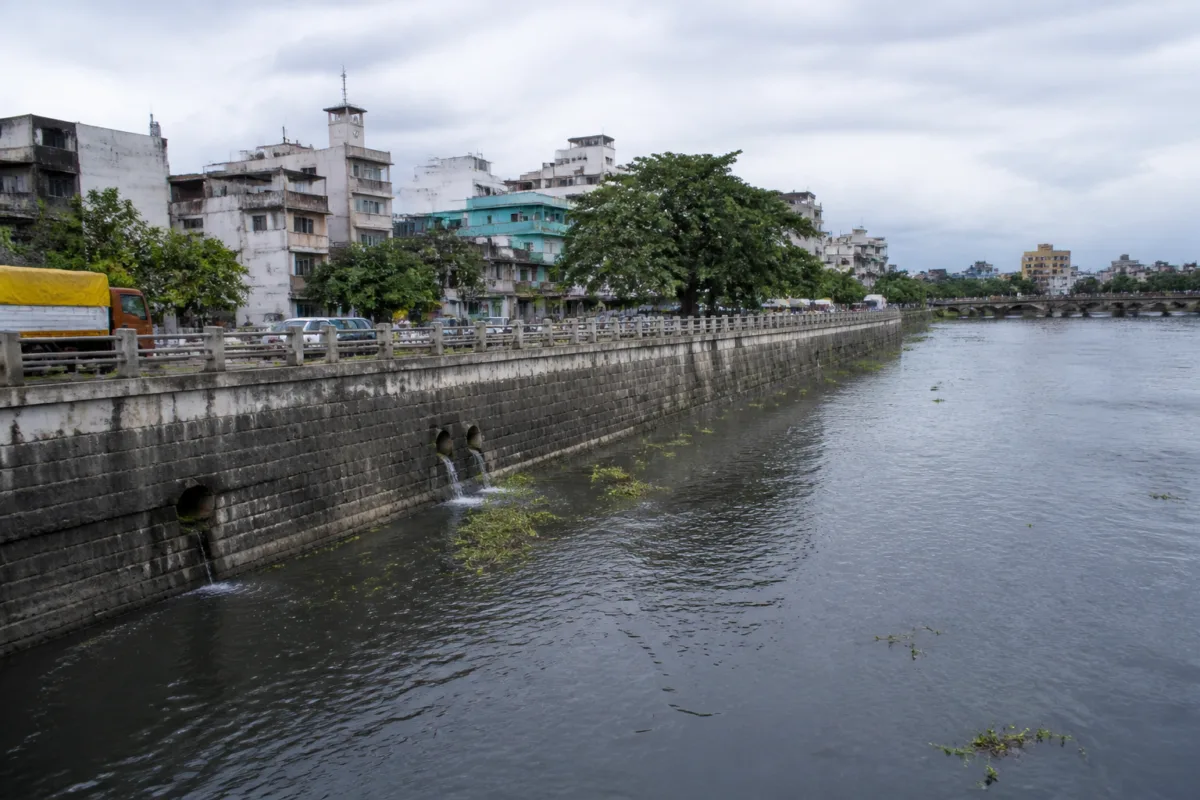
The Maharashtra Pollution Control Board’s show-cause notice to the Nashik Municipal Corporation over polluted water samples from the Godavari is more than an environmental enforcement action. It places the city’s sewage collection, treatment and disposal system under scrutiny at a time when preparations for the Simhastha Kumbh are bringing renewed attention to the river. The notice also makes clear that the responsibility for preventing urban sewage from entering the river rests with the civic administration under the Water (Prevention and Control of Pollution) Act, 1974.
The notice was issued on October 23 after water samples collected from three locations along the Godavari were found to have pollutants exceeding prescribed standards, according to the report. The sampling was conducted on October 5 at the Godavari-Kapila confluence in Tapovan, near the Godavari along the Mumbai-Agra Highway in Dasak, and at the river near Samta Nagar in Takali. The locations cover different points along the river’s passage through and around Nashik, making the episode a question of the city’s wider wastewater management rather than a single isolated site.
MPCB directed the Nashik civic body to explain why its bank guarantee should not be forfeited and why further action, including disconnection of electricity and water supply under environmental laws, should not be initiated. The corporation has been given 15 days to submit a written reply with supporting documents. These provisions give the notice an institutional significance: the matter is not limited to a laboratory finding, but is linked to the consequences that may follow if the civic body cannot demonstrate that it has met its statutory obligations.
The sampling was carried out in the presence of the applicant and in compliance with directions of the high court in Original Application No. 176/2012. The report does not identify the applicant or provide the individual pollutant readings from the laboratory analysis. It does, however, state that MPCB concluded that the samples failed to meet prescribed standards and that its inquiry and examination of records indicated violations of environmental norms.
That distinction matters for understanding the case. The notice records the pollution control board’s conclusion based on sampling, laboratory analysis and an inquiry. It does not, by itself, establish the final outcome of the proceedings against the civic body. Nashik Municipal Corporation has yet to file its response, and its deputy commissioner for environment, Sangita Nandurkar, said the corporation had not received the notice when contacted. She said the NMC would comment after receiving and examining it.
The central issue is therefore not only whether pollution was detected at three points, but whether the city can account for the complete chain through which sewage is managed. MPCB held NMC responsible for ensuring the proper collection, treatment and disposal of sewage generated within city limits. That responsibility places the river at the end of a municipal service system whose performance depends on several linked stages: sewage must be captured from properties and neighbourhoods, conveyed through the drainage network, treated adequately and disposed of without allowing untreated or inadequately treated flows to enter the river.
A failure at any stage can produce the outcome described in the notice. However, the supplied report does not establish which specific part of the system failed, whether the problem was caused by inadequate treatment capacity, gaps in the sewer network, operational shortcomings, illegal discharge or another factor. It also does not provide the number or capacity of sewage treatment plants, the volume of sewage generated, the treatment performance at the sampled locations or the identity of any specific discharge point. Those gaps will need to be addressed through the civic body’s written reply and any subsequent regulatory action.
The three sampling locations are important because they shift attention from a single facility to the condition of the river across multiple points. The Godavari-Kapila confluence at Tapovan, the river stretch near the Mumbai-Agra Highway in Dasak and the section near Samta Nagar in Takali represent distinct urban settings. Yet the report does not provide comparative readings between the locations. Without those figures, it is not possible to determine whether pollution was concentrated at one point, worsened progressively along the river or reflected a broader pattern.
The absence of such figures also limits what can be concluded about the severity and source of the contamination. The report says pollutants exceeded prescribed standards, but it does not specify the standards or the substances detected. The regulatory finding is consequently clear at the level of non-compliance, while the technical profile of the pollution remains unspecified in the supplied material. That information will be central to any assessment of the measures required and the responsibility of different agencies or facilities.
The case demonstrates how environmental regulation intersects with ordinary municipal administration. Sewage management is often treated as an engineering function, but the notice frames it as a legal obligation of the civic body. MPCB’s action is based on the position that NMC has a statutory duty to prevent sewage generated within the city from polluting the river. In this framework, treatment infrastructure is only one part of compliance. The corporation must also be able to show that its collection and disposal arrangements operate in accordance with environmental requirements.
The threatened action against the bank guarantee further connects environmental compliance with financial accountability. The report does not state the value of the bank guarantee or the conditions under which it was furnished. It also does not say whether any electricity or water disconnection has been ordered. What the notice establishes is that MPCB has warned of these measures if the civic body fails to provide a satisfactory explanation. The immediate next step is therefore procedural: NMC must respond within the specified 15-day period with documents supporting its position.
The legal background cited in the report adds another layer. The sampling was undertaken in compliance with high court directions in Original Application No. 176/2012, indicating that the regulatory process is connected to continuing judicial scrutiny. The supplied material does not describe the full history of that application or earlier orders. It does, however, show that the latest sampling was not presented as an informal inspection. It followed a court-linked process and was conducted in the presence of the applicant.
That institutional chain is significant for public accountability. The pollution board is examining the matter through sampling, laboratory analysis and an inquiry. The court directions provide the procedural context. The municipal corporation is the agency expected to explain how it is meeting its sewage-related responsibilities. The resulting exchange should clarify whether the problem is being treated as an isolated breach or as evidence of a wider failure in the city’s wastewater system.
The timing has added public importance. The report links the notice to preparations for the Simhastha Kumbh and growing scrutiny of pollution levels in the Godavari. It does not provide details of the preparations, a pollution target or a separate plan for protecting the river during the event. Even so, the timing brings the routine performance of municipal sewage systems into sharper focus. A river used as an important civic and religious landscape cannot be assessed only through event-period arrangements; its condition also depends on the everyday functioning of the city’s drainage and treatment systems.
This is the larger urban question raised by the notice: whether river protection is being managed as a continuous municipal service or addressed mainly through inspections, court directions and event-related pressure. The evidence supplied does not answer that question. It does show that the regulator found pollution at three locations and attributed responsibility for sewage management to the civic body. It also shows that the corporation had not yet responded substantively because its environment department said the notice had not been received when contacted.
The next phase will determine what the notice produces beyond an exchange of documents. NMC’s written reply may establish the status of sewage collection, treatment and disposal arrangements relevant to the sampled locations. It may also clarify whether the corporation disputes the findings, accepts deficiencies or identifies other causes. MPCB will then have to assess whether the explanation and supporting records are satisfactory and whether the threatened enforcement measures should proceed.
For Nashik, the immediate issue is the response to the notice. The deeper issue is whether the city can demonstrate that its statutory sewage responsibilities are being fulfilled across the urban area and along the river’s course. The available evidence confirms regulatory concern and a formal compliance process, but not the final cause, remedy or outcome. Those remain tied to the NMC’s 15-day reply and the subsequent decision of the Maharashtra Pollution Control Board.

