


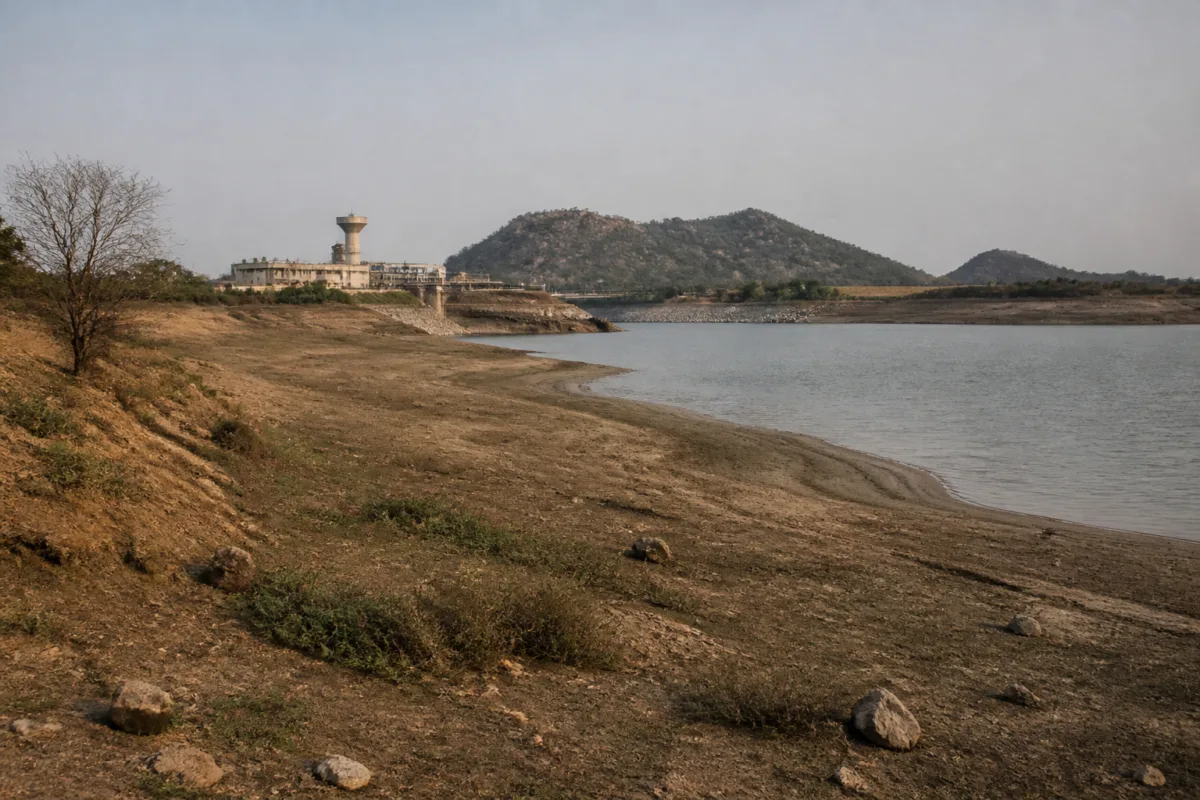
Telangana’s water crisis is no longer only an irrigation problem. With Singur reservoir holding just 3.21 tmc against a full capacity of 29.91 tmc, the state government is preparing to prioritise drinking water over irrigation, exposing how closely Hyderabad’s urban supply remains tied to rainfall, reservoirs and inter-basin transfers.
The immediate pressure is visible in the state’s competing water requirements. According to the report, the government has concluded that available storage may not be sufficient to serve the entire 30.56 lakh acres of ayacut dependent on reservoir releases while also protecting drinking-water supplies. It has proposed releasing 47 tmc to support irrigation across about seven lakh acres, with the remaining area dependent on future inflows and storage availability.
That allocation is not simply an agricultural decision. It is a test of how Telangana manages a water system in which cities, farms and reservoirs depend on the same limited pool. The government has proposed reserving available water primarily for drinking purposes until July 2027. Irrigation releases in water-stressed areas would be deferred, while protective irrigation for rain-fed crops would be considered only if surplus water remains.
The figures indicate the scale of the constraint. Major and medium irrigation projects across Telangana hold 179.63 tmc of usable water, compared with normal storage of 470.2 tmc. That represents a shortage of nearly 62% against the normal level. Irrigation releases are already 18% lower than last year, and no irrigation water is being supplied in 176 mandals across 19 districts.
For Hyderabad, the most immediate concern is Singur’s role as a drinking-water source. The reservoir’s reported storage is only 10.73% of capacity. The government estimates that the available water may last until December 10 if current conditions persist, placing the city’s supply planning under pressure well before the next dependable replenishment cycle.
The rainfall data explains why reservoir management has become so restrictive. Telangana received 618.9 mm of rainfall between June 1 and October 23, against a normal 816.6 mm, a deficit of 24%. During the southwest monsoon, rainfall was 615.5 mm against a normal 740.6 mm, a shortfall of 17%. October has been particularly severe: rainfall up to October 23 was only 3.4 mm against a normal 76 mm, a deficit of 96%.
The report identifies the looming impact of El Niño as a major concern for the state government. The available evidence does not establish a single-cause explanation for the water shortage, but it shows how a rainfall deficit is transmitted through the reservoir system. Lower inflows reduce the water available for irrigation releases, drinking-water reserves and the replenishment of tanks and groundwater.
That transmission is important because Telangana’s water security is not based only on large reservoirs. Nearly 40% of the state’s 44,034 tanks hold less than 25% of their capacity. Tanks are a critical part of the distributed water network, particularly for local irrigation and groundwater recharge. Their low storage indicates that the stress extends beyond a few high-profile reservoirs and is spread across smaller water bodies as well.
Groundwater data adds another layer to the crisis. The average depth to groundwater increased from 4.41 metres below ground level in September 2025 to 7.52 metres in September 2026. The reported decline of 3.11 metres indicates that groundwater is becoming less accessible even as surface-water supplies weaken. This reduces the room available for households, farms and local authorities to compensate for poor reservoir storage through additional extraction.
For Hyderabad, the urban challenge is therefore one of substitution. If Singur cannot provide enough water, the city must rely on other sources, additional pumping, treatment capacity and network adjustments. The government’s alternative supply plan proposes drawing 40 million gallons per day from the Godavari, securing 15 MGD through adjustments in Krishna supplies or additional pumping, and generating another 5 MGD through enhanced pressure filtration at Osman Sagar and Himayat Sagar.
The plan also includes support through Mission Bhagiratha networks, pipeline interconnections, diversions, pressure filters and repairs to electric borewells in the core urban region. These measures show that urban water security depends not only on the volume stored in a reservoir but also on the capacity to move, treat and distribute water through multiple systems.
That institutional complexity makes contingency planning central to the state’s response. The proposed sources are managed through different infrastructure and administrative arrangements: reservoir supplies, inter-basin transfers, treatment facilities, pipelines, pumping systems and local borewells. A shortfall in one part of the network cannot automatically be solved unless the others have available capacity and can operate together.
The government’s proposed 47 tmc irrigation release also reflects this conditional approach. Even the water earmarked for seven lakh acres would remain subject to drinking-water requirements and actual storage levels. This means the allocation is not a guaranteed irrigation schedule. It is a release proposal constrained by the same storage conditions that have already reduced supplies elsewhere.
The decision to prioritise drinking water places Hyderabad at the centre of the state’s water-management framework. The city’s demand has to be protected, but the same reservoirs support rural livelihoods and irrigated agriculture. The reported proposal to defer irrigation releases until July 2027 makes clear that the government is considering water availability across a longer planning period rather than treating the current shortage as a short-term operational disruption.
The numbers also reveal the limits of a reservoir-led response. Even if rainfall improves, the state’s water position depends on how much of that rainfall becomes usable inflow, how quickly reservoirs recover, and how much water is committed to different uses. The report does not provide a forecast of future inflows or a confirmed timetable for restoring normal irrigation releases. What it establishes is that present storage is insufficient to support all existing demands at normal levels.
For the urban system, the most significant signal is the need to combine major-source planning with local network resilience. The proposed use of Godavari and Krishna supplies, filtration at Osman Sagar and Himayat Sagar, pipeline interconnections and borewell repairs indicates that Hyderabad’s contingency response is being assembled from several types of infrastructure. Each measure addresses a different bottleneck: source availability, transfer capacity, treatment, pressure or last-mile supply.
The water crisis also exposes the relationship between surface water and groundwater. Low tank levels and deeper groundwater together suggest that the state cannot treat groundwater as an unlimited fallback when reservoirs decline. The reported figures do not establish how much additional extraction is occurring in different districts, but they show that the groundwater buffer itself is under pressure.
The larger urban question is whether water planning can keep pace with a system where climate variability, agricultural demand and metropolitan consumption are increasingly interconnected. Telangana’s current response is built around prioritisation, selective releases and alternative supply arrangements. Its success will depend on storage conditions, network capacity and the government’s ability to protect drinking-water supplies while managing the consequences for irrigation.
The evidence confirms a severe and geographically broad water shortage: reservoir storage is well below normal, rainfall has been substantially deficient, tanks are depleted and groundwater levels have fallen. For Hyderabad, the immediate focus is the alternative supply plan and the reported December 10 pressure point at Singur. For the wider state, the next milestones are actual inflows, reservoir storage, decisions on the proposed 47 tmc release and whether drinking-water reserves can be protected through July 2027.

