


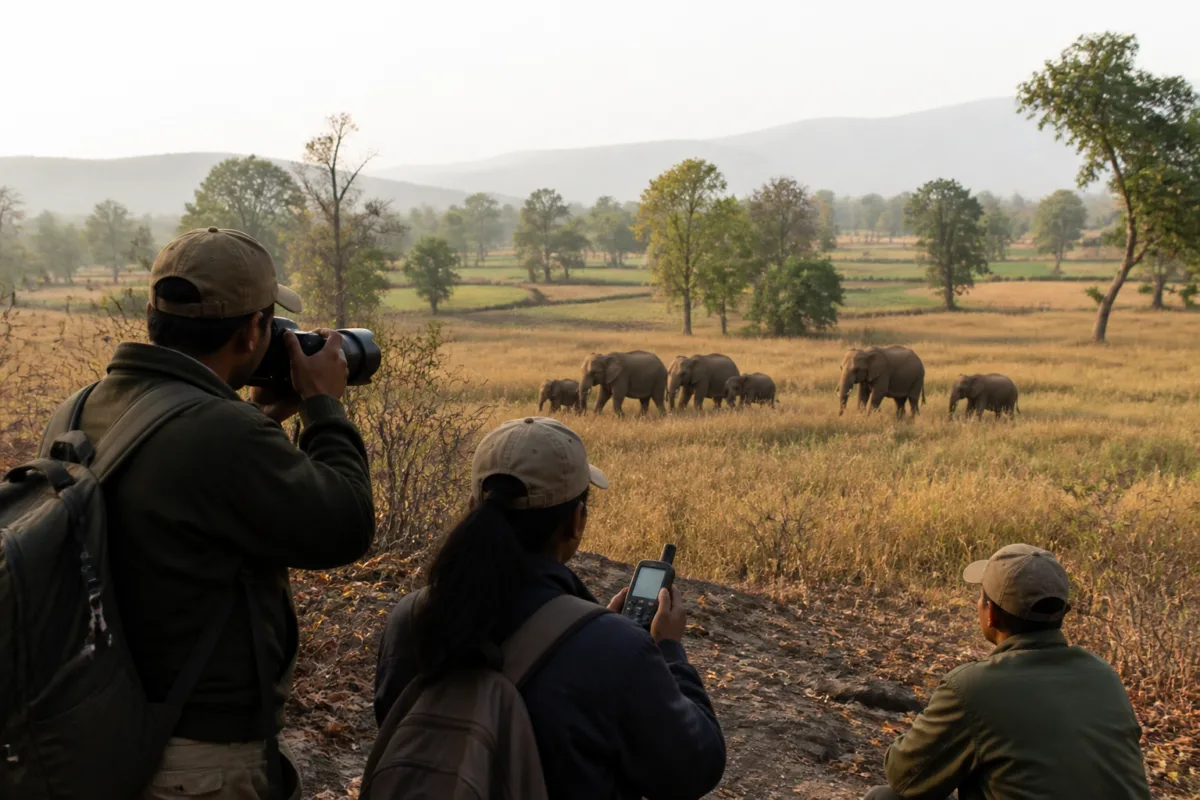
Palamu Tiger Reserve’s planned elephant observatory marks a significant shift in how Jharkhand is attempting to manage human-elephant conflict: away from improvised responses and towards a system built around movement data, land-use information, behavioural studies and preparedness mapping. The initiative is being developed in a state where more than 500 people have died in such conflicts over the past five years, according to Union government data cited by the Times of India, and where more than 40 people have been killed so far this year.
The observatory is therefore not simply a technology project. It is an attempt to create an institutional mechanism for understanding where elephant herds move, how their behaviour changes and how communities and authorities can prepare before encounters become dangerous. Its success will depend not only on artificial intelligence, but also on the quality of field data, coordination between forest officials and local communities, and the availability of funds for implementation.
### From reaction to anticipation
Palamu Tiger Reserve officials have laid the groundwork for the observatory and recently reviewed its basic infrastructure. Deputy director P K Jena said data collection has already begun, including documentation of elephant movements, age and sex structures, photographs and videography. The information is intended to form the base for behavioural analysis and future decision-support systems.
The proposed system would combine several kinds of information. Elephant movement records would be integrated with conflict maps, land-use and land-cover maps, and preparedness maps. According to Jena, the long-term objective is to use AI-based analytics to forecast movement patterns and enable targeted mitigation measures.
This is an important change in administrative logic. Conventional conflict management often begins after elephants have entered fields, settlements or other areas of human activity. The response may involve attempts to drive the animals away, warn residents or contain the immediate situation. An observatory, by contrast, is designed to make the landscape legible before an incident occurs. It seeks to turn scattered field observations into a shared operational picture for forest officials and other responders.
The distinction matters because an elephant movement is not an isolated wildlife event. It can affect standing crops, property and the safety of residents across multiple locations. If information is collected in one part of the landscape but is not connected to land-use conditions, local preparedness or response capacity elsewhere, its value remains limited. The proposed integration of these datasets is intended to address that fragmentation.
### The scale of the conflict
The numbers cited in the report establish the seriousness of the problem. More than 500 people have been killed in human-elephant conflicts in Jharkhand over five years, while more than 40 people have died in the state so far this year. The report also records damage to standing crops and property caused by wandering elephant herds.
These figures show that the conflict has both a public-safety dimension and a livelihood dimension. Fatalities are the most visible measure, but crop and property damage can impose recurring costs on households and communities. The supplied information does not provide a district-wise breakdown, a seasonal distribution of incidents or the number of affected households. It does, however, show why a system based only on emergency response is inadequate: the consequences extend beyond individual encounters and can affect entire rural landscapes around forest areas.
Palamu Tiger Reserve is home to around 180 resident elephants. That population gives the observatory a defined ecological setting in which to build a long-term evidence base. At the same time, the report refers to wandering herds and wider conflict across Jharkhand, indicating that the challenge is not confined to the reserve boundary. Elephant movement can intersect with agricultural land, settlements and infrastructure outside protected areas, making coordination between protected-area management and surrounding administrations essential.
The proposed observatory could help close one of the most important information gaps in conflict management: the difference between knowing that an incident has happened and understanding the conditions that preceded it. Movement records, photographs, videography and information on age and sex structures may help officials identify recurring patterns. The report does not establish that such forecasting is already operational. At present, the AI-enabled decision-support system remains a long-term objective while basic data collection is underway.
### Infrastructure, funding and institutional capacity
The observatory is being developed alongside PTR’s integrated elephant camp, which officials describe as more than a holding facility. The camp includes grassland development, watershed management, hydrotherapy facilities and support from resident mahouts and veterinary professionals. These features point to a broader approach in which habitat conditions, animal care and human-wildlife conflict management are treated as connected responsibilities.
The institutional design is significant. An observatory can produce maps and alerts, but field-level mitigation still depends on people and physical systems. Mahouts, veterinary professionals and forest staff bring different forms of expertise to the management of elephants. Grassland and watershed interventions address aspects of the animals’ habitat, while field documentation provides the information needed for planning. The available material does not specify how the observatory will be staffed, what alert protocols will be used or which agencies will receive its outputs. Those details will determine whether the platform becomes an operational tool or remains primarily a data repository.
Funding is another unresolved component. PTR has sought support under the Compensatory Afforestation Fund Management and Planning Authority, or CAMPA, and has sent a proposal to the Union government through the state forest department. Approval is awaited. This means the project has entered the administrative funding process but does not yet have confirmed financial clearance in the information supplied.
That funding pathway also highlights the relationship between conservation objectives and public administration. The observatory requires more than a one-time investment in equipment. It will need continuing resources for field surveys, image and video documentation, data management, technical analysis and coordination with response teams. The source does not provide the project cost, proposed completion date or procurement plan, so the implementation timeline remains undefined.
The initiative has attracted interest from the Sálim Ali Centre for Ornithology and Natural History in Coimbatore, which has expressed interest in partnering with the state. PTR is also expected to be supported by complementary elephant rehabilitation centres in Bokaro and Dalma. These links could expand the project beyond a single reserve, although the available information does not confirm a formal partnership structure or a statewide operating framework.
### Why technology alone cannot resolve the conflict
The proposed use of AI is significant because it places technology inside a complex ecological and administrative problem. Algorithms can identify patterns in sufficiently large and reliable datasets, but they cannot compensate for missing observations, inconsistent reporting or weak coordination. The observatory’s early work—recording movements, photographs, videography and demographic information—is therefore as important as the eventual analytical platform.
The report also records officials’ criticism of traditional methods, including chasing elephant herds with torches and firecrackers. Such practices have often proved ineffective and can aggravate the situation, Jena said. His call for more scientific and empathetic approaches suggests that the project is intended to change not only the information available to officials but also the behaviour of response teams.
That is where the human dimension becomes central. A forecast is useful only if it reaches people who can act on it in time and in a way that does not intensify risk. The supplied material does not describe how alerts will reach villages, how residents will be trained or how responsibilities will be divided between forest officials and local administrations. These unanswered questions are not peripheral to the observatory; they are part of its core design.
The project also raises a question about the scale at which conflict should be governed. PTR’s observatory may begin with data from the reserve and its surrounding landscape, but the reported toll covers Jharkhand as a whole. The presence of rehabilitation centres in Bokaro and Dalma and the interest of a national research institution indicate the possibility of a wider network. Whether that develops into a coordinated system will depend on formal institutional arrangements that are not yet established in the supplied report.
### What the observatory can and cannot yet prove
The evidence currently supports three conclusions. First, Jharkhand faces a serious human-elephant conflict with substantial loss of life and damage to crops and property. Second, Palamu Tiger Reserve is building an institutional response centred on field data, habitat interventions and planned analytical tools. Third, the project remains at an early stage: funding approval is awaited, basic data collection is underway and the forecasting system has not yet been demonstrated as operational.
The observatory’s importance will therefore be measured by implementation rather than announcement. Key developments to monitor include CAMPA approval, the establishment of the observatory’s staffing and data systems, the formal role of prospective research partners, and the creation of protocols that connect forecasts with village-level preparedness and field response.
Palamu’s initiative represents a promising move towards evidence-led wildlife governance, but its larger significance lies in whether it can connect ecological knowledge with public safety. The central test will be whether data collected in the forest can become timely, coordinated and trusted action across the landscape where elephants and people meet.

