


Emmvee Photovoltaic Power’s planned ₹5,500-crore expansion puts a sharper number on one of India’s most important solar-sector constraints: the country may have substantially less effectively usable solar-cell manufacturing capacity than the headline capacity figures suggest. The company’s chairman and managing director, D.V. Manjunatha Donthi, estimates that India needs around 100 GW of usable cell-making capacity, compared with roughly 41 GW currently cited by the industry.
The difference is not simply a matter of adding more factories to a capacity list. It raises questions about whether announced plants are operational, whether equipment has been installed and qualified, whether output can meet project specifications, and whether domestic manufacturers can supply the different segments of India’s solar market at the required pace. Emmvee’s expansion is therefore significant not only for the company but also as a case study in how domestic manufacturing is attempting to catch up with demand.
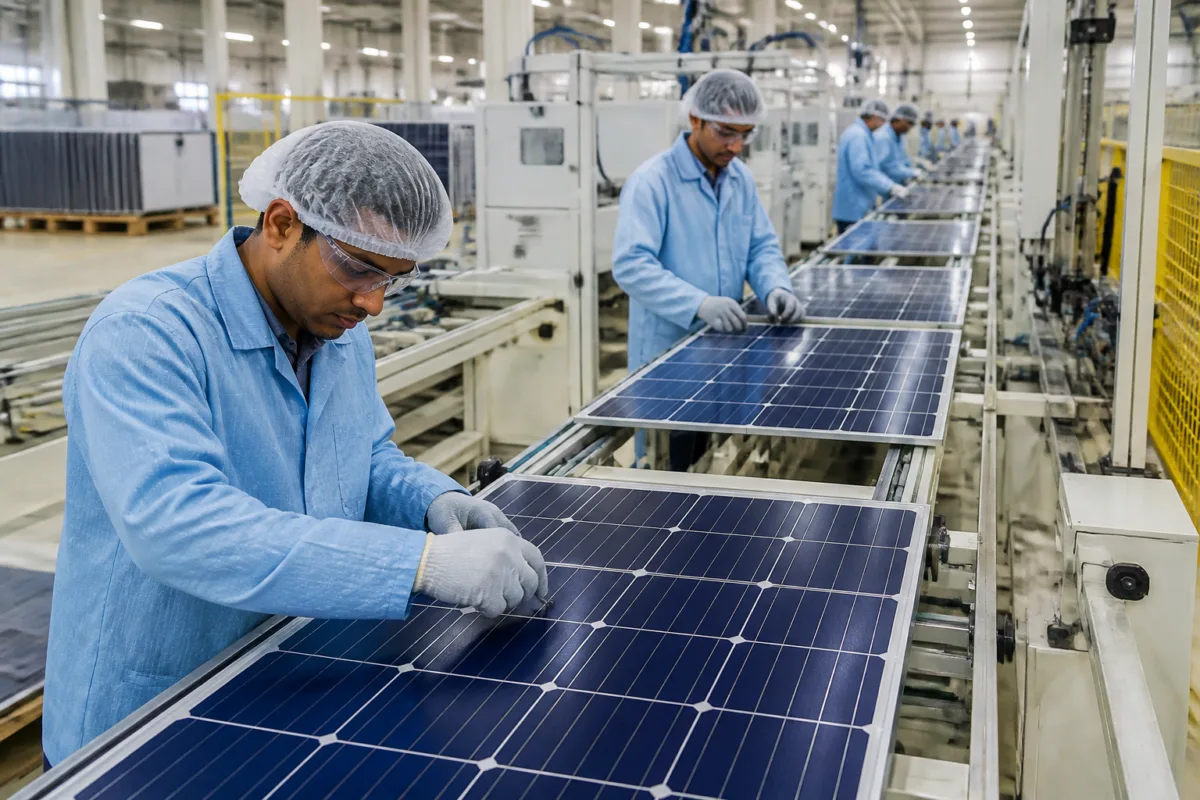
Emmvee said its integrated expansion has entered the equipment-installation phase, with most critical machinery orders placed and deliveries expected by November. The company is targeting commissioning of a 6 GW module plant by December and an additional 6 GW of solar-cell capacity by next March. If completed, its annual module capacity would rise to 16.3 GW and its cell capacity to 8.9 GW.
These numbers indicate the scale of the company’s planned shift. Emmvee is not limiting its expansion to module assembly, the downstream part of the solar manufacturing chain. It also plans phased backward integration into ingot and wafer production, with ₹5,000-5,500 crore earmarked for the effort. The company is targeting 5 GW of such capacity by FY29 and another 4 GW by FY30.
Backward integration matters because the availability of modules depends on more than final assembly lines. Cells, wafers and ingots sit at successive stages of the manufacturing chain, and gaps at any stage can constrain domestic supply. Emmvee’s stated plan suggests that the company sees supply-chain depth as a long-term competitive requirement rather than a short-term capacity addition.
The company expects to fund the backward-integration programme largely through internal accruals, subject to regulatory clarity and market conditions. That qualification is important. The expansion timetable depends not only on machinery deliveries and construction progress but also on the company’s cash generation, regulatory conditions and the pace at which the market absorbs additional domestic output.
Emmvee’s financial position provides some support for the expansion plan. Its order book stood at 10.4 GW at the end of the second quarter of FY27, after approximately 1.5 GW of new order inflows during the quarter. About 70 per cent of the order book comprised orders linked to the Domestic Content Requirement, indicating that a substantial portion of contracted demand is tied to domestically manufactured solar equipment.
The company reported revenue from operations of ₹3,131.9 crore in the first half of FY27, a 45 per cent year-on-year increase. EBITDA rose 47 per cent to ₹1,105 crore, while net profit increased 79 per cent to ₹762 crore. Cash generated from operating activities reached ₹410 crore during the period, compared with ₹121 crore in the year-earlier period. Net debt-to-equity stood at 0.12 times at the end of September.
Those figures do not establish that the planned capacity will be commissioned on schedule, but they explain why Emmvee is presenting internal accruals as a principal source of funding. They also show the relationship between order visibility, operating cash flow and manufacturing expansion. A large order book can support investment, but converting that demand into production requires equipment installation, supply-chain coordination and compliance with applicable procurement rules.
The company’s expansion is unfolding as India’s solar demand comes from several distinct project categories. Manjunatha said utility-scale plants, rooftop systems, commercial and industrial projects, and hybrid power projects could widen the gap between announced capacity and actual domestic supply. These segments have different procurement patterns and operating requirements, making aggregate capacity an incomplete measure of whether manufacturers can meet market demand.
A factory counted in an industry estimate may not immediately provide usable supply to every category of buyer. Capacity can be under installation, awaiting equipment, undergoing qualification or directed towards specific product configurations. The distinction drawn by Emmvee between roughly 41 GW of cited capacity and around 100 GW of required effectively usable capacity therefore shifts attention from nominal potential to production that can be delivered on time and under the relevant procurement conditions.
The regulatory framework is also influencing the market. Emmvee said the Approved List of Models and Manufacturers, or ALMM, List-II is already in effect. The company expects a further extension of the December transition deadline for specified open-access and net-metering projects to be unlikely. It has also secured inclusion of its G12R TOPCon cells in ALMM List-II.
ALMM-linked eligibility can affect which manufacturers and products are available for projects covered by the applicable rules. For domestic manufacturers, inclusion can strengthen access to compliant demand. For project developers and electricity consumers, the timing of regulatory transitions can affect procurement decisions and project execution. The supplied information does not establish the impact on project costs or deployment schedules, but it does show that manufacturing capacity is being built within a policy environment that links market access to approved suppliers and models.
The Domestic Content Requirement provides another demand signal. With 70 per cent of Emmvee’s order book linked to DCR requirements, the company’s expansion is being supported by a segment of the market that specifically seeks domestic equipment. At the same time, the company’s own comments suggest that demand alone is not enough. Timely capacity expansion is necessary if the gap between project requirements and available domestic supply is to narrow.
This is the central institutional issue in the capacity debate. Government policy can create demand for domestic equipment through eligibility rules and procurement requirements, while manufacturers must build and operate the physical capacity needed to satisfy that demand. If the two move at different speeds, the result can be a mismatch between policy ambition, listed capacity and equipment that is actually available to projects.
Emmvee’s planned module and cell additions offer a measurable near-term test. The company is targeting a 6 GW module plant by December and 6 GW of additional cell capacity by next March. The subsequent ingot and wafer targets extend the test into FY29 and FY30. Each milestone will indicate whether the expansion is progressing from financial commitment to installed and operational manufacturing capability.
The company’s order book and first-half financial results also provide indicators of market traction, but they should not be confused with national capacity. Emmvee’s projected annual capacity of 16.3 GW for modules and 8.9 GW for cells would be substantial at the company level, yet the wider requirement identified by its CMD is around 100 GW of effectively usable cell capacity across India. The scale comparison shows why a single company’s expansion cannot close the national gap on its own.
What the available evidence confirms is a growing alignment between domestic demand, policy-linked procurement and private investment in integrated manufacturing. It also confirms that the industry’s headline capacity figure is being challenged by a more demanding measure: capacity that is operational, compliant and capable of serving different project categories when required.
What remains unestablished is how much of the cited 41 GW is currently operational, how quickly the wider industry can add capacity, and whether all planned projects will meet their announced schedules. Those questions will become clearer through equipment installation, commissioning, ALMM eligibility, order execution and the next stages of Emmvee’s backward-integration programme. For India’s solar build-out, the decisive issue is no longer only how much capacity has been announced, but how much can reliably enter the domestic supply chain.

