


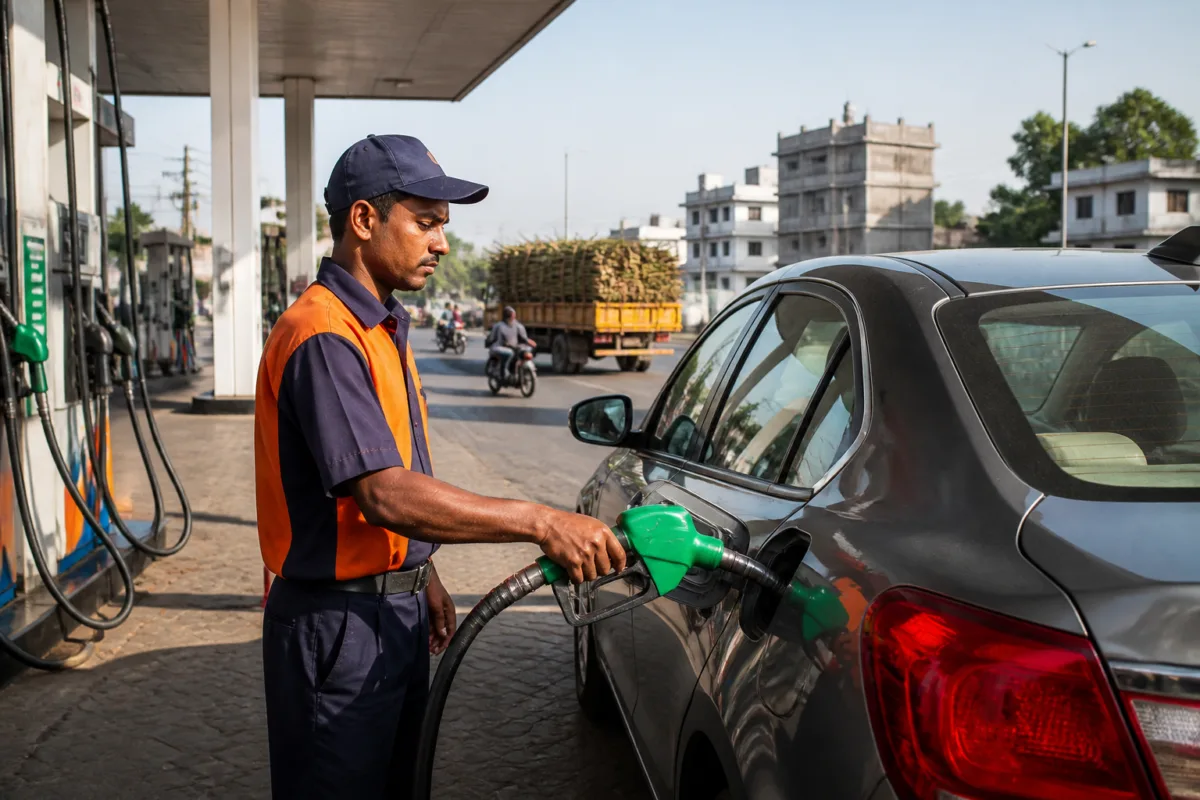
India will not raise ethanol blending in petrol beyond 20% for now, Union petroleum and natural gas minister Hardeep Singh Puri said on Tuesday, as the Centre defended the E20 programme against concerns over vehicle compatibility and engine damage.
Speaking on the sidelines of the 29th Energy Technology and Innovation Meet in Betul, Puri said the government had no immediate plans to increase the existing blending target. “In so far as biofuels are concerned, 20% was the target, and there is no desire, just now, to increase it beyond 20%,” he said.
The statement keeps the current national blending ceiling unchanged while the transition to E20 petrol continues across the fuel retail network. It also places vehicle compatibility at the centre of the public debate, particularly for owners of older vehicles.
Puri rejected allegations that E20 petrol was causing widespread engine damage, describing such claims as a “contrived narrative” driven by misinformation. He said vehicles designed and certified to use the blended fuel were compatible with it, while older vehicles, especially those manufactured before 2003, could face compatibility issues.
The minister also suggested that some complaints attributed to E20 could be linked to fuel transportation and handling practices. He argued that any widespread damage would have become evident given that around six crore vehicles visit fuel stations daily, although the statement did not provide a separate breakdown of complaints, vehicle ages or technical assessments.
The ethanol programme has also become an important part of the government’s agricultural and energy policy. Puri said it had generated savings of Rs 1.6 lakh crore, with Rs 1.4 lakh crore going back to farmers. He said the programme was expanding the role of farmers in the energy economy, describing them as “Urjadatas”, or providers of energy, in addition to their traditional role as food producers.
The decision comes as the government continues to frame biofuels as part of India’s broader effort to reduce exposure to international energy disruptions. At a subsequent news conference, Puri said India had increased the number of countries from which it imports crude oil from 27 to 41, strengthening diversification during the West Asian crisis.
He said domestic LPG production had risen from 34,000 metric tonnes per day to 55,000 metric tonnes per day. The United States now accounts for 67% of India’s LPG imports, after the country initially arranged to source 10% of its requirements from the US, according to the minister.
India’s refining capacity is expected to reach 290 million tonnes per annum in the current period and rise to 300 million tonnes by 2030. Puri said the country currently exports around one million barrels of petroleum products a day and could increase those volumes as new capacity becomes operational.
The government is also expanding supporting energy infrastructure. The gas pipeline network has grown from 14,000 km to 25,600 km, with a target of 33,000 km by 2030, Puri said. He added that green hydrogen could reduce import dependence if production costs fall to around $2 per kg from more than $3 per kg currently.
For now, the immediate policy position is clear: the 20% ethanol blending target remains the limit, with no increase planned in the near term. The Centre’s next policy signals will determine how it addresses compatibility concerns for older vehicles while sustaining the programme’s claimed benefits for farmers and energy security.

