


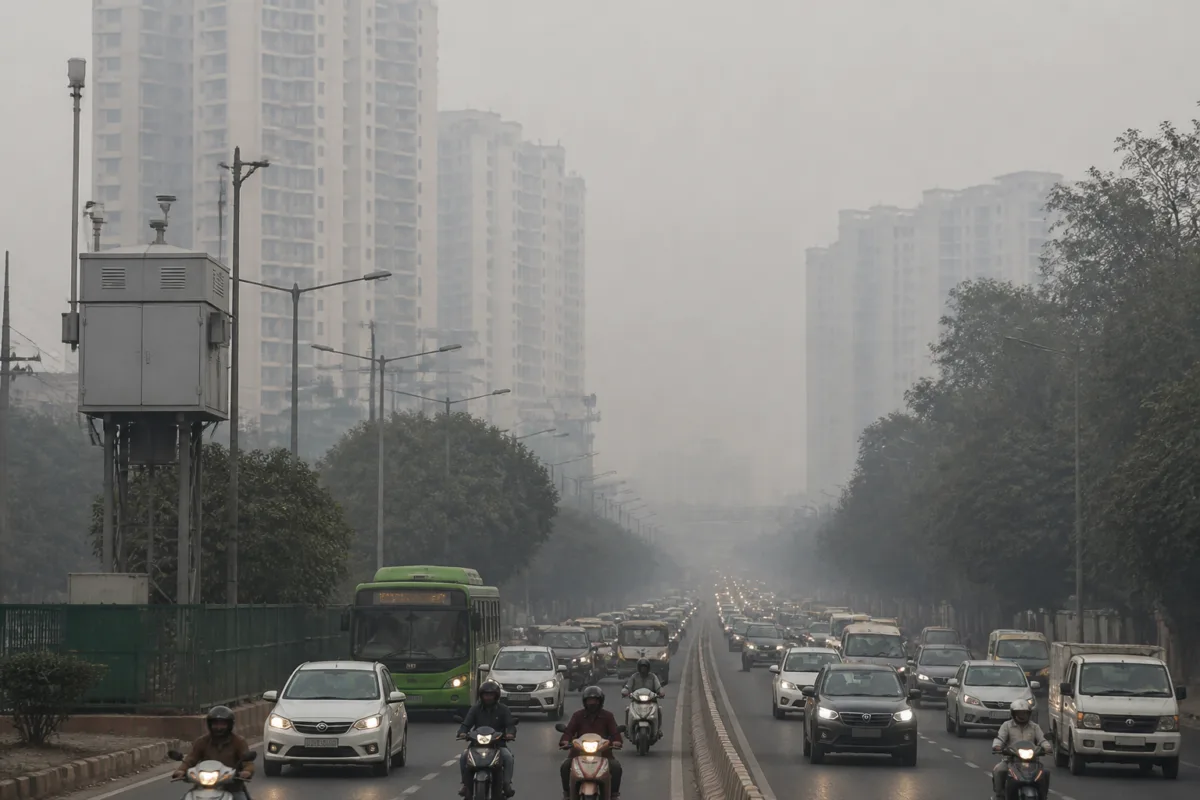
India’s National Clean Air Programme has spent Rs 12,087 crore over seven years, yet 117 of its 130 participating cities recorded annual PM10 levels above the national standard in 2025-26, according to figures reported by Jagran and an independent analysis by the Centre for Research on Energy and Clean Air. The numbers expose a central weakness in India’s urban air-quality strategy: spending has expanded, but improvement has not kept pace across the programme’s city network.
The problem is not limited to a few heavily polluted metropolitan areas. Only 13 of the 130 cities covered by the National Clean Air Programme, or NCAP, reached the prescribed annual PM10 limit of 60 micrograms per cubic metre in 2025-26. The number of cities above the standard increased from 112 in 2019-20 to 117 in 2025-26. That change matters because the programme was created to produce measurable reductions in pollution, not simply to finance local activities labelled as clean-air measures.
Delhi illustrates the scale of the challenge. According to the figures cited in the report, the capital’s annual PM10 average was 197.3 micrograms per cubic metre in 2025, more than three times the national standard. Its annual PM2.5 average was 96.4 micrograms per cubic metre against a standard of 40. Delhi did not meet the national standards for either pollutant in any year between 2016 and 2025, according to the data reported.
The Delhi figures are not presented as a measure of the Rs 12,087 crore spent by the capital alone. The expenditure figure covers all 130 cities included in NCAP. That distinction is important for assessing public spending. The programme’s aggregate allocation and expenditure cannot, by themselves, establish whether a particular city’s actions worked. The relevant question is whether spending was connected to pollution sources, implemented at sufficient scale and evaluated against the pollutants that most directly affect public health.
NCAP began in January 2019 with an initial objective of reducing PM10 concentrations by 20 to 30 per cent. The target was later revised to a 40 per cent reduction by 2025-26 or to bringing the annual average PM10 level down to 60 micrograms per cubic metre. The revised framework made the outcome more measurable, but the reported results show that a large majority of participating cities still remained above the standard at the end of the period.
The trend also suggests that the challenge is not only one of insufficient money. The report says PM10 levels increased between 2019-20 and 2025-26 in 43 cities, which together spent Rs 2,857 crore under NCAP. It also says pollution levels in 23 cities were higher in 2025-26 than in 2017-18. These figures do not prove that NCAP spending caused pollution to rise, but they do show that expenditure did not guarantee improvement and that city-level performance varied substantially.
This variation points to an institutional problem in how urban air pollution is managed. Air quality is experienced within city boundaries, but its sources often operate across them. Vehicles move between municipalities, industrial emissions travel across administrative borders, power plants serve wider regions, and household fuel use is distributed across neighbourhoods and settlements. A city-based programme can finance local interventions, but a city boundary may not match the geography of the pollution problem.
The report quotes CREA chief analyst Manok Kumar as calling for the next phase of pollution control to move beyond city limits and adopt regional plans. He also calls for separate targets for pollution from industries, power plants, vehicles and household fuels, along with monitoring of PM2.5 and gaseous emissions in addition to PM10. These suggestions identify a major gap in the way progress is currently represented: a single particulate indicator cannot fully describe the sources, movement or health burden of urban air pollution.
PM10 is a useful measure of larger inhalable particles, but the reported Delhi data shows why PM2.5 must also remain central to assessment. Delhi’s annual PM2.5 average in 2025 was 96.4 micrograms per cubic metre, more than twice the national standard of 40. If city performance is judged mainly through PM10 reduction, interventions may appear successful without adequately addressing finer particles or gaseous pollutants that contribute to poor air quality.
The available figures therefore raise questions about the design of performance measurement. NCAP’s revised goal combined a percentage reduction with an absolute concentration threshold. This creates a clearer benchmark than expenditure alone, but it still leaves open several implementation questions: which pollution sources were targeted in each city, what proportion of the funds went to each source, how local actions were monitored, and whether reductions were sustained across multiple years. The supplied report does not provide those city-wise implementation details, so the spending figures should not be treated as a complete audit of the programme.
The governance structure is equally important. Urban local bodies are closest to roads, construction sites, waste systems and neighbourhood-level enforcement, but many major sources of pollution sit outside municipal control. Industrial regulation, transport policy, power generation and regional planning involve state and central agencies as well as local administrations. Without coordinated targets and shared accountability, a municipal body may be held responsible for air-quality outcomes it cannot independently deliver.
The reported results also challenge the assumption that urban environmental spending automatically translates into environmental improvement. A programme can have a large financial footprint while producing uneven outcomes if projects are fragmented, source inventories are incomplete or monitoring is not linked to enforcement. The fact that 43 cities recorded higher PM10 levels despite spending Rs 2,857 crore does not reveal which of these factors was decisive, but it makes such questions unavoidable for the programme’s next phase.
There is a further data limitation in comparing cities. The report gives the number of cities above the PM10 standard and identifies Delhi’s annual averages, but it does not provide a full city-wise table of spending, baseline pollution, source composition or intervention outcomes. A city starting from a very high pollution level may record a significant percentage reduction while remaining above the standard. Another city may have a lower baseline but show a smaller reduction. Transparent city-level reporting would be needed to distinguish these situations.
That distinction matters for public accountability. Residents need to know not only how much money was allocated or spent, but what was purchased, where it was deployed and whether pollution fell at the locations and times targeted. For example, the evidence supplied does not establish whether funds were concentrated on road dust, transport emissions, industrial sources, waste burning or household fuel. Nor does it establish whether the same monitoring methods were used consistently across the 130 cities.
The policy issue is therefore larger than the failure of a numerical target. NCAP has created a national framework for addressing urban air pollution, but the results reported after seven years indicate that the framework has not yet overcome the fragmentation between funding, source control, monitoring and administrative responsibility. The rise in cities above the PM10 standard from 112 to 117 suggests that national programme membership has not translated into uniform city-level progress.
The evidence confirms three points. First, the programme has involved substantial public expenditure. Second, most participating cities remained above the annual PM10 standard in 2025-26. Third, performance has been uneven, with some cities recording higher pollution even after spending NCAP funds. What remains unclear from the supplied material is why individual cities succeeded or failed, how funds were distributed across interventions and whether reductions in particular locations were sustained.
The next phase of the clean-air programme will therefore need to be judged not only by its total spending or the number of projects completed, but by source-specific, pollutant-specific and region-wide outcomes. The figures reported from 2025-26 show that India’s urban air challenge is no longer simply a question of announcing targets. It is a test of whether multiple levels of government can measure pollution accurately, act across administrative boundaries and connect public expenditure to cleaner air.

