


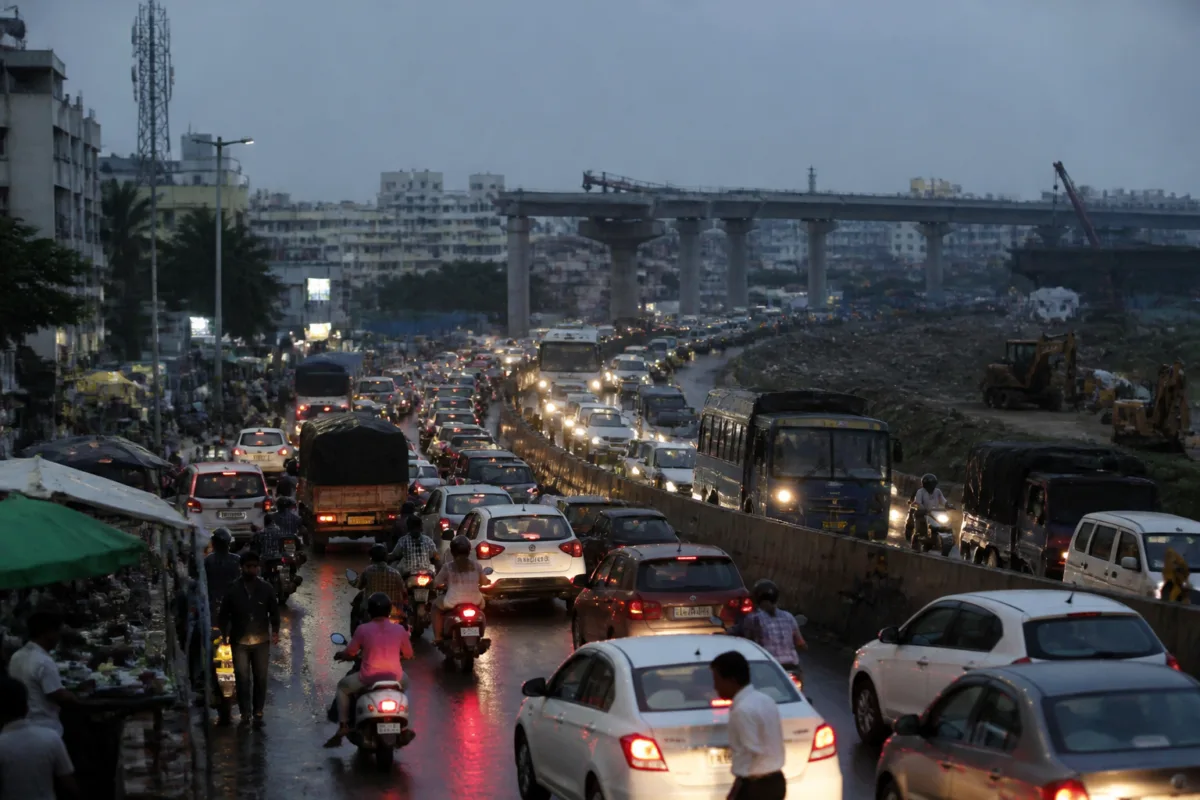
Dhayari’s traffic congestion is no longer only a problem of overloaded roads. The complaints emerging from Sinhagad Road and surrounding neighbourhoods point to a wider delivery gap in Pune’s urban system: projects are announced, meetings are held and deadlines are cited, but residents say the changes are not reaching the street. The result is a daily burden of delays, fuel loss and uncertain travel for commuters, students, patients, senior citizens and local businesses.
The Clean and Beautiful Dhayari Action Committee has asked the Pune Municipal Corporation (PMC) and Pune traffic police to publish clear timelines and take responsibility for measures already announced. Its demands cover several connected problems: unfinished roads, delayed bridge approaches, encroachments, unauthorised parking, excavation undertaken without adequate notice and weak coordination between civic agencies. Taken together, these complaints show why traffic congestion cannot be addressed only by adding a flyover or widening an isolated road.
The immediate issue is the mismatch between the geography of travel and the geography of administration. Traffic moves continuously across Dhayari, Narhe, Vadgaon, Nanded City, Sinhagad Road and the Dandekar Bridge area, while decisions about roads, excavation, parking, encroachments and traffic control may involve different offices and agencies. When those interventions are not sequenced, work intended to improve movement can temporarily worsen it, and new infrastructure can be absorbed by bottlenecks immediately before or after it.
The residents’ committee has alleged that excavation work begun during peak hours, without prior notice, left commuters stranded for two to three hours. That claim raises a practical governance question: who is responsible for ensuring that planned road work is communicated, scheduled and managed as part of a traffic plan? The supplied report does not establish the specific agency responsible for the excavation or record a response from that agency. It does, however, show how a lack of advance coordination can turn routine infrastructure work into a major disruption.
The committee’s criticism also extends to the new Sinhagad Road flyover. Although the structure has opened, residents say congestion continues on the flyover and on the roads beneath it. Roadside vendors, unauthorised parking, encroachments and narrow carriageways have been cited as factors worsening the situation. This does not by itself establish that the flyover has failed as a project. It does show that a grade-separated structure cannot resolve congestion if the approach roads, junctions and road space below remain constrained or poorly managed.
That distinction matters for how Pune evaluates transport infrastructure. A flyover is a discrete project with a visible completion point. Traffic, by contrast, is a network condition. Vehicles do not disappear when they leave a congested junction; they are redistributed to the next conflict point. If access roads are incomplete, parking occupies carriageway space or junction management is weak, the relief provided by one structure may be limited. The residents’ observations indicate that the corridor needs to be assessed as a connected route rather than through the performance of the flyover alone.
The proposed Suncity-Karvenagar bridge illustrates the same issue from another angle. The committee has raised concerns about incomplete approach roads and has sought a firm opening date for the entire route. The bridge is expected to offer an alternative to the congested Rajaram Bridge, but that function depends on the full connection being usable. A bridge without finished approaches cannot provide a reliable diversion, and uncertainty over completion makes it difficult for residents to understand when the promised alternative will actually be available.
The committee has also demanded a time-bound schedule for widening Rajaram Bridge from approximately 18 metres to 30 metres. The requested widening is not presented in the supplied report as an approved or completed project. It is a demand for a defined administrative response to an existing bottleneck. The difference is important: public announcements about a project, a formal approval, land availability, funding, construction and operational opening are separate stages. Without information on those stages, residents cannot assess whether a deadline is realistic or whether a project has moved beyond an assurance.
A similar demand concerns the proposed Development Plan road between Savitri Garden and the Lokmat office. The report says Municipal Commissioner Naval Kishore Ram reportedly gave a six-month completion assurance in August. The committee has sought a written progress report covering land acquisition, funding, approvals and canal-crossing bridges. These details identify the institutional chain behind road delivery. Construction is only one part of the process; land, finance, permissions and structures required to cross physical barriers can each determine whether a planned road becomes operational.
The demand for progress information is therefore not merely a request for more announcements. It is a request to distinguish between intention and implementation. A project status report that identifies land acquisition, funding, approvals and bridge works would allow residents to see which constraint is holding up delivery. The supplied material does not include such a report or confirm the status of each component. That absence is part of the accountability problem described by the committee, but it cannot be treated as proof that no administrative action has taken place.
The reported traffic survey ordered by Mayor Manjusha Nagpure on August 5 is another test of this process. The survey reportedly covers Dhayari, Narhe, Vadgaon, Nanded City and the Dandekar Bridge area. The committee wants the survey, its recommendations and the action taken to be made public. A survey can be useful only if its findings are connected to decisions on junctions, road capacity, parking, encroachments, construction sequencing and public transport or traffic diversion. The supplied report does not provide the survey’s findings, so it is not possible to assess whether it identified the same problems residents are describing.
Additional Commissioner of Police for the Western Zone and Traffic, Manoj Patil, is quoted as saying that traffic surveys would be conducted in Dhayari, Narhe, Vadgaon, Nanded City and the Dandekar Bridge area. His statement indicates that the traffic police are examining the problem across a wider area rather than treating one junction in isolation. It does not specify the survey methodology, completion date, responsible teams or how the results will be converted into enforcement or engineering measures. Those details will determine whether the exercise becomes an operational intervention or remains another stage in a cycle of review.
The corridor’s problems also show the limits of treating encroachments and unauthorised parking as secondary issues. Where carriageways are already narrow, even modest occupation of road space can reduce movement and create conflict between through traffic, local access, pedestrians and roadside commerce. The report records the committee’s demand for action against such obstructions and for ward-level inspection reports to be made public. It does not establish the number or location of encroachments, the enforcement action taken or the legal status of affected spaces. Those facts would be necessary for a full assessment of the enforcement challenge.
What is clearer is the cumulative effect on residents. Committee coordinator Vineet Dharankar said repeated assurances have not produced visible change and that residents want existing commitments fulfilled. Resident Jayshree Deshpande described congestion as part of everyday life, affecting travel to work, school journeys and emergencies. These accounts place travel time at the centre of the issue. The report does not provide measured journey-time data, traffic counts or fuel-loss estimates, but it identifies the groups bearing the cost of unreliable movement and the locations where the pressure is experienced.
The administrative question is consequently one of coordination and public accountability. The PMC is responsible for civic works and roads within its remit, while the traffic police manage traffic regulation and enforcement. Bridge projects, Development Plan roads, excavation, land acquisition and canal crossings may involve additional departments or agencies. The report’s central complaint is that residents receive assurances without a consolidated, publicly trackable plan for the Dhayari Phata–Dhayari village stretch, including Benkar Vasti, Pari Company Chowk and Ladli Chowk.
A coordinated plan would need to connect project milestones with traffic management. It would also need to clarify which agency owns each action, when the action is due and what temporary arrangements will apply while construction continues. The supplied report does not say that such a plan has been issued. It records the committee’s demand for one and its call for immediate action instead of further announcements.
Dhayari therefore offers a useful case study in how urban congestion becomes persistent. The problem is not presented as a single missing road. It is a combination of incomplete network links, constrained road space, roadside activity, excavation, delayed information and a lack of publicly visible follow-through. The opening of the Sinhagad Road flyover has not removed those wider constraints, while the proposed bridge and Development Plan road remain tied to unfinished approaches, approvals and other implementation stages.
The next meaningful evidence will be administrative rather than rhetorical: the traffic survey and its recommendations, the status of the Suncity-Karvenagar bridge approaches, the schedule for the proposed Rajaram Bridge widening, and the written progress report on the Savitri Garden–Lokmat office road. Until those documents and milestones are made clear, Dhayari residents’ account remains one of a transport network where announcements move faster than completed connections.

