


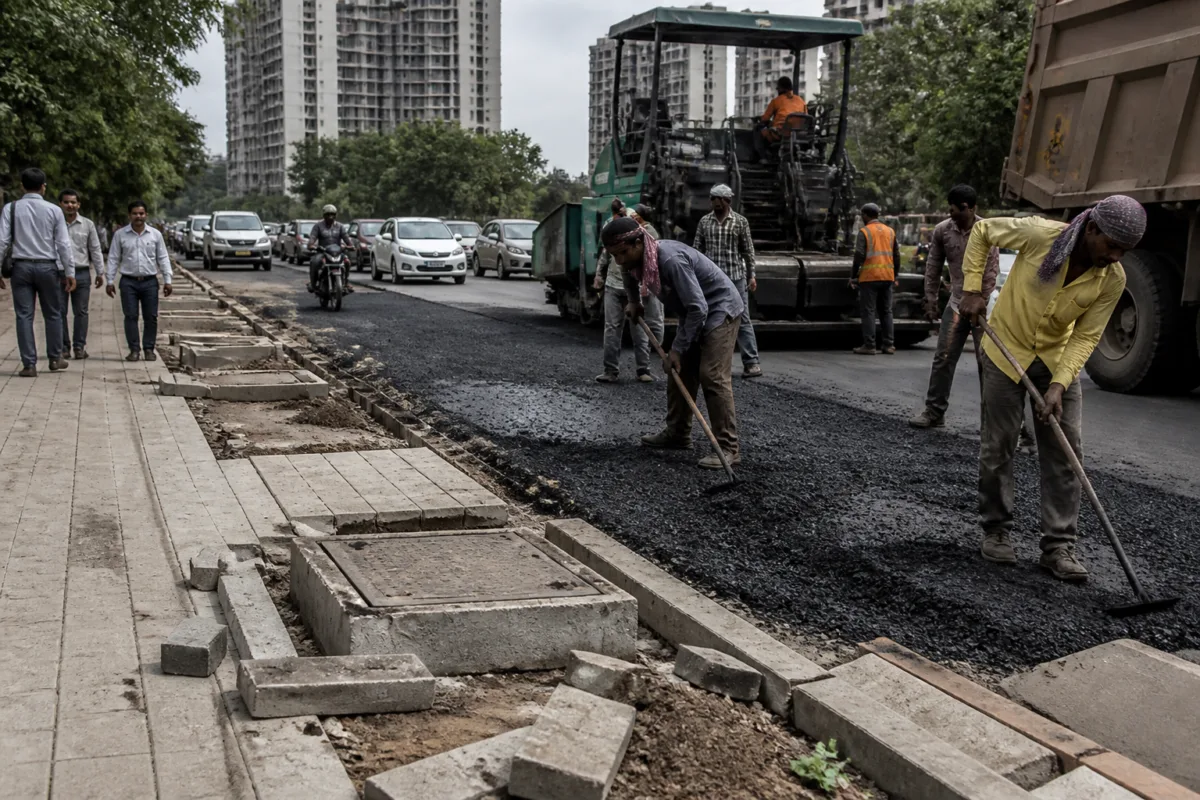
Pune’s latest road repair programme is not only a Rs 116.50 crore exercise in resurfacing streets and rebuilding footpaths. It is also a test of whether the Pune Municipal Corporation can convert repeated road excavation, tendering and reinstatement into a system that produces durable public infrastructure. The immediate programme covers Rs 58.60 crore for footpath improvements and Rs 57.90 crore for road reinstatement, with work expected over the next two months according to the report by Sakal.
The spending follows a familiar urban cycle. Roads are cut to install utility services, municipal departments undertake their own excavations, surfaces deteriorate, and residents are then asked to rely on a new round of repairs. The report says permissions were issued over the past year to excavate around 70 kilometres of roads for different services, while municipal departments themselves cut another 15 kilometres. Together, about 85 kilometres of road will now be repaired. The scale is significant because it shows that road damage is not limited to weather, traffic or poor resurfacing. It is also linked to the way urban utilities are installed and restored.
The corporation has issued seven revised tenders for road reinstatement amounting to Rs 57.90 crore. These replace an earlier set of three tenders valued at Rs 75 crore. Municipal Commissioner Navalkishor Ram cancelled the earlier process after scrutiny found confusion created by the conditions and insufficient competition, the report says. The revised process changes the eligibility terms and divides the work into seven tenders, with the stated aim of enabling wider participation rather than allowing a small group of contractors to dominate the process.
That change matters because tender design is one of the least visible but most consequential parts of urban infrastructure delivery. A road may appear to be a construction problem once it develops potholes or uneven patches, but the quality of the final outcome is often influenced much earlier: by how work is packaged, who is allowed to bid, what technical and financial qualifications are demanded, how performance is monitored and whether defects can be attributed to a particular agency. The report indicates that the corporation’s first tender structure did not generate adequate competition. The revised structure is therefore an administrative intervention before construction begins, not merely a financial adjustment.
The road reinstatement work also raises a basic question about responsibility. When a utility agency or municipal department cuts a road, restoration cannot be treated as a separate event with no connection to the original excavation. The report does not establish how individual agencies will be held accountable for the quality or timing of restoration, nor whether the revised tenders include a mechanism to track each excavation from permission to final repair. Those details will determine whether the new spending repairs a backlog or simply absorbs the recurring cost of fragmented road management.
The programme’s footpath component adds another layer to the issue. The corporation has invited tenders worth Rs 58.60 crore to repair footpaths and claims that the upgraded pedestrian routes will be of “world-class” quality. The report does not provide a technical definition of that standard. It does, however, indicate that the footpath works will be undertaken along routes associated with the Pune Grand Tour cycling competition as well as other roads. That makes the quality of pedestrian infrastructure an important measure of whether the investment is being designed for an event or for everyday city use.
A durable footpath is not simply a paved strip alongside a carriageway. Its practical performance depends on continuity, drainage, access to properties, treatment around utility chambers, safe crossings and the absence of obstructions. The source report specifically mentions that road chambers will be raised or lowered to bring them to the correct level as part of the road work. The same principle is relevant to pedestrian movement: a footpath that is newly built but interrupted by poorly aligned covers, utility poles, abrupt level changes or vehicle access points will remain difficult to use even if its surface is new.
The report separately refers to four roadwork packages for about 83 kilometres connected with the cycling competition, including new road construction in some locations and removal and replacement of the upper asphalt layer in others. It states that this work will cost Rs 167.25 crore. This figure is distinct from the Rs 116.50 crore described for footpaths and road reinstatement. The report also uses both 83 kilometres and 85 kilometres for different parts of the programme. That distinction is important: the figures should not be combined as though they describe one identical package. They indicate overlapping or parallel road-related works, but the supplied material does not fully establish their contractual boundaries.
This separation also reveals a broader planning challenge. Cities frequently execute infrastructure through multiple departments, tenders and project-specific deadlines. A road may be resurfaced under one package, excavated by a utility agency soon afterwards, repaired under a reinstatement contract and then modified again for an event or another civic project. Without a shared register of road condition and excavation history, the public sees only the final surface, while the administration manages several disconnected contracts.
The Pune case suggests that the municipal corporation is attempting to address at least one part of this problem by changing tender conditions. The earlier Rs 75 crore process was cancelled after the commissioner’s scrutiny, and the revised road reinstatement tenders have been divided into seven packages. According to officials quoted in the report, the rules and conditions were changed to encourage adequate competition and prevent a situation in which only selected contractors submit bids. This is a stated administrative objective, not yet evidence that the revised process has succeeded. Its success will be measurable only after the tenders attract bids, contracts are awarded and completed work meets the required standard.
The procurement sequence therefore needs to be read alongside the construction sequence. A competitive tender can improve the possibility of value for money, but it cannot by itself guarantee a pothole-free road. That depends on specifications, materials, preparation of the existing surface, drainage, supervision, curing and post-completion liability. The source material does not provide those technical specifications or a defect-liability framework, so it is not possible to assess from the report whether the new contracts are designed to prevent early failure. What is clear is that the corporation is making a substantial public commitment without yet disclosing, in the supplied material, how outcomes will be evaluated beyond completion of the listed works.
The pedestrian component creates a similar accountability requirement. A claim that footpaths will meet global standards needs to be translated into measurable criteria: width, accessibility, surface quality, continuity and protection from encroachment, among other practical features. The report establishes the financial value and broad purpose of the tenders, but not the design standards, location-wise scope or inspection process. These omissions are not minor details for residents. They determine whether the Rs 58.60 crore allocation produces a connected walking network or a series of isolated repairs.
There is also a question of sequencing. The corporation is planning road reinstatement after extensive utility and departmental excavation, while separate road and footpath works are being undertaken around routes linked to a cycling event. If these projects are not coordinated, newly restored surfaces could again be disturbed by unfinished utility work or later municipal interventions. The supplied report does not say whether the corporation has established a common schedule for the different packages. That is a key implementation detail because the value of road repair is reduced when construction agencies work in isolation.
For Pune residents, the consequences are direct. Uneven road surfaces affect buses, two-wheelers, cars and emergency movement. Broken or discontinuous footpaths shift pedestrians into traffic and make streets harder to navigate for older people, children and people with mobility limitations. Reinstatement quality also affects drainage and the safety of access points around chambers and excavated areas. These impacts are not separate from procurement decisions; they are the public result of how contracts are framed, coordinated and enforced.
The immediate evidence supports two conclusions. First, Pune’s road problem is partly a maintenance backlog created by repeated excavation and fragmented civic works, not simply a shortage of resurfacing. Second, the corporation has recognised a procurement concern by cancelling an earlier tender and issuing a revised seven-tender structure intended to widen competition. What remains unestablished is whether the new process will deliver better workmanship, stronger coordination and longer-lasting surfaces.
The next milestones are the response to the revised tenders, the award of contracts and the completion of the planned works. The corporation’s stated promise of improved footpaths and restored roads will ultimately be tested on the street: by whether the 85 kilometres identified for reinstatement are repaired consistently, whether pedestrian routes remain usable after construction, and whether future utility excavations are managed without returning the city to the same repair cycle.

