


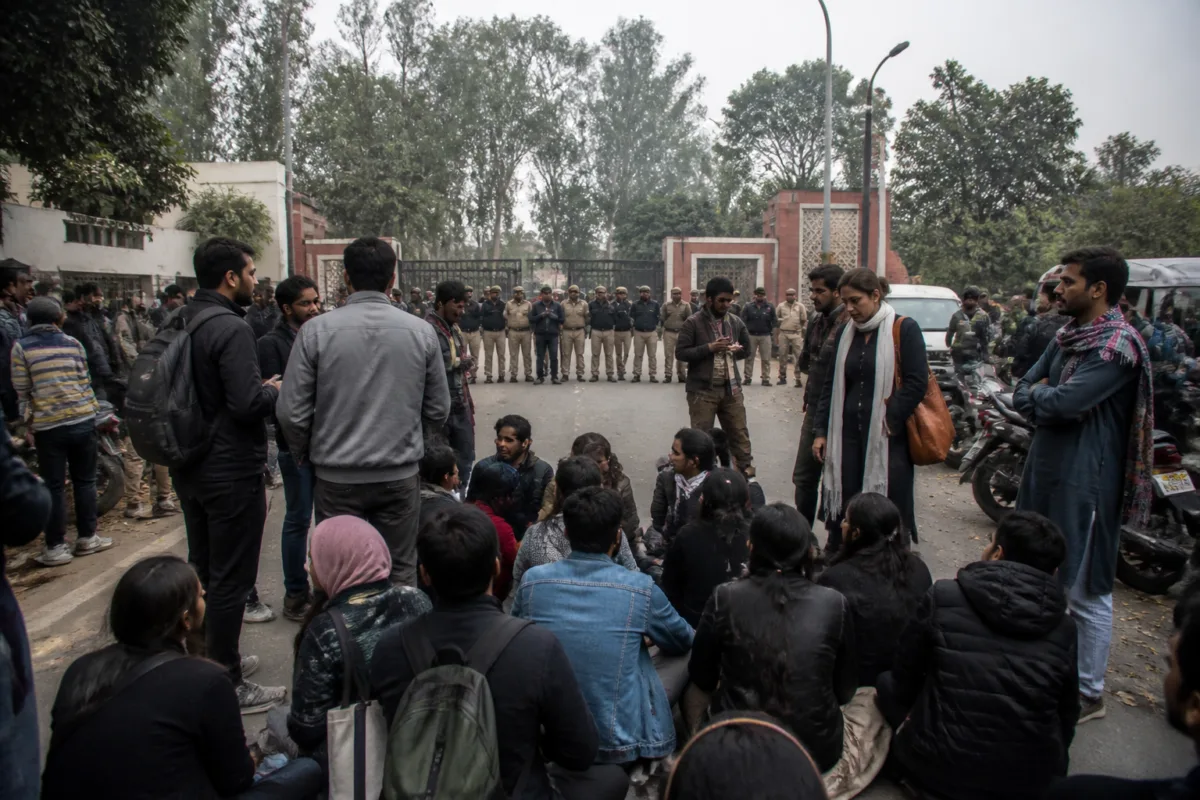
Police have imposed Section 163 of the Bharatiya Nagarik Suraksha Sanhita around Jamia Millia Islamia in New Delhi amid continuing student protests, restricting gatherings as hunger-striking students announced a march from Okhla Head to the vice-chancellor’s residence on Tuesday.
According to a report by Jagran – New Delhi, the order prohibits crowds in and around the university during the ongoing demonstrations. The measure was introduced as tensions continued on the campus and near its surrounding areas.
Students observing a hunger strike reportedly locked themselves inside the Polytechnic Building, citing concerns that they could be forcibly removed. Other students dispersed from the protest site after the police restrictions were imposed, the report said.
Despite the restrictions, the hunger-striking students announced that students would assemble at Okhla Head at 3 pm and march towards the vice-chancellor’s residence. The proposed route places the immediate focus on access points and movement around the university, where any gathering could come under the restrictions announced by the police.
The latest development follows protests linked to demands around student representation at Jamia Millia Islamia. The report also refers to the long wait for student union elections at the university and to an earlier announcement that elections would be held after the election draft is prepared. The supplied report does not provide further details on the students’ specific demands or the administration’s response to the announced march.
Classes at the university are continuing online. The administration had already ordered that online classes remain in operation until November 8, according to the report. This arrangement means that academic activity is continuing while in-person mobilisation and access around the campus face restrictions.
The use of Section 163 adds a formal public-order layer to the dispute. Such restrictions affect how students can assemble and move through public areas, while the continuation of online classes separates teaching operations from physical campus activity. The report does not specify the exact geographical limits of the order, its duration, or the number of people covered by it.
The immediate issue for the university is therefore the interaction between the police order, the students’ proposed march and the online teaching arrangement. The students’ announcement of a 3 pm gathering at Okhla Head was the next stated milestone in the developing situation. Jagran’s report did not include a subsequent police statement on whether the march would be permitted or what enforcement action would follow.

